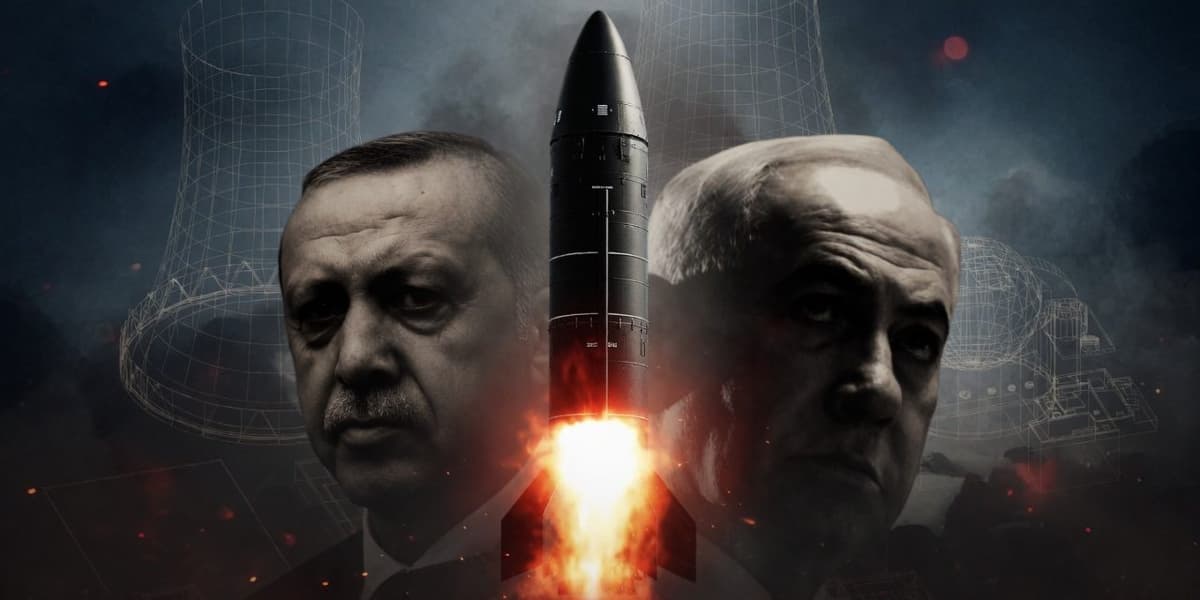
NATO’s Rogue Player vs Israel: The Clash Nobody Wants — But Everyone’s Talking About: What’s Cooking?
Why It Matters
The feud risks destabilizing an already volatile Middle East and could test NATO cohesion, as member Turkey’s antagonism toward a U.S. ally may complicate collective security decisions.
Key Takeaways
- •Erdoğan threatened military action against Israel, later denied as disinformation.
- •Turkey and Israel support opposite sides in Libya and Nagorno‑Karabakh conflicts.
- •NATO Article 5 protection not automatic; consensus required for any Turkey‑Israel clash.
- •Turkey ranks higher in overall military size; Israel leads in air‑power technology.
- •Rhetoric escalates regional instability and strains Turkey’s ties within NATO.
Pulse Analysis
The latest diplomatic volley between Ankara and Jerusalem reflects a broader shift in Middle‑East power dynamics. Erdoğan’s incendiary remarks, framed as a warning against Israeli “provocations,” echo Turkey’s recent cross‑border engagements in Libya and Nagorno‑Karabakh, while Israel’s Prime Minister Netanyahu has countered with accusations of Turkish complicity with Iran and Kurdish militants. Both leaders have leveraged social media to amplify nationalist narratives, prompting Turkey’s communications directorate to label the invasion threat as fabricated, a move aimed at curbing escalation and managing domestic perception.
Beyond rhetoric, the military balance between the two states shapes strategic calculations. Global Firepower data places Turkey ninth worldwide in overall capability, buoyed by a 481,000‑strong active force, extensive tank fleets, and a growing naval presence. Israel, though smaller with roughly 170,000 active troops, compensates with superior air power—fielding F‑35I stealth fighters, a layered missile‑defense architecture, and advanced intelligence networks. This asymmetry means any confrontation would likely be fought on Israel’s technological edge versus Turkey’s numerical advantage, a dynamic that influences regional allies and adversaries alike.
The dispute also reverberates within NATO, where Turkey’s membership is increasingly scrutinized. Article 5’s collective defense hinges on political consensus; Ankara’s hostile posture toward a U.S. major non‑NATO ally could fracture alliance unity, especially as NATO grapples with divergent interests in the Eastern Mediterranean. For policymakers, the episode underscores the need for diplomatic channels to mitigate rhetoric‑driven crises, preserve alliance cohesion, and prevent a bilateral feud from spilling into broader regional instability.
NATO’s Rogue Player vs Israel: The Clash Nobody Wants — But Everyone’s Talking About: What’s Cooking?
Comments
Want to join the conversation?
Loading comments...