Kennedy’s successful launch will restore the Navy’s carrier count and validate the costly Ford‑class upgrades, influencing future shipbuilding budgets and strategic readiness.
The Ford‑class program was launched to replace the aging Nimitz fleet with carriers that integrate electromagnetic aircraft launch systems (EMALS), advanced arresting gear, and next‑generation radar. While the lead ship USS Gerald R. Ford entered service in 2017, its own set of integration problems has become a cautionary tale. USS John F. Kennedy, the second unit, finally slipped into the water for sea trials after a decade of schedule slips caused by elevator malfunctions, EMALS reliability concerns, and a redesigned arresting cable system. These technical hurdles have driven the delivery date from an original 2022 target to mid‑2026 and inflated the contract price by nearly $2 billion.
The timing of Kennedy’s entry is crucial because U.S. law mandates a twelve‑carrier force to sustain power‑projection in a contested environment. With the decommissioning of USS Nimitz scheduled for 2025, the Navy would temporarily fall to ten operational supercarriers if Kennedy’s launch falters. Maintaining the full complement safeguards forward‑deployed strike groups, ensures redundancy in crisis scenarios, and preserves the United States’ ability to control sea lanes. Moreover, a fully functional Ford‑class carrier validates the massive investment in EMALS and the AN/SPY‑6(V)3 radar, influencing future procurement decisions.
Looking ahead, the Navy has already laid keels for USS Enterprise and USS Doris Miller, with service entry projected for 2030, and plans for USS William Clinton and USS George W. Bush are on the books. Lessons learned from Kennedy’s protracted development are expected to streamline those programs, reducing the risk of cost overruns and schedule delays. Successful integration of the new technologies will also shape the next generation of amphibious assault ships and potentially accelerate the shift toward unmanned carrier air wings, reinforcing U.S. maritime dominance for decades.
Maciej Szopa · 3 February 2026, 08:00
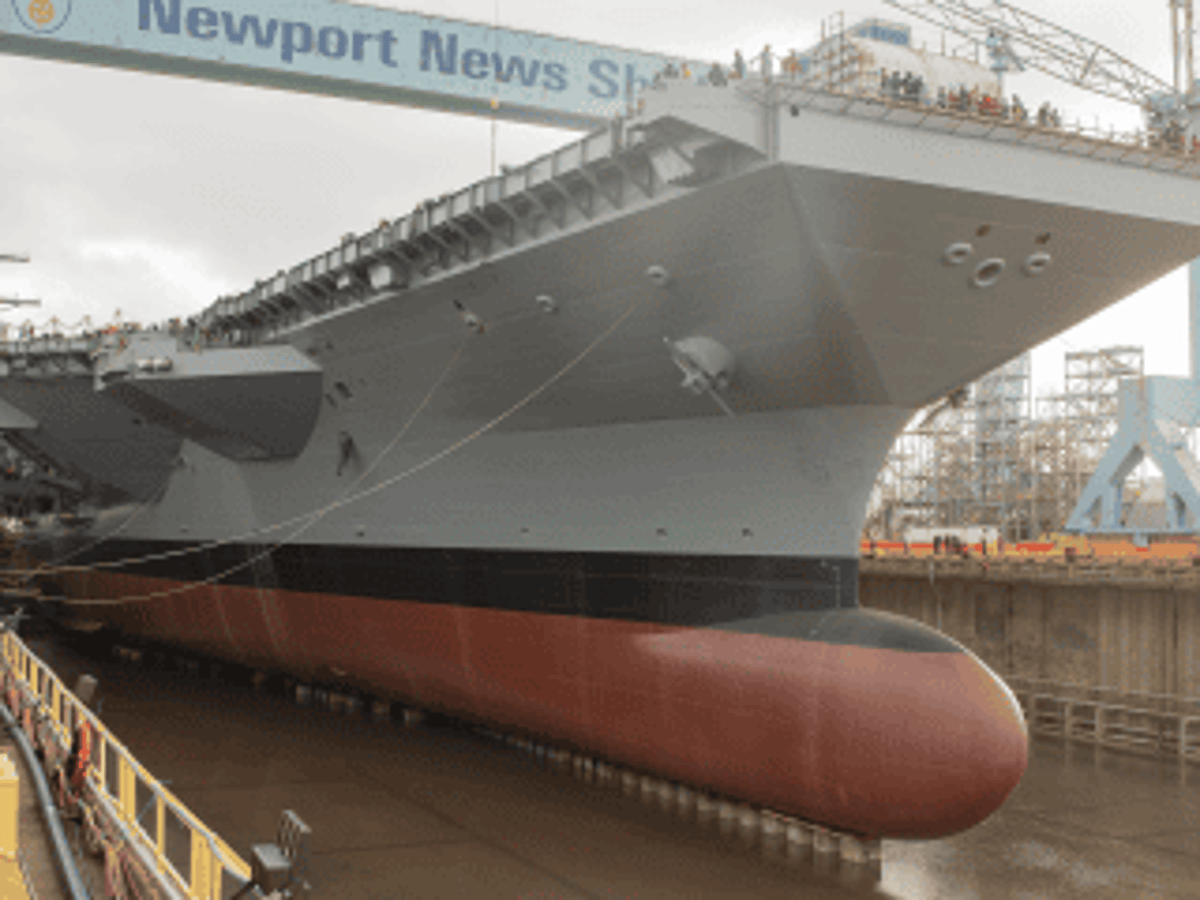
The latest, second Ford‑class aircraft carrier, USS John F. Kennedy, has gone out for its first‑ever sea trials, The Warzone portal reported. The ship will soon enter service, but this does not change the weak state of the U.S. fleet of carriers.

USS John F. Kennedy launch ceremony. Photo: Mass Communication Specialist 3rd Class Adam Ferrero, U.S. Navy
Going out for trials marks the next important stage of the program, which—following the US Navy’s tradition—is far from smooth. USS John F. Kennedy was ordered in 2013, and its keel was laid at Newport News Shipbuilding in 2015. The hull was launched before the COVID‑19 pandemic—in 2019. The goal was to deliver the ship in 2022. At that time, the Navy was supposed to receive a vessel with incomplete capabilities, including no ability to operate F‑35C aircraft, which were to be enabled later. However, Congress demanded that Kennedy enter service with its full set of capabilities. This pushed the delivery date to 2024, then to 2025, 2026, and finally to March or June 2026.
The cause of the delays is technical issues. These concern the elevators that lift aircraft and supply from the hangars to the flight deck, as well as the electromagnetic catapults and the arresting cable system. In short, all the improvements over the previous Nimitz class that allow the carrier to operate F‑35C aircraft (although the Nimitz class with its steam catapults can already operate F‑35Cs). The extended delivery timeline also increased the ship’s cost—from $11.3 billion to $13.2 billion, although inflation is partially a factor.
Similar issues did not affect the previous carrier—USS Gerald R. Ford. That ship currently operates only with F/A‑18 aircraft, and its ability to carry F‑35Cs will come later after modifications. Compared to Ford, Kennedy also has another improvement—a new AN/SPY‑6(V)3 radar, replacing the problematic Dual‑Band Radar (DBR) on Ford.
Kennedy entering service as the first carrier of the new type without “teething problems” is therefore very important for the US Navy. Especially since, although the Navy is legally required to have 12 supercarriers in service, it currently has 11. And if USS Nimitz is retired as planned, the number will drop to 10 until the second Ford‑class unit enters service.
Meanwhile, two more Ford‑class carriers are under construction in the United States—USS Enterprise and USS Doris Miller. These ships should no longer face surprises like their predecessors and will replace USS Dwight D. Eisenhower and USS Carl Vinson, respectively. Enterprise is expected to enter service in 2030. The U.S. Navy has indicated that it needs a significantly larger number of carriers. USS William Clinton and USS George W. Bush are already in the plans. The question remains whether it will be possible to return to 11—or even 12—legally mandated carriers ready for service.
The number 12 was intended, according to the plan, to be maintained especially in times of crisis and threat.
Comments
Want to join the conversation?
Loading comments...