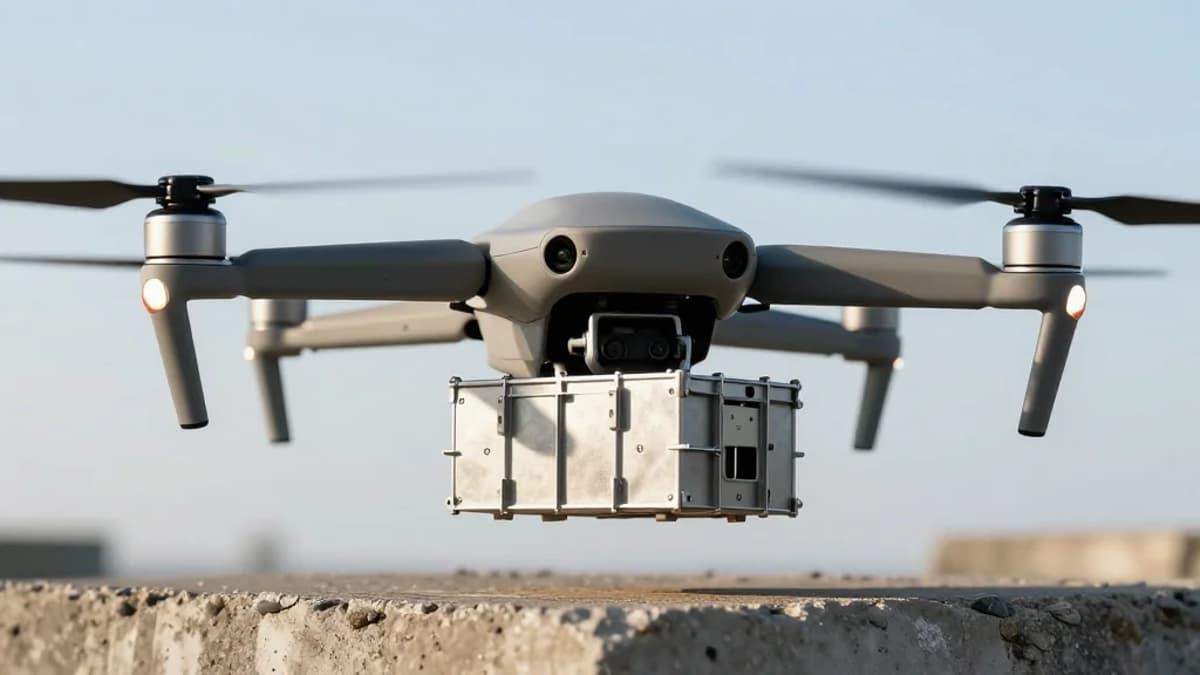
Achieving a 4:1 payload‑to‑weight ratio could transform logistics, disaster response, and commercial drone services, reshaping supply chains and operational capabilities across sectors.
The DARPA Lift Challenge arrives at a pivotal moment for unmanned aerial systems, as industry leaders grapple with the inherent limitation of a 1:1 payload‑to‑weight ratio. By setting a bold 4:1 target, the program leverages recent advances in aerodynamic modeling, lightweight composites, and high‑efficiency propulsion. The competition’s open‑entry format encourages participation from startups, academia, and established aerospace firms, fostering a cross‑pollination of ideas that could accelerate the commercialization of heavy‑lift drones far beyond the defense sector.
Beyond the prize money, the real value of the Lift Challenge lies in its rigorous performance criteria. Teams must design a vertical‑lift craft under 55 pounds that can transport double its weight over a five‑nautical‑mile course in less than half an hour, mirroring real‑world scenarios such as delivering medical supplies to remote disaster zones or moving construction materials to high‑rise sites. These constraints push innovators to prioritize energy density, structural integrity, and autonomous flight control, potentially yielding design templates that can be adapted for a range of payload‑critical missions.
If successful, the outcomes of the Lift Challenge could ripple through multiple markets. Heavy‑lift UAVs promise to reduce reliance on ground transport in congested urban areas, lower carbon emissions for last‑mile deliveries, and provide rapid response capabilities for emergency services. Moreover, the technology could spur new business models around on‑demand aerial logistics, prompting regulators to revisit airspace policies. DARPA’s investment thus not only aims to produce a record‑breaking drone but also to catalyze an ecosystem where high‑payload UAVs become a standard tool for both defense and commercial operations.
DARPA Lift Challenge Aims for Drones That Can Carry Four Times Their Own Weight
As drone use grows, a key limitation has been the typical payload‑to‑weight ratio of about 1:1, meaning these craft can only carry payloads up to their own weight.
Now, DARPA wants to overcome this barrier by asking innovators to build a drone that can lift at least four times its weight. The initiative, known as the DARPA Lift Challenge, is to culminate in a live flight competition this August, with the agency offering up to $6.5 million in prize money.
DARPA sees the 4:1 ratio as “plausible based on recent advances in aerodynamic design, materials science, and propulsion systems,” reads an agency webpage about the initiative.
Lt. Col. Phillip Smith, the DARPA Lift Challenge program manager, in an interview pointed to advances in alternative aerodynamic designs, computational modeling and simulation, 3D printing and open‑source flight controllers.
“When you combine all of those, there’s this real opportunity for innovation to come from places we didn’t really think about it,” he told me.
The Lift Challenge marks the latest DARPA effort to explore heavy‑lift drone technology. In 2024, the agency solicited “innovative and revolutionary concepts for heavy lift Uncrewed Aerial Systems.”
“We got a lot of very interesting thoughts,” Smith said. It showed that “people are thinking about this. They are starting to break out of the box.”
Based on the responses and other internal research, DARPA asked an outside organization to “look into a bunch of different ideas” for vertical‑lift drones capable of carrying payloads heavier than their weight, Smith said. This work confirmed that the technology was possible.
DARPA announced the Lift Challenge in October and began accepting applications in late January. The initiative is open to all, including researchers, businesses and individuals. International teams are allowed to participate as long as their lead representative is a U.S. citizen. Team applications close in May, with live trials planned for Aug. 2‑9.
Although the fly‑off location has not been confirmed, Smith said in a January speech that the leading contender is the National Museum of the U.S. Air Force in Dayton, Ohio.
The challenge calls for teams to design a vertical‑lift craft that weighs 55 pounds or less, carries at least 110 pounds of weight‑lifting plates and can complete a 5‑nautical‑mile course in under 30 minutes — all without needing repairs before being able to return to fly again.
The challenge requirements are intended to simulate real‑life scenarios, such as a disaster‑relief team using a small‑ or mid‑sized drone to ferry emergency supplies to a hard‑to‑reach location, or the military using a drone to deliver ammunition, food or other supplies to troops. Heavy‑lift drones with a higher payload‑to‑weight ratio could also have a range of civil applications: delivering grocery orders, spraying agricultural pesticides or seeds and lifting construction materials to crews building high‑rises, among others.
The DARPA Lift Challenge is “about trying to spark a goal, trying to imagine a future that is worthwhile,” Smith said.
Drones must have at least a 2:1 payload‑to‑weight ratio to qualify for the top prizes, but the winning design will be the drone with the highest payload‑to‑weight ratio that completes the course within the allotted time.
DARPA will award $2.5 million to the first‑place finishers, $1.5 million to the second and $1 million to the third‑place finishers. If the top three teams do not meet the 4:1 ratio, the prize money will be halved.
Smith said he hopes a “bunch” of designs are able to complete the course. This would allow DARPA to evaluate if they all include similar features or if “actually 10 or 15 different styles made it,” he said.
Even if no competitor reaches the 4:1 ratio goal, Smith said the challenge still creates “an environment where all these innovators will get to collaborate with each other.”
He pointed to DARPA’s inaugural Grand Challenge in 2004, focused on self‑driving vehicles. No vehicles completed the course, but five teams crossed the finish line at the 2005 event. The agency’s subsequent challenges have been aimed at sparking developments in robotics, radio and electromagnetic spectrum sharing, cyber defenses and rocket launches.
Within a few years of the Lift Challenge, Smith said he hopes “all of the current drones that we see on the shelf or on websites are obsolete because we identified and found new styles that were way more efficient and way more useful to the user.”
Comments
Want to join the conversation?
Loading comments...