New Details Of Russia’s Super-Weapon Submarine ‘Khabarovsk’
Why It Matters
Khabarovsk gives Russia a dedicated launch platform for Poseidon, potentially reshaping strategic deterrence and forcing NATO navies to reconsider undersea defense postures.
Key Takeaways
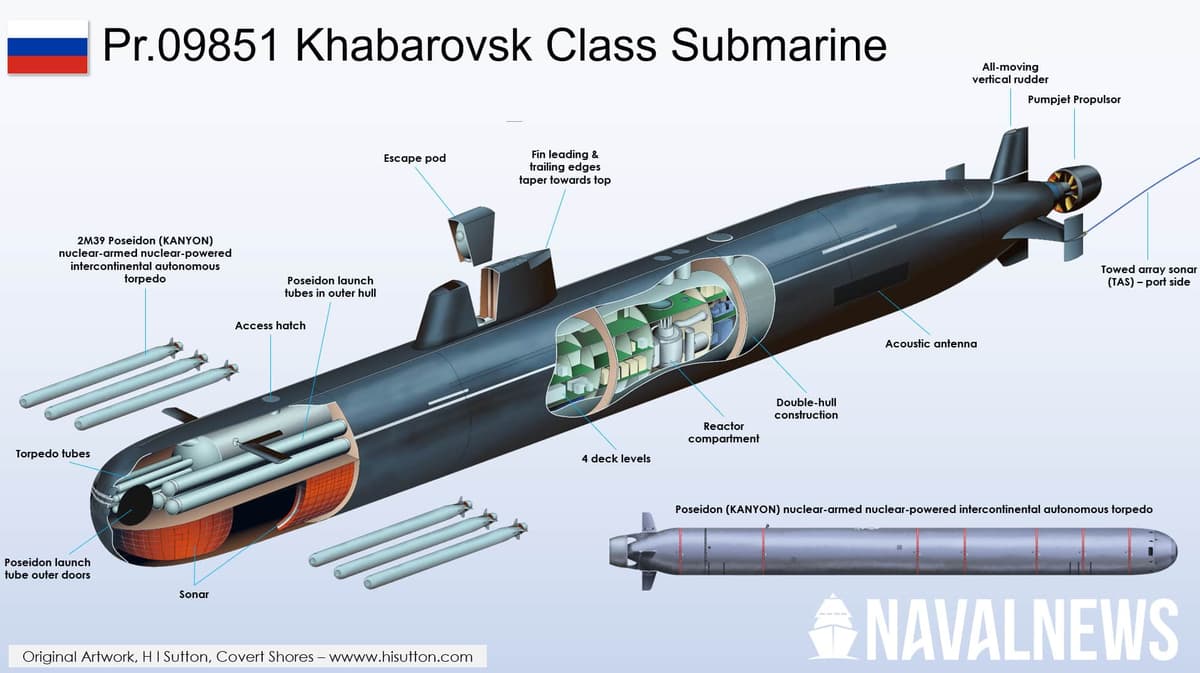
- •Khabarovsk is a 135‑meter submarine built solely for Poseidon torpedoes
- •Design merges Borei‑class stern with Belgorod‑class bow, omitting midsection
- •Holds up to six Poseidon weapons in two flooded hangars
- •Retains limited regular torpedo capacity, emphasizing Poseidon priority
- •Single OK‑650V reactor provides quiet propulsion for stealth missions
Pulse Analysis
The Poseidon torpedo—often described as an autonomous, nuclear‑powered, intercontinental weapon—represents Russia’s answer to the growing vulnerability of surface fleets and coastal infrastructure. First unveiled by President Putin in 2018, the system promises a range that rivals strategic missiles while delivering a massive radioactive payload. Analysts view it as a strategic escalation, blurring the line between conventional torpedoes and weapons of mass destruction, and prompting renewed debate over arms‑control frameworks that have yet to address underwater nuclear drones.
Khabarovsk’s design reflects a pragmatic blend of existing Russian submarine technology. By grafting the rear section of a Borei‑class ballistic missile sub onto the forward hull of the Belgorod, engineers eliminated the midsection that normally houses missile tubes or a docking bay, freeing volume for two large hangars that can each launch a Poseidon. The vessel’s dimensions—approximately 135 m long and 13.5 m wide—make it one of the world’s largest attack submarines, yet its internal layout sacrifices conventional torpedo capacity in favor of the super‑weapon. A single OK‑650V reactor powers the craft, delivering the low acoustic signature essential for covert penetration of NATO’s anti‑submarine networks.
The operational debut of Khabarovsk forces NATO to reassess undersea threat models that have long prioritized ballistic missile submarines and conventional attack platforms. If Poseidon can be deployed from a stealthy, nuclear‑propelled submarine, it could threaten coastal cities, naval bases, and carrier groups with a weapon that is difficult to detect and intercept. Consequently, Western navies are likely to invest in enhanced sonar arrays, under‑ice detection capabilities, and diplomatic avenues to address the emerging class of underwater strategic weapons. The Khabarovsk thus marks a pivotal step in Russia’s super‑weapon strategy, with implications that could reverberate across global maritime security for years to come.
New Details Of Russia’s Super-Weapon Submarine ‘Khabarovsk’
Comments
Want to join the conversation?
Loading comments...