New Mystery Submarine Signals China’s Rapid Undersea Expansion
Companies Mentioned
Why It Matters
The launch underscores a widening capability gap in undersea warfare, forcing the United States and allies to reassess strategic postures in the Indo‑Pacific.
Key Takeaways
- •Sailless design reduces drag, improves stealth for next-gen Chinese subs.
- •China has built 15‑20 submarines, eight new classes, in five years.
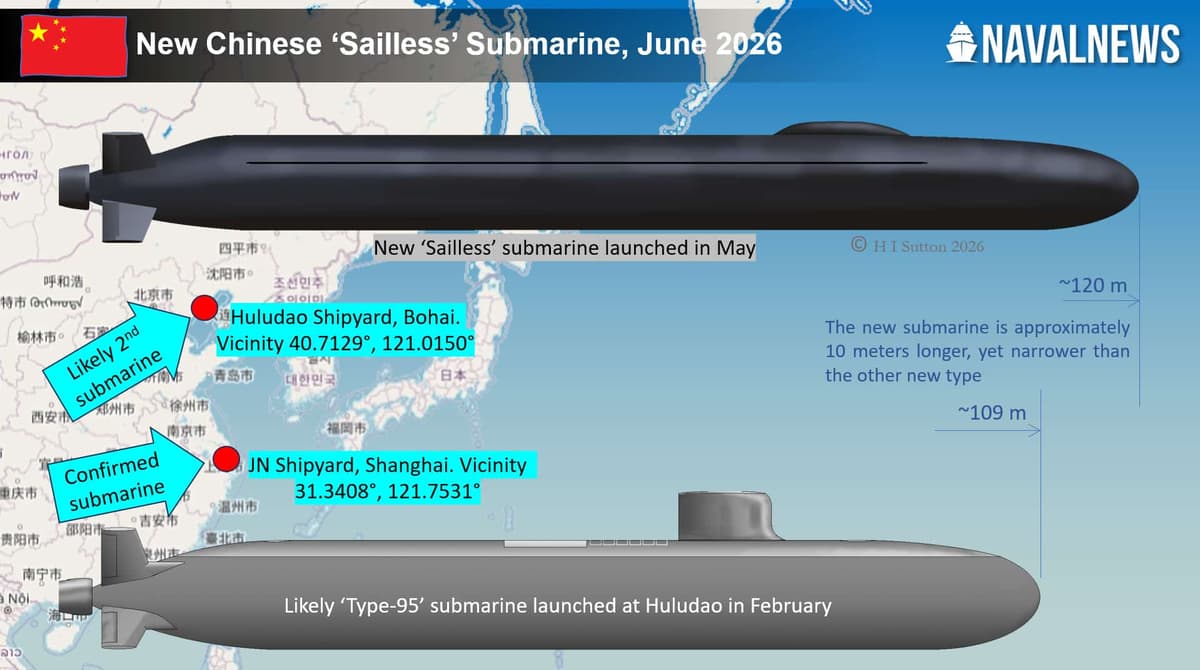
- •Simultaneous launches at JN and Huludao yards suggest serial production.
- •Submarine size implies nuclear propulsion; conventional power would be unprecedented.
- •Unclear classification may reshape assessments of Type‑095 deployment timeline.
Pulse Analysis
China’s submarine construction tempo is reshaping the global undersea balance. In the last half‑decade the People’s Liberation Army Navy (PLAN) has delivered roughly 15‑20 submarines, introducing eight distinct classes—a rate that dwarfs the output of the United States, United Kingdom and France, each typically commissioning one or two hulls annually. This surge reflects a strategic push to field a diversified fleet capable of both regional dominance and blue‑water power projection, while Western shipyards grapple with budget constraints and lengthy build cycles.
The newly observed vessel departs from conventional designs by eliminating the traditional sail, a move that trims hydrodynamic drag and potentially lowers acoustic signatures. Its sleek bow, X‑form rudders and narrow beam hint at a focus on speed and stealth, while the 120‑meter length aligns with nuclear‑propulsion requirements. If powered by a conventional engine, it would become the world’s largest diesel‑electric submarine; however, analysts favor a standard nuclear reactor or a low‑power nuclear AIP system, offering virtually unlimited endurance and greater operational flexibility.
Strategically, the mystery sub amplifies concerns over China’s anti‑access/area‑denial (A2/AD) capabilities in the Western Pacific. A fleet of quiet, long‑range attack submarines can threaten carrier strike groups, disrupt sea‑lane security, and complicate intelligence‑gathering efforts. The United States Navy may need to accelerate its own submarine procurement, invest in advanced undersea detection technologies, and deepen allied cooperation to counter this emerging threat. Continuous satellite monitoring and open‑source analysis will be crucial as China continues to conceal class details and launch schedules.
New Mystery Submarine Signals China’s Rapid Undersea Expansion
Comments
Want to join the conversation?
Loading comments...