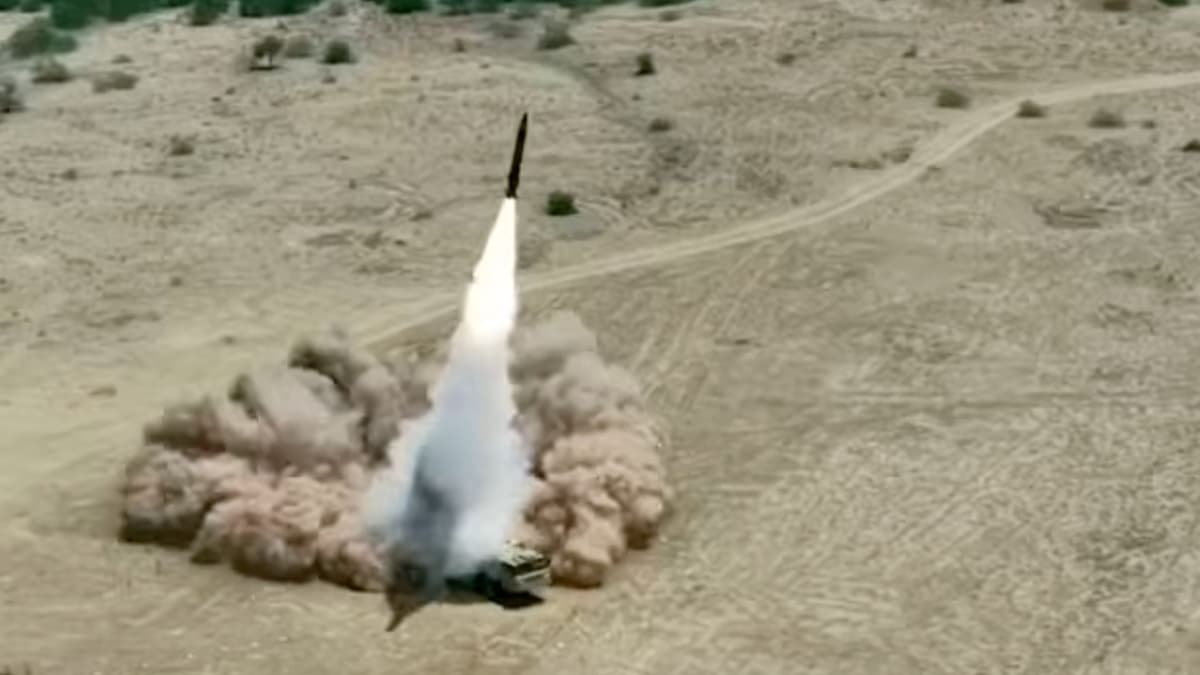
Pakistan Test-Fires Fatah-II Missile: What the ARFC Training Launch Means
Why It Matters
The launch signals Pakistan’s ability to field an independent conventional long‑range strike capability, bolstering its deterrence posture and supporting a networked precision‑fire strategy.
Key Takeaways
- •Fatah-II achieved a 400 km training launch, confirming operational readiness.
- •Missile features supersonic speed, 365 kg warhead, 50 m CEP accuracy.
- •Launch signals ARFC’s shift to independent long‑range conventional strike.
- •Standardized platform enables scaling production with Chinese component supply.
- •Fatah family now provides layered strike range from 140 km to 750 km.
Pulse Analysis
The April 2026 training launch of Pakistan’s Fatah‑II missile marks a pivotal moment for the Army Rocket Force Command (ARFC). By demonstrating a 400 km supersonic strike with a 365 kg warhead and sub‑50 m circular error probable, the system proves its readiness for operational deployment. Its all‑course manoeuvrability, powered by a dual‑thrust solid motor and guided by inertial‑plus‑GNSS navigation, is tailored to evade modern missile‑defence shields, positioning the Fatah‑II as a credible conventional precision‑strike asset.
Strategically, the Fatah‑II fills the mid‑range tier of Pakistan’s emerging layered strike portfolio, which now spans the 140 km Fatah‑I, the 400 km Fatah‑II, and the 750 km Fatah‑IV cruise missile. This spectrum allows the Pakistan Army to conduct deep‑recess strikes on air‑defence nodes, logistics hubs, or command centres without depending on the Pakistan Air Force’s aircraft availability. The ARFC’s dedicated command structure, established in 2025, reflects a doctrinal shift toward autonomous ground‑based precision fire, echoing trends seen in other regional militaries seeking to diversify their stand‑off options.
However, fielding a sizable conventional missile inventory presents industrial challenges. NESCOM’s current production capacity is modest, prompting a pragmatic partnership model with Chinese suppliers for key components such as solid‑propellant motors and guidance electronics. This “systems integrator” approach accelerates output while preserving domestic design control. Coupled with Pakistan’s expanding satellite constellation and the nascent Integrated Battlefield Management System, the Fatah‑II launch illustrates a coordinated push toward a sensor‑shooter network capable of rapid, data‑driven targeting. If the production pipeline scales and the connective IBFMS matures, Pakistan could achieve a truly network‑centric strike capability within the next few years.
Pakistan Test-Fires Fatah-II Missile: What the ARFC Training Launch Means
Comments
Want to join the conversation?
Loading comments...