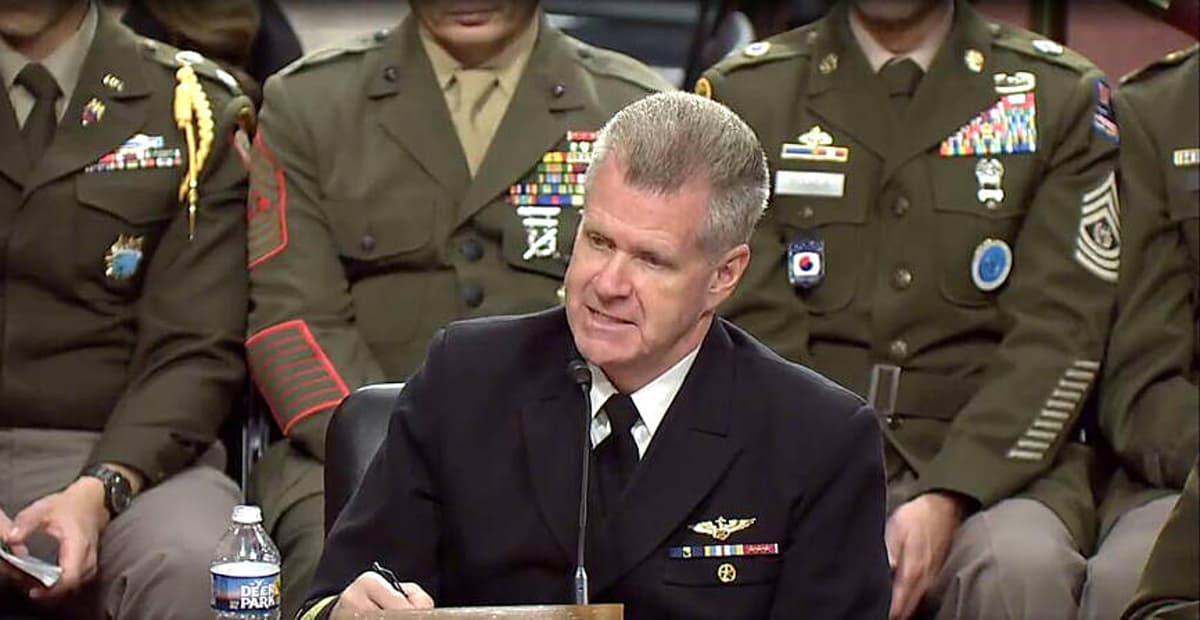
Pass Budget on Defense to Show Resolve: US Indo-Pacific Commander
Why It Matters
Approving the budget would secure continued U.S. arms sales and strengthen Taiwan’s deterrence, while a failure could embolden Beijing and weaken U.S. credibility in the Indo‑Pacific.
Key Takeaways
- •Taiwan seeks NT$1.25 trillion ($39.6 bn) special defense budget.
- •Opposition offers only NT$380‑400 bn ($11.1 bn) insufficient for future purchases.
- •Admiral Paparō stresses self‑funded defense to secure U.S. support.
- •Meta‑trends: cyber, cheap drones, low‑cost precision munitions reshape warfare.
- •U.S. backs “hellscape” strategy of massed drones to deter Chinese invasion.
Pulse Analysis
Taiwan’s security calculus has sharpened as Beijing steps up pressure, prompting Washington to press for a robust, self‑funded defense plan. Admiral Samuel Paparō’s testimony underscored that a NT$1.25 trillion ($39.6 bn) special budget is not merely a financial request but a litmus test of Taipei’s resolve and a prerequisite for sustained U.S. military assistance. The budget would fund a new wave of American weapons, including advanced missile systems and cyber‑defense tools, ensuring Taiwan can field a credible deterrent without relying solely on foreign subsidies.
Domestically, the budget faces a political impasse. The opposition‑controlled legislature has counter‑offered NT$380‑400 bn ($11.1 bn), enough only for the U.S. arms package announced in January but falling short of covering future acquisitions or indigenous drone programs. This stalemate threatens to delay critical procurement, eroding Taiwan’s ability to modernize its forces amid rapid advances in unmanned and AI‑driven warfare. Paparō highlighted three meta‑trends—information operations, cheap mass‑produced uncrewed systems, and low‑cost precision munitions—that are reshaping conflict dynamics and raising the cost of any amphibious assault on the island.
Strategically, the United States is championing a “hellscape” doctrine that saturates Taiwan’s surrounding airspace and waters with thousands of autonomous drones and low‑cost strike munitions. By leveraging AI, data analytics, and space‑based sensors, this approach aims to impose prohibitive attrition on any invading force, turning Taiwan’s defensive posture into a high‑risk target for Beijing. The endorsement of this asymmetric, AI‑enhanced strategy by senior U.S. lawmakers signals a deeper commitment to Indo‑Pacific stability and reinforces the message that Taiwan’s self‑funded defense is a cornerstone of regional security.
Pass budget on defense to show resolve: US Indo-Pacific commander
Comments
Want to join the conversation?
Loading comments...