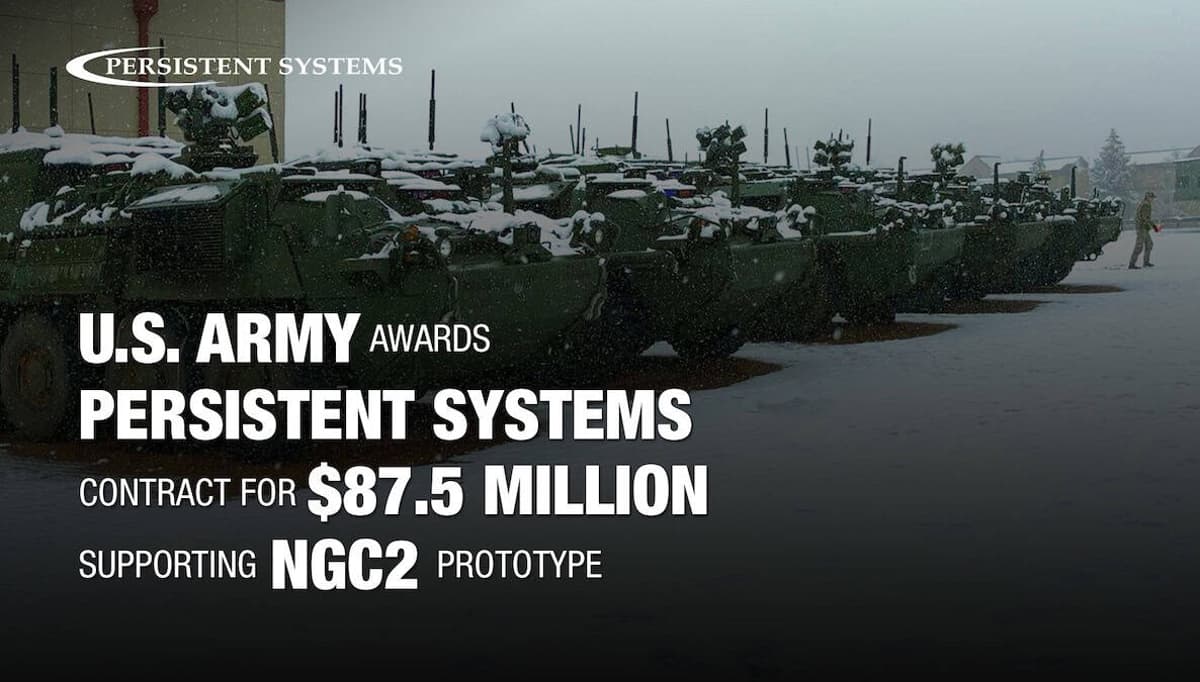
Persistent Systems Secures $87.5M MANET Order for NGC2 Prototype
•February 13, 2026
0
Why It Matters
The contract speeds the Army’s transition to a data‑centric, mobile network, boosting command‑and‑control effectiveness, while confirming Persistent’s commercial technology as a core component of future military communications.
Key Takeaways
- •$87.5M MANET order from U.S. Army CPE C3N.
- •Combined awards total $121.5M for NGC2 prototype.
- •MANET devices deliver resilient transport layer for battlefield data.
- •Faster data delivery improves command and control decision-making.
- •Deliveries begin soon, supporting Army's future network development.
Pulse Analysis
Mobile Ad Hoc Networks (MANET) have become a cornerstone of modern battlefield communications, offering on‑the‑fly routing and robust connectivity for unmanned platforms. As the U.S. Army pushes toward a more agile, data‑driven force, contracts like Persistent Systems’ $87.5 million award signal a broader shift from legacy, static radios to flexible, software‑defined solutions that can adapt to contested environments. Industry analysts note that the rapid adoption of MANET technology is driven by the need for low‑latency, high‑throughput links that support everything from sensor feeds to autonomous vehicle coordination.
The award is tied to the Next‑Generation Command and Control (NGC2) prototype, where Persistent’s MANET radios serve as the transport layer—essentially the digital highway moving “1s and 0s” across the battlefield. By ensuring that data reaches the warfighter in real time, the system enhances situational awareness and accelerates decision cycles for commanders at all echelons. This capability aligns with the Army’s objective to field a resilient network that can survive jamming, spectrum congestion, and physical disruption, thereby preserving mission continuity in high‑intensity conflicts.
For the defense communications market, the combined $121.5 million investment underscores confidence in commercial‑off‑the‑shelf (COTS) solutions that meet stringent military standards. Persistent Systems, already a recognized player in unmanned networking, now positions itself as a key supplier for the Army’s future digital infrastructure. The contract may spur further partnerships and R&D funding, encouraging other vendors to innovate in areas such as AI‑enhanced routing, edge computing integration, and secure, low‑observable waveforms, ultimately reshaping the competitive landscape of tactical communications.
Persistent Systems Secures $87.5M MANET Order for NGC2 Prototype
0
Comments
Want to join the conversation?
Loading comments...