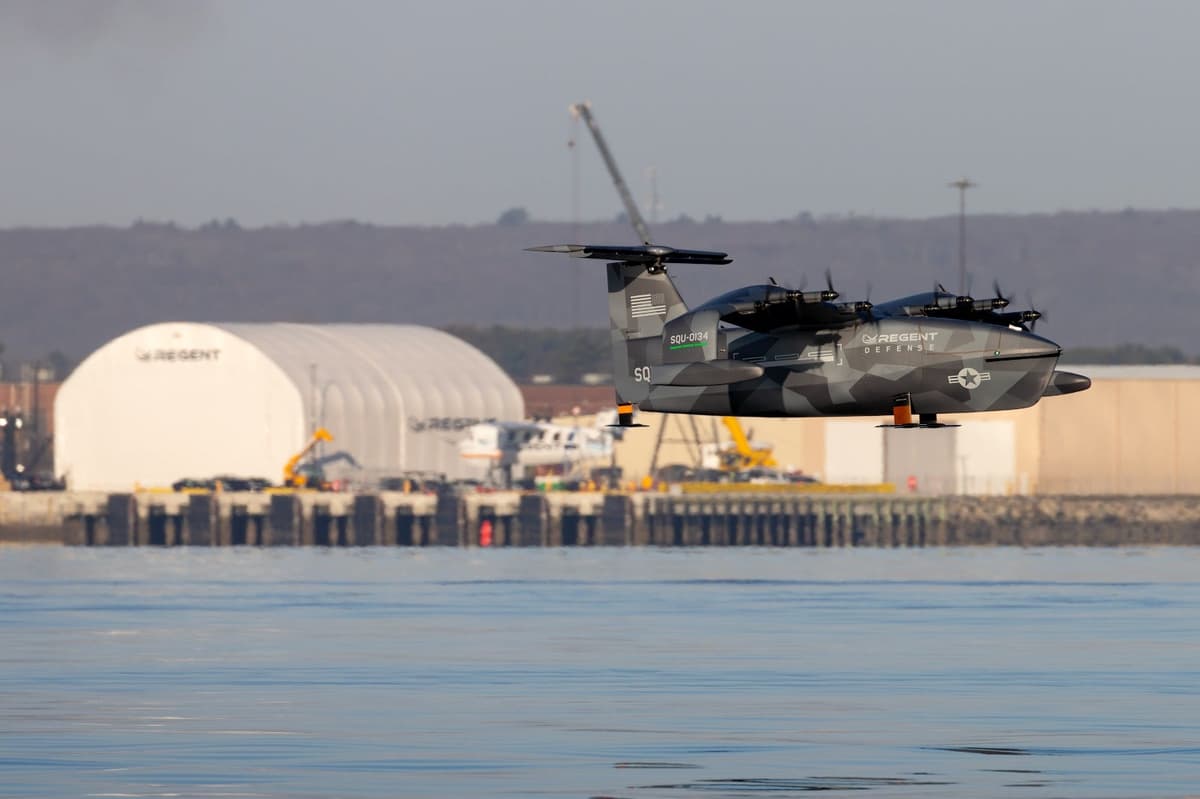
REGENT’s Autonomous Drone Squire Completes First Ground-Effect Flight in U.S. Waters
Why It Matters
Ground‑effect drones like Squire could give U.S. forces rapid, low‑cost maritime reach, closing a capability gap that rivals such as China are aggressively pursuing. The technology promises to reshape contested logistics and anti‑submarine operations for the warfighter.
Key Takeaways
- •Squire achieved first U.S. ground‑effect flight for defense‑configured craft
- •Top speed 70 knots, 100‑nm range, 50‑lb payload at low sea states
- •Mission set includes ISR, logistics, SAR, and anti‑submarine warfare
- •REGENT has $15 M Marine Corps contract and $10 B commercial backlog
Pulse Analysis
Ground‑effect vehicles, which skim just above the water’s surface, have long been a niche of experimental aviation. By exploiting the aerodynamic cushion created between wing and water, they achieve higher speeds and fuel efficiency than conventional hull‑borne craft while avoiding many radar signatures. China has invested heavily in similar platforms, prompting U.S. defense firms to accelerate development. REGENT’s Squire demonstrates that a commercially viable, defense‑ready system can now operate in U.S. waters, signaling a shift from prototype to operational testing and potentially reshaping the strategic calculus for littoral warfare.
Technically, Squire blends aerial agility with maritime resilience. Its 18‑foot wingspan and 13‑foot length enable a top speed of 70 knots and a 100‑nautical‑mile range, while a modest 50‑pound payload can house EO/IR sensors, sonar arrays or small cargo. The drone’s ability to launch and recover in two‑foot sea states, yet overfly in unlimited conditions, offers commanders a flexible tool for ISR, rapid logistics, search‑and‑rescue and anti‑submarine missions. By integrating passive and active sonar with sonobuoy mesh networks, Squire can detect submerged threats in real time, providing a low‑cost complement to larger, more vulnerable surface vessels.
The commercial implications are equally compelling. REGENT has secured a $15 million contract from the U.S. Marine Corps and reports a commercial backlog exceeding $10 billion, underscoring market appetite for high‑speed, autonomous maritime platforms. With over $100 million raised from investors such as Founders Fund, Japan Airlines and Lockheed Martin, the company is positioned to scale production and expand its portfolio, including the 12‑passenger Viceroy prototype. As defense budgets prioritize rapid, distributed capabilities, Squire could become a cornerstone of future naval logistics and surveillance architectures, driving further investment in ground‑effect technology across the defense sector.
REGENT’s Autonomous Drone Squire Completes First Ground-Effect Flight in U.S. Waters
Comments
Want to join the conversation?
Loading comments...