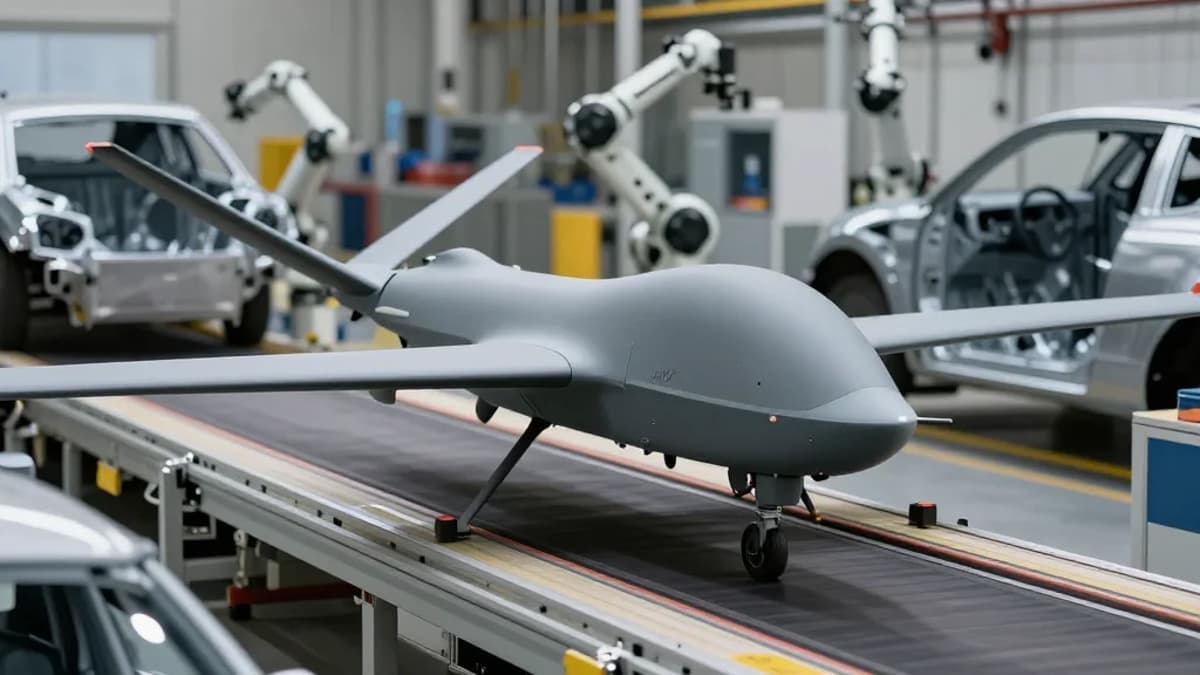
The partnership blurs the line between civilian and military manufacturing, giving Renault a stable income source while strengthening France’s sovereign defense supply chain.
Renault’s decision to convert its Le Mans facility into a drone‑production hub underscores how legacy automakers are repurposing mature assembly lines for high‑tech defense applications. The French government’s contract leverages the plant’s expertise in precision engineering, electronics, and battery systems—core competencies honed through years of vehicle manufacturing. By avoiding a greenfield build, Renault reduces capital outlay and accelerates time‑to‑first‑flight, illustrating how existing automotive infrastructure can be swiftly adapted to meet national security demands.
Across the European Union, policymakers are actively courting the automotive sector to fill gaps in defense procurement. The continent’s dense network of suppliers, robust logistics, and deep talent pool make car manufacturers attractive partners for producing unmanned systems, armored vehicles, and other dual‑use equipment. This strategic pivot also addresses supply‑chain resilience, reducing reliance on non‑European vendors for critical components. As geopolitical tensions rise, the convergence of automotive and defense technologies is becoming a cornerstone of Europe’s broader industrial defense strategy.
For the auto industry, diversification into military contracts offers a hedge against the volatility of consumer demand and the costly transition to electric mobility. Revenue from government‑backed orders can sustain employment, preserve advanced manufacturing skills, and fund further R&D in autonomous and electric propulsion—technologies that benefit both cars and drones. If Renault’s venture proves profitable, it could set a precedent, prompting other manufacturers to explore similar dual‑use opportunities, thereby reshaping the European industrial landscape into a more integrated, defense‑ready economy.
In a significant move that underscores the changing industrial landscape of Europe, the Renault Group has officially confirmed its entry into the military hardware sector. The French automotive giant announced plans to manufacture unmanned aerial vehicles intended for use by the French armed forces. This development marks a pivotal moment for the legacy automaker, signaling a broader trend in which traditional civilian manufacturers are increasingly integrated into national defense strategies.
The initiative centers on producing up to 600 drones, a contract that solidifies the relationship between the commercial industrial base and the French Ministry of Defense. Rather than building a new facility for this purpose, Renault will utilize its existing infrastructure in Le Mans. Located in western France, the Le Mans plant is historically renowned for its contributions to automotive engineering and chassis manufacturing. By retooling a portion of this facility for aerospace defense applications, the company is demonstrating the versatility of modern manufacturing lines and the growing convergence between automotive technology and military requirements.
This announcement serves as a microcosm of a larger phenomenon sweeping across the European Union. As geopolitical tensions rise and demand for security equipment outpaces traditional production capacity, governments are looking to the automotive sector for solutions. Car manufacturers possess specific competencies that are highly valuable to modern defense needs: mastery of supply chains, expertise in mass production, and advanced knowledge of electronics and battery systems.
For decades, the European auto industry operated largely independently of the defense sector, focusing primarily on consumer mobility and export markets. However, recent calls from EU leadership for a ramp-up in military capabilities have prompted a reevaluation of industrial assets. The decision by Renault to dedicate resources to drone production indicates that the line between civilian and military manufacturing is becoming increasingly porous. This shift suggests that the war economy is moving from a theoretical concept to a tangible reality on the factory floor.
The choice of the Le Mans facility is both symbolic and practical. By keeping production within French borders, the initiative supports the strategic goal of national sovereignty. In recent years, there has been a concerted effort across Europe to reduce reliance on foreign suppliers for critical security equipment. By leveraging a domestic champion like Renault, the French Ministry of Defense ensures that the supply chain for these tactical units remains secure and immune to external disruptions.
Furthermore, this pivot offers a degree of economic resilience for the manufacturer. As the automotive industry faces challenges, from the transition to electric vehicles to fluctuating global demand, diversifying into defense contracts offers a stable, government-backed revenue stream. It allows the workforce at Le Mans to apply their skills in high-precision assembly to a new vertical, potentially safeguarding jobs and technical expertise within the region.
The production of 600 drones represents more than just a procurement order; it highlights the technological overlap between modern cars and modern weapons systems. Both rely heavily on sensors, autonomous software, electric propulsion, and lightweight materials. As automakers invest billions into self-driving algorithms and battery efficiency, those same technologies are directly applicable to the development of unmanned military systems.
Observers note that this could be the beginning of a sustained trend. If Renault’s integration of drone manufacturing proves successful, it may set a precedent for other European automakers to follow suit. The industrial logic is sound: if a factory can produce hundreds of thousands of complex, computer-controlled vehicles annually, it is well positioned to produce the hardware needed for 21st-century security.
As the first units move toward production in Western France, the implications extend beyond the factory gates. This collaboration between Renault and the state defense apparatus serves as a test case for the dual-use potential of Europe’s heavy industry. It represents a pragmatic response to a changing world order, where the security of the continent relies not just on specialized defense contractors but on the adaptability of its most historic commercial brands. The auto industry, once solely the engine of mobility, is now becoming a distinct component of the engine of defense.
Comments
Want to join the conversation?
Loading comments...