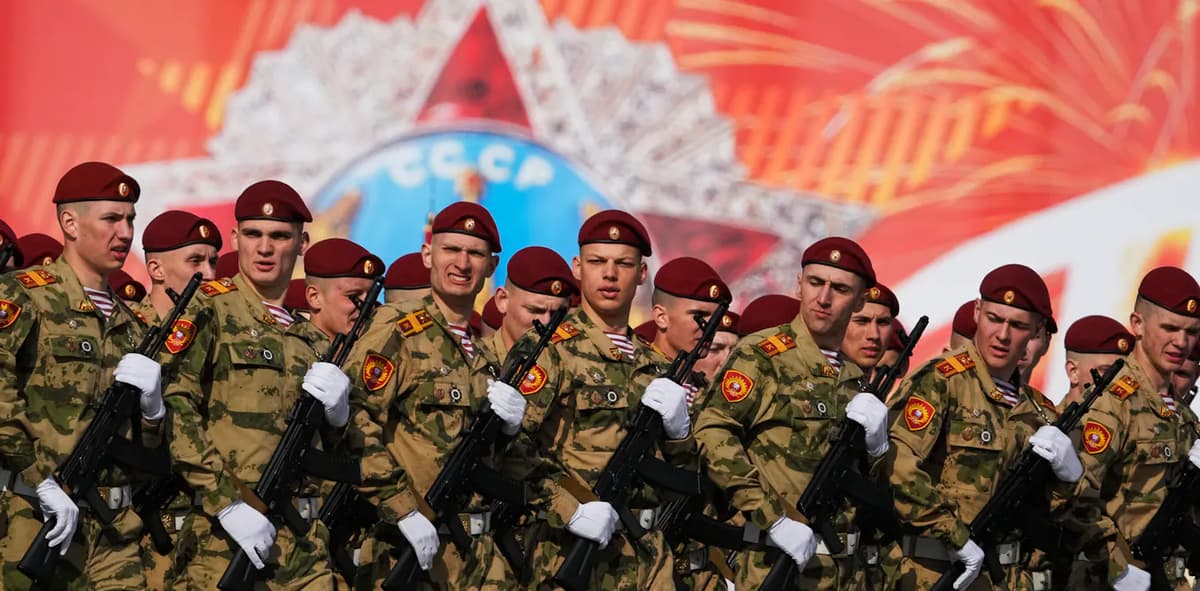
Russia Doesn’t Have Much to Celebrate on Victory Day, as Ukraine Brings the War Home to Putin
Why It Matters
The muted parade signals a crack in Russia’s narrative of invincibility and highlights Ukraine’s growing strategic reach, reshaping the war’s political calculus and prompting reassessment of Moscow’s long‑term security posture.
Key Takeaways
- •Victory Day parade omitted tanks, missiles for first time in two decades.
- •Ukraine’s long‑range strikes hit Russian oil, defence sites hundreds of kilometres away.
- •Russian recruitment falls short of 30‑35k monthly combat losses.
- •Ukraine’s defence industry grew 50‑fold, now supplies 70% of its arms.
- •EU approved ~ $97 bn loan to Ukraine, bolstering its war effort.
Pulse Analysis
Victory Day has long been a showcase of Russian military might, a ritual that President Vladimir Putin used to legitimize his regime and project power abroad. This year’s parade, however, was conspicuously sparse—no heavy armor, no fly‑overs, and a markedly reduced roster of foreign leaders. The Kremlin’s decision to close airports and limit mobile data ahead of the holiday reflects an acute fear of Ukrainian long‑range attacks, a fear that would have been unimaginable two decades ago when the Red Square spectacle featured the latest tanks and missiles.
Ukraine’s ability to strike deep inside Russian territory has evolved from ad‑hoc drone raids to coordinated missile attacks on strategic infrastructure such as oil refineries and defence plants hundreds of kilometres away. The rapid expansion of Kyiv’s defence industrial base—now 50‑times larger than in 2022 and responsible for roughly 70 % of its weaponry—has enabled this shift. Recent export contracts with Saudi Arabia, the United Arab Emirates and Qatar not only provide revenue but also signal growing international confidence in Ukrainian defence technology, reinforcing its capacity to sustain a protracted conflict.
The domestic fallout in Russia is equally stark. Recruitment numbers are lagging behind the estimated 30‑35 000 monthly combat losses, and the quality of conscripts is deteriorating. Coupled with a stagnant economy, high inflation and tightening internet censorship, public discontent is simmering, as evidenced by rare public criticism of Putin and warnings of potential unrest from political insiders. These pressures may force Moscow to reconsider its hard‑line stance on peace negotiations, while Western allies continue to back Kyiv with substantial aid, including an EU‑approved loan of roughly $97 bn. The convergence of military, economic, and political strains suggests a pivotal moment in the Russia‑Ukraine war, with implications that extend far beyond the Red Square ceremony.
Russia doesn’t have much to celebrate on Victory Day, as Ukraine brings the war home to Putin
Comments
Want to join the conversation?
Loading comments...