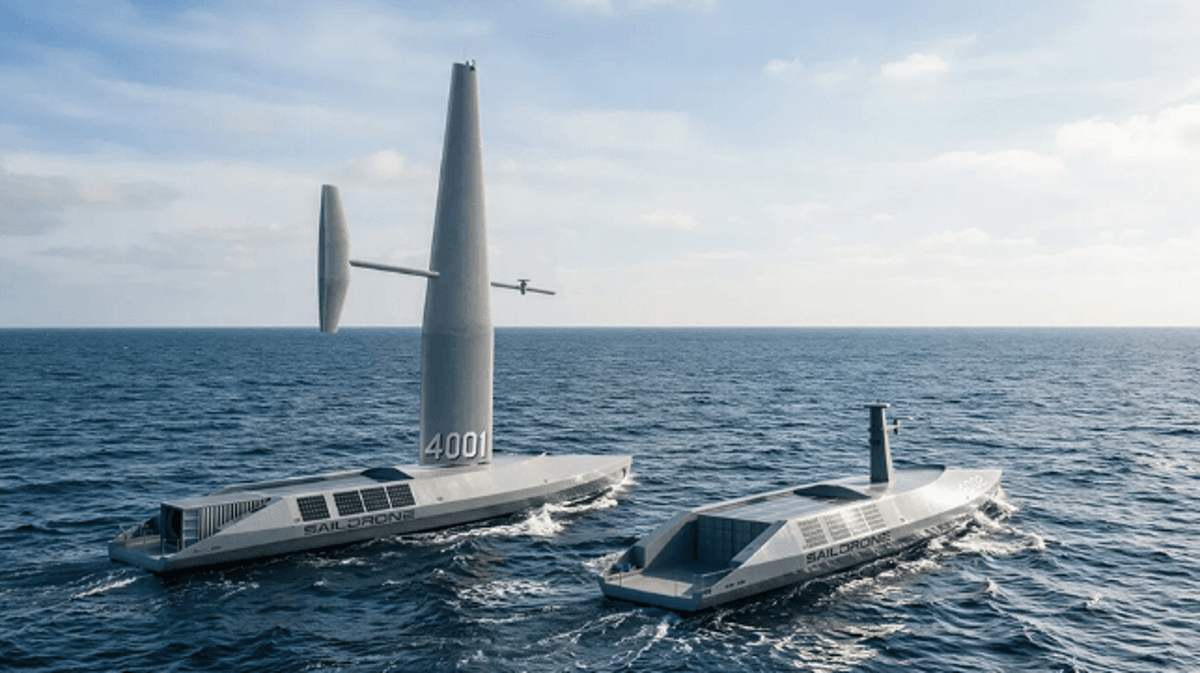
Saildrone Joins Growing Competition for Navy's Medium-Sized Drone Vessel
Companies Mentioned
Why It Matters
Saildrone's entry adds a low‑acoustic, sail‑enabled option to a heavily funded Navy initiative, potentially reshaping how the service conducts anti‑submarine and strike operations with unmanned surface platforms.
Key Takeaways
- •Saildrone's Spectre can reach 27 knots with 25‑tonne payload.
- •Optional sail enables near‑silent operation for anti‑submarine missions.
- •Two Mk70 VLS launchers give the vessel eight strike cells.
- •Program funded by $2.1 billion MUSV allocation and $188 million R&D.
- •Consortium includes Saildrone, Fincantieri, and Lockheed Martin.
Pulse Analysis
The U.S. Navy’s push for medium‑sized unmanned surface vessels reflects a strategic shift toward blue‑water autonomy. After several rebrandings, the MUSV program now draws a diverse field of traditional defense contractors and agile startups, each vying to supply a platform that can operate far from shore with minimal crew oversight. Funding streams such as the One Big Beautiful Bill Act underscore the service’s commitment, earmarking $2.1 billion for production and an additional $188 million for research, positioning unmanned vessels as a cornerstone of future maritime dominance.
Saildrone’s Spectre differentiates itself with a hybrid sail‑propulsion system that dramatically reduces acoustic signatures, a critical advantage in anti‑submarine warfare where stealth is paramount. The 250‑tonne hull can sprint to 27 knots, yet its electric‑powered CPP drive maintains a whisper‑quiet 12‑knot cruise, enabling effective towed‑array sonar deployment. For strike missions, the modular design sheds the sail and integrates two Mk70 vertical launch system (VLS) modules, delivering eight precision‑guided missiles. Partnering with shipbuilder Fincantieri and aerospace heavyweight Lockheed Martin, Saildrone leverages proven shipbuilding expertise and advanced combat systems integration.
The financial backdrop amplifies the commercial stakes. With the FY2027 defense budget projected at $1.5 trillion and explicit language calling for "unprecedented investments" in unmanned tech, successful bidders stand to secure multi‑year contracts that could reshape the maritime defense supply chain. Saildrone’s entry not only intensifies competition but also signals that innovative, low‑signature platforms are gaining traction alongside traditional hull designs. As sea trials commence early next year, the Navy’s selection will likely influence the trajectory of autonomous surface combatants across allied navies and commercial sectors alike.
Saildrone Joins Growing Competition for Navy's Medium-Sized Drone Vessel
Comments
Want to join the conversation?
Loading comments...