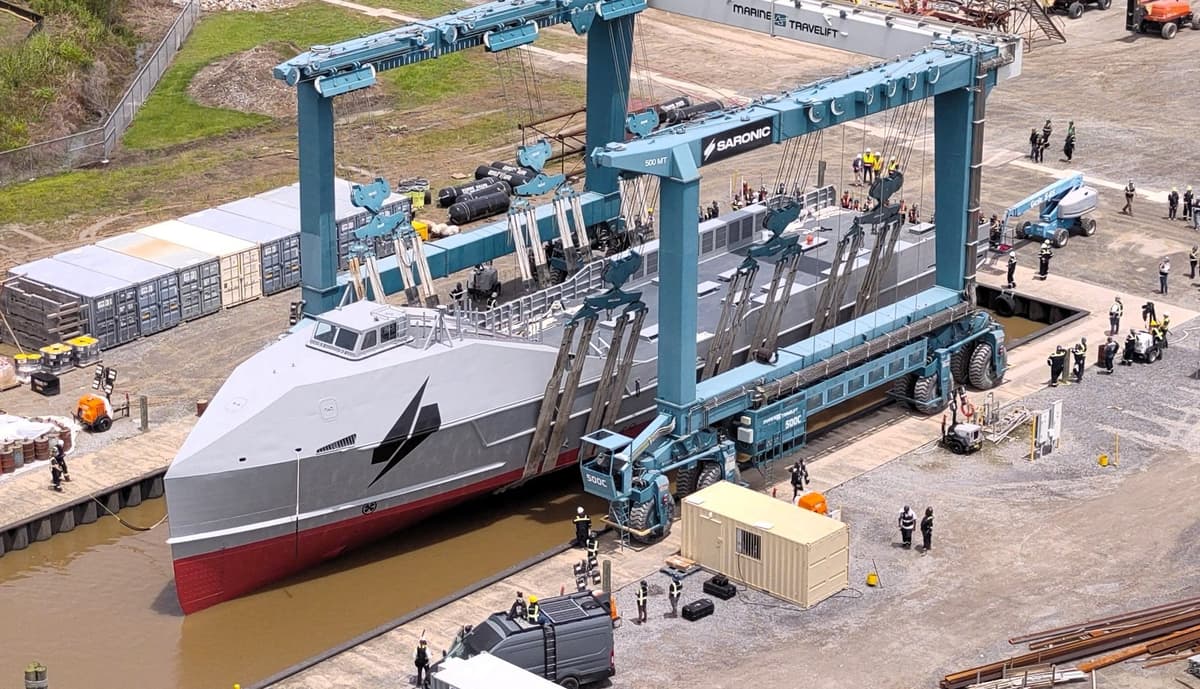
Saronic Launches First Marauder Medium Unmanned Surface Vessel
Companies Mentioned
Why It Matters
The rapid build cycle and scalable production signal a shift toward mass‑produced autonomous ships, lowering costs and accelerating fleet integration for both military and commercial users. This could redefine maritime logistics, surveillance, and offshore operations in the coming decade.
Key Takeaways
- •First Marauder hull built from design to launch in under one year
- •Production target: 20 autonomous vessels annually by end‑2026
- •150‑ton payload supports up to four 40‑ft containers
- •25+ knots speed, 5,400‑nm range enables long‑range missions
- •Integrated software platform provides real‑time human‑on‑the‑loop control
Pulse Analysis
Saronic’s breakthrough with the Marauder MUSV demonstrates how consolidating design, engineering, and autonomy under one roof can compress traditional shipbuilding timelines dramatically. By leveraging modern aluminum construction, modular sub‑assemblies, and a resilient supply chain, the company delivered a fully autonomous vessel from concept to launch in less than twelve months—a cadence that rivals historic wartime production rates. This approach not only reduces labor and material waste but also creates a repeatable factory model capable of scaling to fleet‑size output.
Beyond the engineering feat, the Marauder’s specifications position it as a versatile workhorse for a range of maritime tasks. With a top speed exceeding 25 knots, a 5,400‑nautical‑mile endurance, and a 150‑metric‑ton payload that can accommodate up to four 40‑foot ISO containers, the vessel can support logistics, scientific research, and persistent ISR missions without a crew on board. The modular payload architecture allows operators to reconfigure the ship for different roles quickly, making it attractive to both defense agencies seeking low‑risk, long‑duration surveillance platforms and commercial players looking for autonomous cargo delivery across offshore routes.
The broader industry impact could be profound. As Saronic scales to 20 units per year by 2026, autonomous surface vessels may transition from experimental prototypes to standard fleet components, driving down unit costs and encouraging wider adoption. The integrated software platform that offers real‑time telemetry and human‑on‑the‑loop control addresses regulatory and safety concerns, paving the way for tighter maritime domain awareness and more transparent autonomous operations. In a market where maritime logistics and security are increasingly data‑driven, Saronic’s model may set a new benchmark for speed, scalability, and operational intelligence in shipbuilding.
Saronic Launches First Marauder Medium Unmanned Surface Vessel
Comments
Want to join the conversation?
Loading comments...