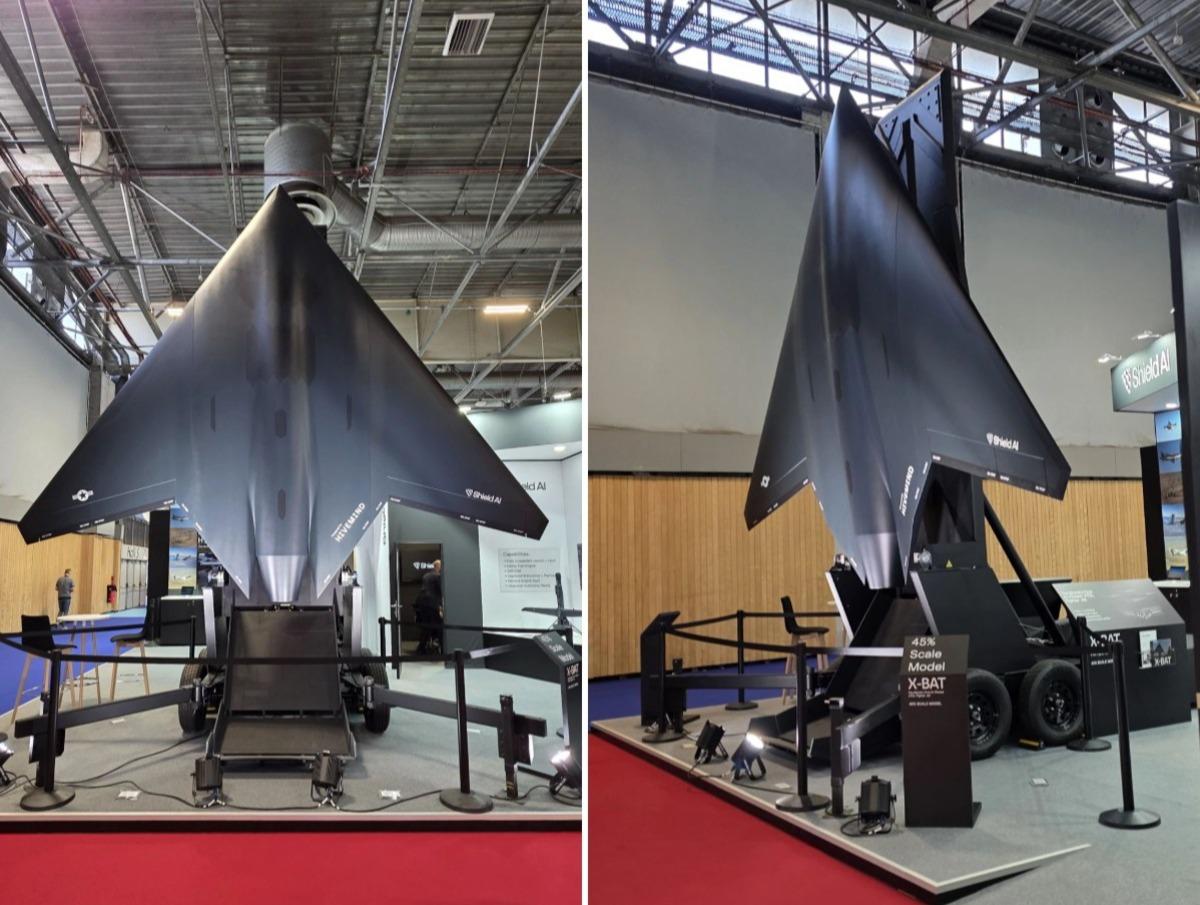
Shield AI Brings Its Runway-Free Autonomous Fighter Jet to Eurosatory
Companies Mentioned
Why It Matters
X‑BAT could redefine air‑power logistics by removing runway dependence, giving militaries rapid, distributed strike capability at a lower cost than crewed fifth‑generation fighters.
Key Takeaways
- •X‑BAT aims for first VTOL flight in 2026, mission‑ready by 2028
- •Powered by GE F110‑129 turbofan with thrust‑vectoring for vertical lift
- •Range exceeds 3,700 km (2,000 nm) with full combat payload
- •Can store three X‑BATs in space of one legacy fighter
- •Hivemind AI enables GPS‑free, jam‑resistant autonomous missions
Pulse Analysis
Shield AI’s X‑BAT represents a paradigm shift in combat aviation by marrying vertical‑take‑off‑and‑landing (VTOL) capability with autonomous, fighter‑class performance. Unveiled at Eurosatory 2026, the jet is positioned as the first AI‑piloted VTOL fighter, a niche that bridges the gap between traditional carrier‑based aircraft and the proliferating swarm of unmanned drones. Competitors such as General Atomics and Anduril are developing collaborative combat aircraft that still rely on conventional runways, leaving a strategic opening for a runway‑free platform that can operate from ships, austere islands, or forward bases.
The X‑BAT is driven by a modified GE Aerospace F110‑GE‑129 turbofan, the same powerplant that fuels F‑16 and F‑15 fighters, augmented with thrust‑vectoring nozzles to achieve vertical lift. Shield AI claims a combat‑range of over 3,700 km (2,000 nm) and a service ceiling of 15,240 m (50,000 ft), while its folding wings shrink the storage footprint to roughly one‑third of a conventional fighter. This compactness allows three X‑BATs to occupy the deck space of a single legacy jet, enabling distributed launch from a single platform and reducing vulnerability to anti‑access/area‑denial threats.
The aggressive development schedule—first VTOL flight slated for 2026 and full mission capability by 2028—signals Shield AI’s intent to capture early market share in a nascent segment of autonomous strike assets. By marketing the aircraft as affordable and attritable, the company aims to lower the cost barrier for navies and expeditionary forces that cannot afford fifth‑generation crewed fighters. If the program meets its milestones, X‑BAT could reshape procurement strategies, prompting defense budgets to allocate funds toward modular, AI‑driven fleets rather than traditional, runway‑dependent platforms.
Shield AI brings its runway-free autonomous fighter jet to Eurosatory
Comments
Want to join the conversation?
Loading comments...