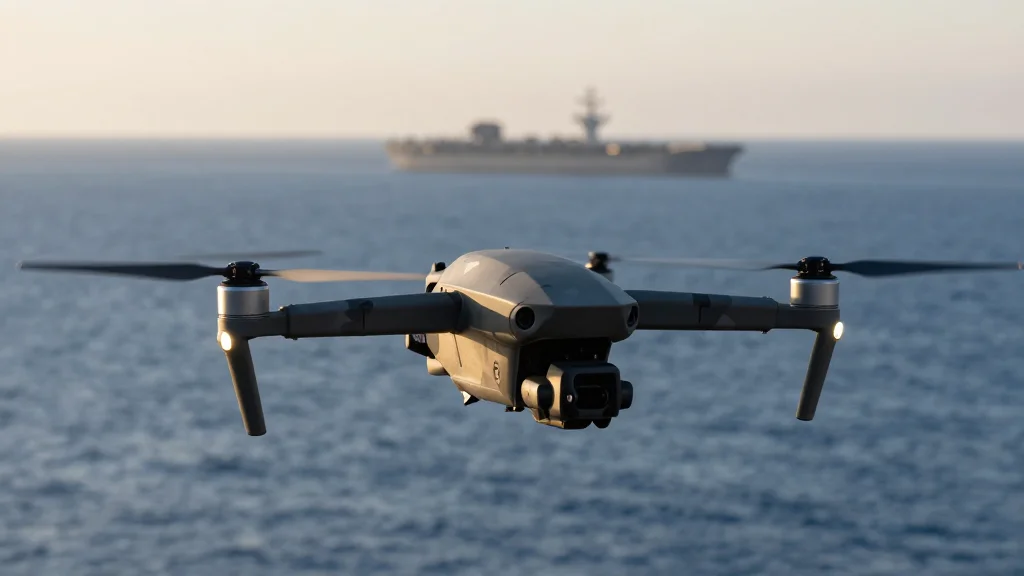
Shield AI’s V‑Bat Joins US Navy $800 Million ISR Competition

Companies Mentioned
Why It Matters
The Navy’s $800 million COCO ISR framework could redefine how the U.S. military sources and fields autonomous intelligence platforms. By moving production, sustainment and data‑processing to private contractors, the Department of Defense aims to accelerate innovation cycles, reduce manpower burdens, and embed advanced AI directly into the ISR pipeline. Success for Shield AI and its peers would validate the COCO approach, encouraging similar models in other domains such as anti‑submarine warfare and electronic surveillance. Beyond the immediate fiscal impact, the contract underscores a strategic pivot toward persistent, AI‑driven maritime situational awareness. As great‑power competition intensifies in the Indo‑Pacific, the ability to field low‑cost, continuously operating UAS that can feed real‑time sensor data to fleet commanders may become a decisive advantage. The outcome will also influence commercial UAS markets, as defense‑driven technology trickles down to civilian applications.
Key Takeaways
- •Shield AI added to U.S. Navy COCO ISR framework, competing for up to $800 million in task orders.
- •V‑Bat drone credited with intercepting 100,000 lbs of narcotics in Caribbean and Pacific operations.
- •COCO model shifts production, sustainment and data‑processing responsibilities to contractors.
- •Contract period runs from September 1, 2026 to August 31, 2031, with first task orders expected in late 2026.
- •Four companies, including AeroVironment, are currently on the framework, reflecting a broader move toward contractor‑owned ISR services.
Pulse Analysis
The Navy’s embrace of a contractor‑owned, contractor‑operated ISR framework reflects a deeper institutional shift toward leveraging commercial agility for mission‑critical capabilities. Historically, the Department of Defense has relied on traditional procurement cycles that lock in hardware specifications for years, often lagging behind rapid advances in AI and sensor technology. By outsourcing not just the platform but also the data‑processing pipeline, the Navy can iterate faster, integrate emerging algorithms, and scale capacity without the overhead of internal sustainment.
Shield AI’s selection is particularly noteworthy because the V‑Bat’s operational record demonstrates a proven ability to conduct low‑altitude, high‑tempo missions in contested environments—a key requirement for future maritime ISR where adversaries are investing heavily in electronic warfare and anti‑UAS defenses. If Shield AI secures a sizable portion of the $800 million pool, it could fund a new generation of AI‑enhanced payloads, potentially setting a benchmark for autonomous decision‑making at the edge.
However, the COCO model also introduces new risks. Contractors must now shoulder the financial burden of platform upgrades and data‑fusion infrastructure, which could strain smaller firms and accelerate market consolidation. Moreover, the Navy will need robust oversight mechanisms to ensure data integrity and security when processing sensitive ISR streams outside the traditional acquisition chain. The success—or failure—of this experiment will likely influence upcoming service‑wide initiatives, including the Air Force’s own autonomous ISR programs and the Army’s Distributed Common Ground System modernization. In short, the Shield AI V‑Bat award is a litmus test for the viability of a new procurement paradigm that could reshape the defense industrial base for years to come.
Shield AI’s V‑Bat Joins US Navy $800 Million ISR Competition
Comments
Want to join the conversation?
Loading comments...