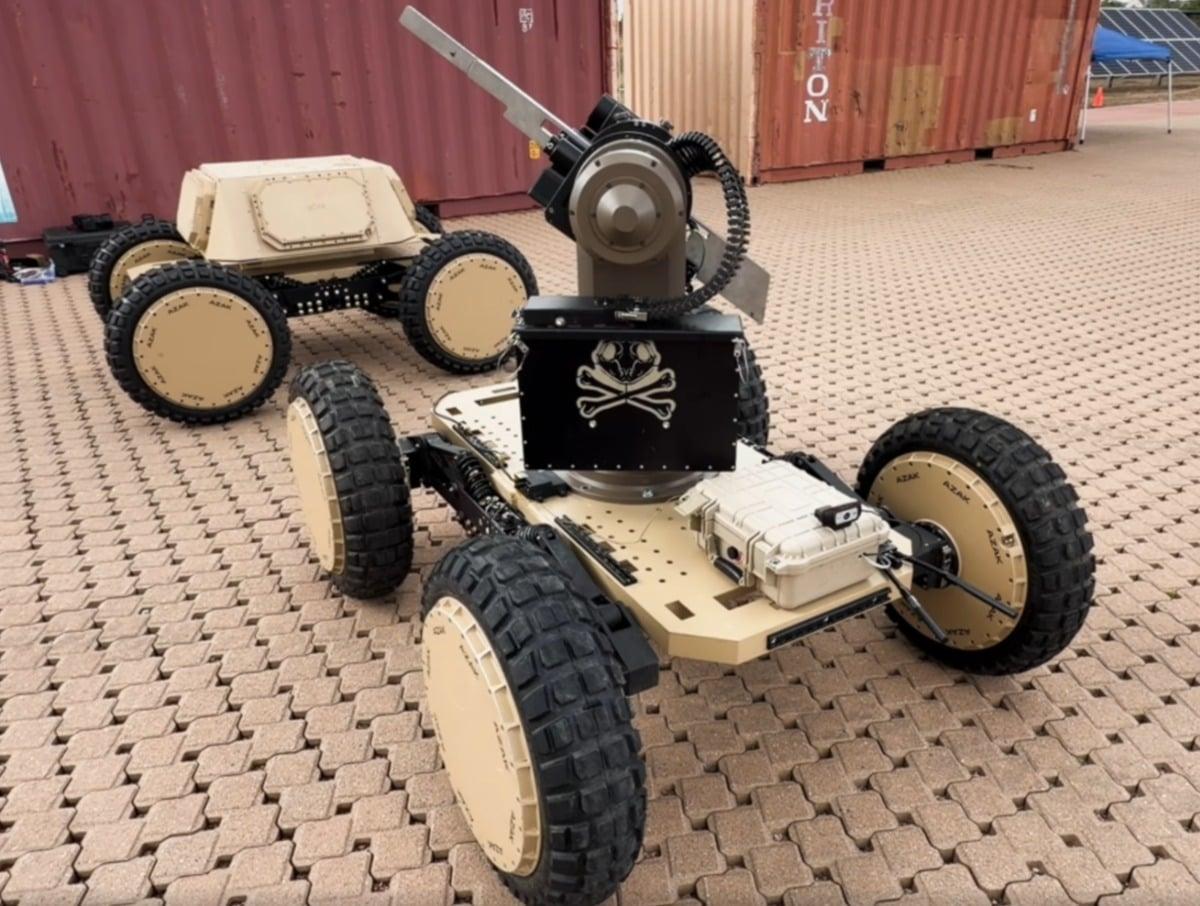
Six Companies Built an Autonomous Hunter-Killer Robot in Under a Week
Companies Mentioned
Why It Matters
The demo proves that modular, open‑architecture solutions can compress acquisition cycles, offering the Army a fast‑track path to fielding urgently needed counter‑drone capabilities.
Key Takeaways
- •Six firms built a two‑vehicle autonomous kill chain in days
- •Integration relied on software layer, not hardware redesign
- •Bullfrog weapon gives ground‑mobile, rapid counter‑drone response
- •Army leadership saw demo, signaling procurement interest
- •Modular open architecture could shave years off acquisition cycles
Pulse Analysis
Operation Jailbreak illustrates a shift from heavyweight, hardware‑first programs to lean, software‑driven integration. By leveraging a common data‑exchange backbone, the six companies sidestepped the lengthy mechanical redesigns that usually dominate defense projects. The result was a functional kill chain where a radar‑equipped UGV detects hostile drones and instantly relays targeting data to a second vehicle armed with Allen Control’s Bullfrog gun. This approach mirrors commercial rapid‑prototype practices, yet it addresses a pressing military need: countering the proliferation of small, commercial‑grade UAVs that threaten troops and assets in contested environments.
The technical architecture hinges on Anduril’s Lattice command layer, which normalizes inputs from Leonardo DRS’s ACHR radar, HavocAI’s autonomy stack, and Picogrid’s integration fabric. Lattice translates sensor feeds into actionable targeting cues, allowing the Bullfrog‑armed “Killer” to fire without a human in the loop. This decoupling of hardware and software enables each partner to contribute best‑in‑class components without redesigning the entire system, dramatically reducing integration risk. Moreover, the wheel‑centric AZAK platforms provide the mobility needed to reposition the kill chain across rugged terrain, ensuring coverage in diverse operational theaters.
For the defense acquisition community, the demonstration raises both optimism and caution. The ability to field a prototype in days suggests that future contracts could prioritize modular, open‑architecture solutions, potentially shaving years off the traditional procurement timeline. However, scaling the demo to full‑military standards will still require rigorous testing for reliability, cybersecurity, and sustainment. If the Army can institutionalize this rapid‑integration model, it may unlock faster fielding of critical capabilities, from counter‑drone systems to broader autonomous combat platforms, reshaping how the Pentagon approaches technology adoption in an era of accelerating threats.
Six companies built an autonomous hunter-killer robot in under a week
Comments
Want to join the conversation?
Loading comments...