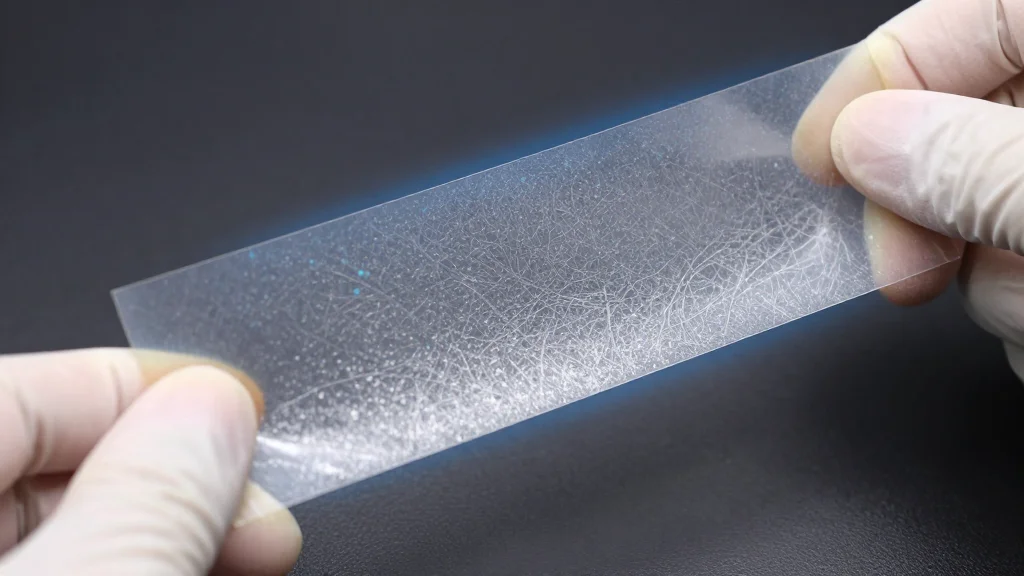
South Korean Researchers at KIST Develop an Ultrathin Composite Film
Why It Matters
By merging EMI and neutron protection into a single, lightweight film, the technology promises significant mass savings and design flexibility for satellites, compact reactors, and advanced medical devices, accelerating adoption of next‑generation high‑performance systems.
Key Takeaways
- •Ultrathin 10‑20 µm film shields EMI and neutrons simultaneously
- •BNNTs achieve ~72% neutron attenuation at 1 mm
- •PDMS stretches >125% strain, 200 cycles at 40% strain
- •3D‑printed honeycomb geometry boosts EMI shielding 10‑15% over flat film
- •Scalable large‑area production and durability testing remain hurdles
Pulse Analysis
Electromagnetic interference and neutron radiation have long forced engineers to install separate shielding solutions, inflating weight and complicating integration in satellites, nuclear reactors, and medical therapy equipment. Traditional EMI barriers rely on metals or carbon composites, while neutron protection depends on bulky boron‑rich or hydrogen‑laden materials. The dual‑threat environment of low‑Earth‑orbit platforms, compact reactor cores, and particle‑accelerator facilities demands a lighter, more adaptable approach, yet no material has yet combined both functions without sacrificing mechanical robustness.
The Korea Institute of Science and Technology’s new composite tackles that gap with a synergistic blend of single‑walled carbon nanotubes (SWCNTs) and boron nitride nanotubes (BNNTs) dispersed in a stretchable polydimethylsiloxane (PDMS) matrix. SWCNTs create a percolated conductive network that absorbs incoming electromagnetic waves, while BNNTs capture thermal neutrons via the ¹⁰B + n reaction, delivering roughly 72% attenuation at just 1 mm thickness. Printed in a honeycomb pattern, the 10‑20 µm film gains an extra 10‑15% EMI shielding efficiency, and the PDMS host endures strains over 125% and 200 cyclic loads at 40% strain across –196 °C to 250 °C, confirming durability under extreme conditions.
The implications extend across multiple high‑value sectors. Spacecraft can coat irregular antennae and sensor housings with a conformal layer that trims launch mass, while compact nuclear reactors and boron neutron capture therapy devices gain a unified protective skin, simplifying assembly and maintenance. However, moving from lab‑scale prints to industrial rolls will require uniform nanotube dispersion and large‑area manufacturing processes, plus rigorous long‑term testing under thermal cycling and mechanical fatigue. Partnerships with Korean aerospace, semiconductor, and defense firms are already being explored, positioning the technology for rapid commercialization once scalability hurdles are cleared.
South Korean researchers at KIST develop an ultrathin composite film
Comments
Want to join the conversation?
Loading comments...