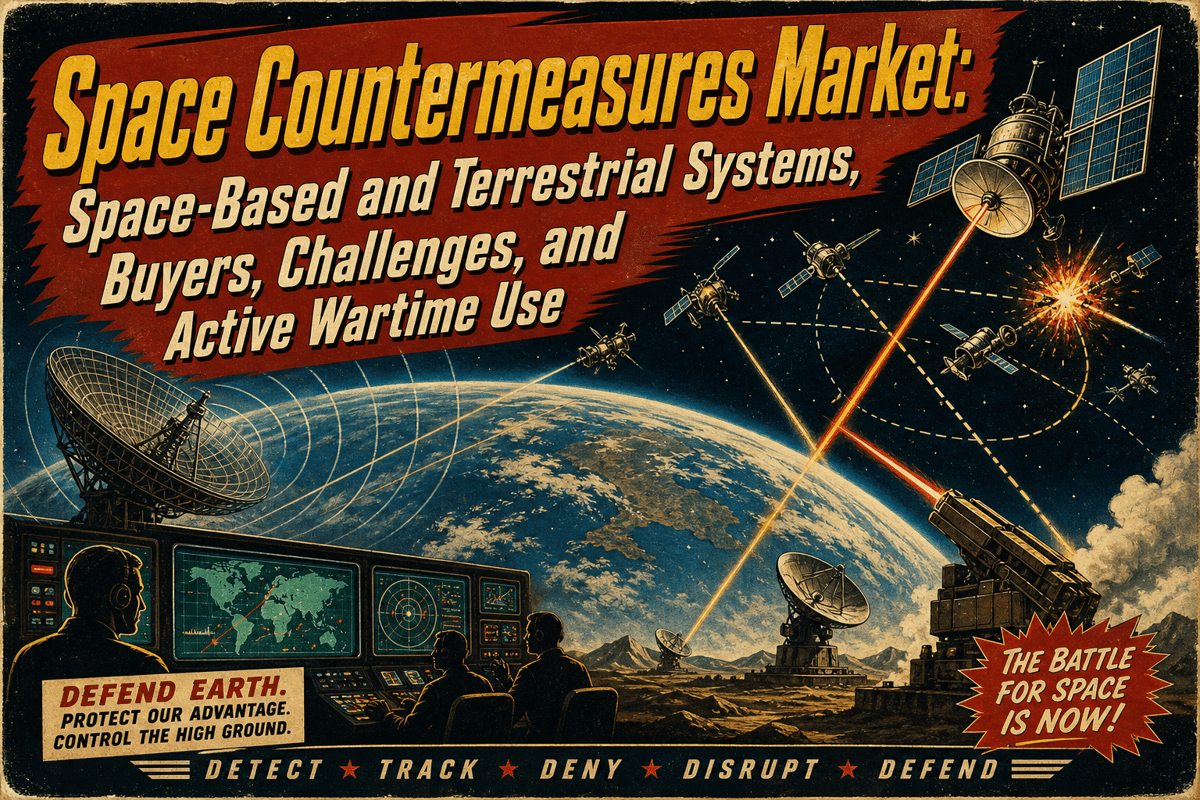
Space Countermeasures Market: Space-Based and Terrestrial Systems, Buyers, Challenges, and Active Wartime Use
Why It Matters
As societies become ever more reliant on satellite services, protecting the full space‑ground chain is essential for national security, economic stability, and resilience during conflicts.
Key Takeaways
- •Governments and militaries drive bulk demand for space countermeasure systems
- •Ukraine war highlighted reliance on commercial satellite communications and anti‑jamming tools
- •Iran conflict underscored need for resilient navigation and maritime tracking services
- •Market growth fueled by satellite‑dependent civil infrastructure like finance and energy
- •Terrestrial ground stations remain the cost‑effective focus of most spending
Pulse Analysis
The surge in space‑countermeasure spending reflects a strategic shift from purely offensive capabilities to comprehensive resilience. While traditional counter‑space systems aim to deny or degrade adversary assets, modern buyers prioritize continuity, attribution, and deterrence through redundancy, encryption, and rapid satellite replacement. This defensive posture is reinforced by the expanding role of satellite‑derived data in sectors ranging from high‑frequency trading to grid management, where a single timing glitch can cascade into multi‑billion‑dollar losses. Consequently, governments are allocating larger portions of defense budgets to hardened ground infrastructure, secure command links, and cyber‑hardening of mission software, creating a lucrative market for vendors that can blend defense‑grade assurance with commercial agility.
The Ukraine and Iran conflicts have turned abstract risk assessments into operational imperatives. In Ukraine, over 50,000 Starlink terminals were deployed, proving that commercial constellations can become lifelines for military command, civilian coordination, and humanitarian aid when terrestrial networks crumble. Simultaneously, persistent GPS jamming and spoofing have forced NATO and regional partners to invest in anti‑jamming waveforms and alternative navigation sources. Iran’s maritime and aviation sectors have faced similar pressures, prompting heightened demand for resilient satellite imagery, secure communications, and spectrum‑monitoring solutions. These wartime case studies underscore that even non‑state actors and commercial operators must plan for contested space environments.
Looking ahead, the market will likely bifurcate between high‑cost, space‑based resilience platforms—such as maneuverable inspection satellites and distributed constellations—and cost‑effective terrestrial solutions like protected ground stations, spectrum‑monitoring networks, and AI‑driven cyber‑defense suites. Private firms that can offer modular, upgradable services will capture a growing share of defense contracts, while traditional aerospace manufacturers will focus on building redundancy into new satellite buses. As regulatory frameworks evolve and the line between civilian and military satellite use blurs, investment in end‑to‑end countermeasure ecosystems will become a cornerstone of national security strategy.
Space Countermeasures Market: Space-Based and Terrestrial Systems, Buyers, Challenges, and Active Wartime Use
Comments
Want to join the conversation?
Loading comments...