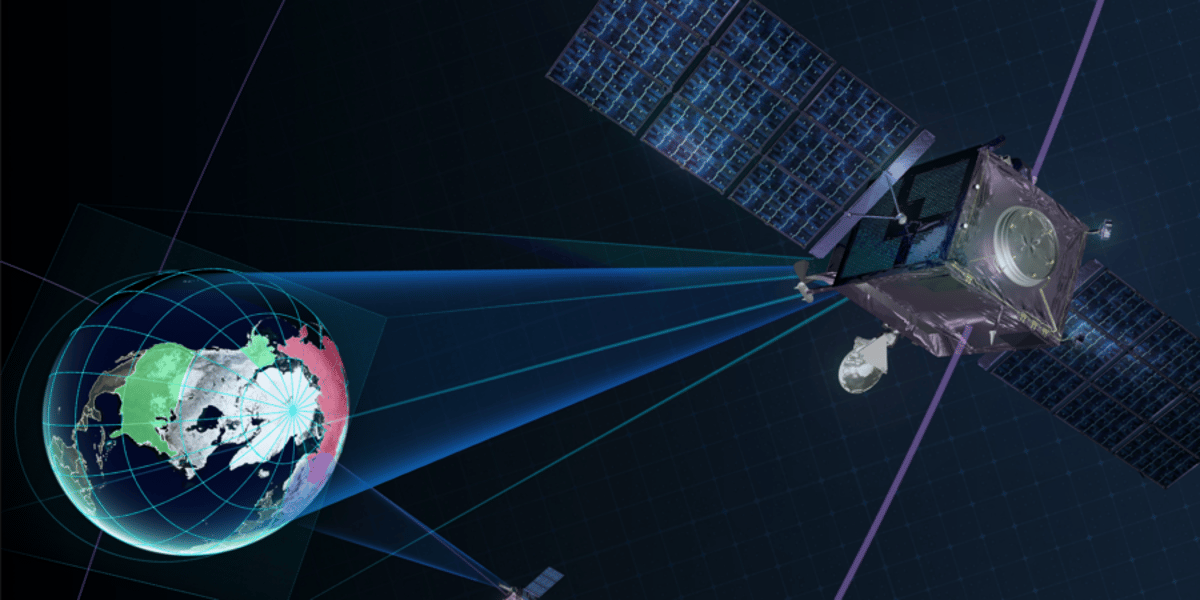
Space Force Proposes Canceling Polar Missile Warning Program
Companies Mentioned

Why It Matters
Canceling NGP demonstrates confidence in a more resilient, lower‑cost multi‑orbit missile‑warning architecture, reshaping defense procurement and accelerating deployment of next‑generation sensors.
Key Takeaways
- •Space Force seeks to cut $3.4 b polar OPIR program.
- •Northrop Grumman maintains schedule despite cancellation proposal.
- •LEO and MEO constellations slated to replace polar coverage.
- •FY27 budget adds $3.5 b for SDA’s Tranche 1 launch.
- •MEO layer funding jumps to $1.4 b, targeting 2027 launch.
Pulse Analysis
The United States’ missile‑warning posture has long relied on the legacy Space‑Based Infrared System (SBIRS) constellation, a mix of geosynchronous and polar satellites that provide persistent infrared surveillance. Over the past decade, the Space Force has experimented with a "bridging" strategy, funding both the traditional large‑bus satellites and emerging proliferated constellations. This dual‑track approach was intended to mitigate risk while the Department of Defense evaluated whether swarms of smaller, cheaper spacecraft could deliver comparable coverage. The FY27 budget request now signals a decisive pivot: the $3.4 b Next‑Generation OPIR Polar (NGP) program will be terminated, freeing resources for the Resilient Missile Warning/Missile Tracking architecture that leverages low‑Earth orbit (LEO) and medium‑Earth orbit (MEO) layers.
The cancellation carries significant implications for industry partners and congressional oversight. Northrop Grumman, the prime contractor for the two polar satellites, has publicly affirmed that development remains on schedule and on budget, suggesting that contractual obligations will be honored even as the program is shelved. Lawmakers, who have historically supported a multi‑orbit architecture, may view the move as a cost‑saving measure but will likely scrutinize the transition’s impact on national security and industrial base health. By reallocating funds to the Space Development Agency’s LEO tranche—now slated for a $3.5 b boost—and expanding the MEO layer to $1.4 b, the Space Force aims to maintain uninterrupted coverage of northern‑hemisphere missile threats while embracing a more agile, proliferated sensor network.
Looking ahead, the success of the new architecture hinges on the timely deployment of SDA’s Tranche 1 constellation, projected to field 28 LEO satellites, and the rollout of the MEO “Epoch” series beginning in 2027. Combined, these layers are expected to cost roughly $12 b through FY31, but they promise a layered, redundant shield that can survive individual satellite failures and adapt to evolving threat trajectories. If the proliferated approach delivers the promised resilience and cost efficiency, it could set a new standard for U.S. space‑based defense, influencing future acquisition strategies across the Department of Defense and potentially reshaping the global missile‑warning market.
Space Force Proposes Canceling Polar Missile Warning Program
Comments
Want to join the conversation?
Loading comments...