Why It Matters
Control of lunar‑based assets will dictate future power projection, logistics, and deterrence in the rapidly militarizing cislunar domain.
Key Takeaways
- •Lunar sensors give high‑ground view of cislunar assets.
- •In‑situ water ice enables on‑orbit refueling, extending mission life.
- •Controlling L1/L2 Lagrange points secures communication and traffic choke points.
- •US and China racing to build lunar infrastructure and defense capabilities.
- •Autonomous systems required due to one‑second Earth‑moon signal latency.
Pulse Analysis
Cislunar space is evolving from a scientific frontier into a contested arena where high‑ground observation matters as much as altitude. By deploying optical and infrared sensors on the lunar surface or in orbit, militaries gain a persistent, atmospheric‑free line of sight into regions beyond geostationary orbit—areas traditionally blind to Earth‑based radars. This expanded space‑domain awareness not only improves early‑warning against adversary satellites but also forces rivals to invest in counter‑measure technologies, accelerating a new arms race in deep‑space surveillance.
The discovery of water ice in permanently shadowed craters reshapes logistical calculus for any force operating beyond low Earth orbit. Converting lunar ice into hydrogen and oxygen creates on‑site propellant, slashing launch mass penalties and enabling frequent orbital adjustments, refueling stations, and longer mission durations. For defense planners, this translates into flexible satellite constellations, rapid response capabilities, and the ability to sustain a persistent presence without relying on costly Earth launches—an advantage that could tip the balance in future conflict scenarios.
Control of the Earth‑Moon Lagrange points, especially L1 and L2, adds a geometric layer to strategic dominance. These gravitational sweet spots require minimal station‑keeping fuel, making them ideal for communication relays, navigation beacons, and even autonomous weapon platforms that can monitor traffic through the lunar gateway. While the Outer Space Treaty bars overt militarization, dual‑use infrastructure and safety‑zone concepts blur the line, prompting nations to embed defensive postures within civilian projects. As the United States, China, and emerging commercial players race to operationalize lunar bases and refueling depots, the architecture established by the mid‑2020s will define the power structure of deep‑space security for decades.
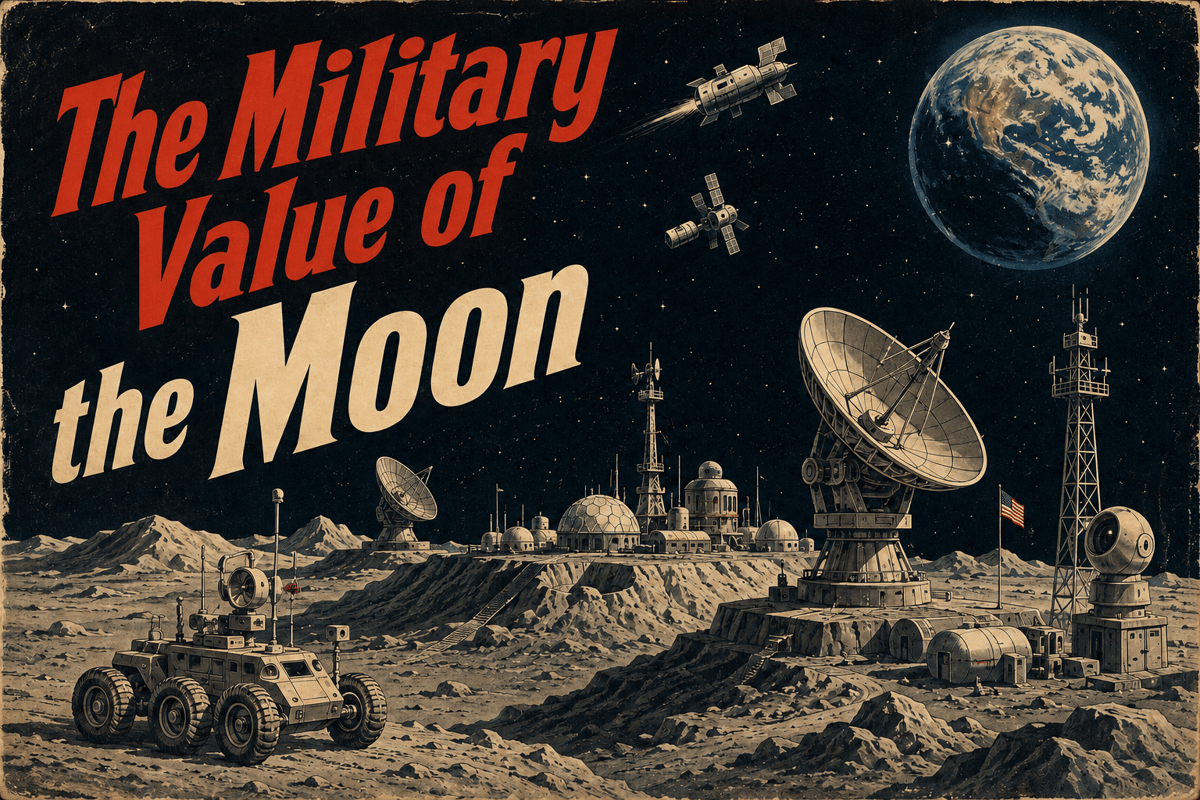
The Military Value of the Moon
Comments
Want to join the conversation?
Loading comments...