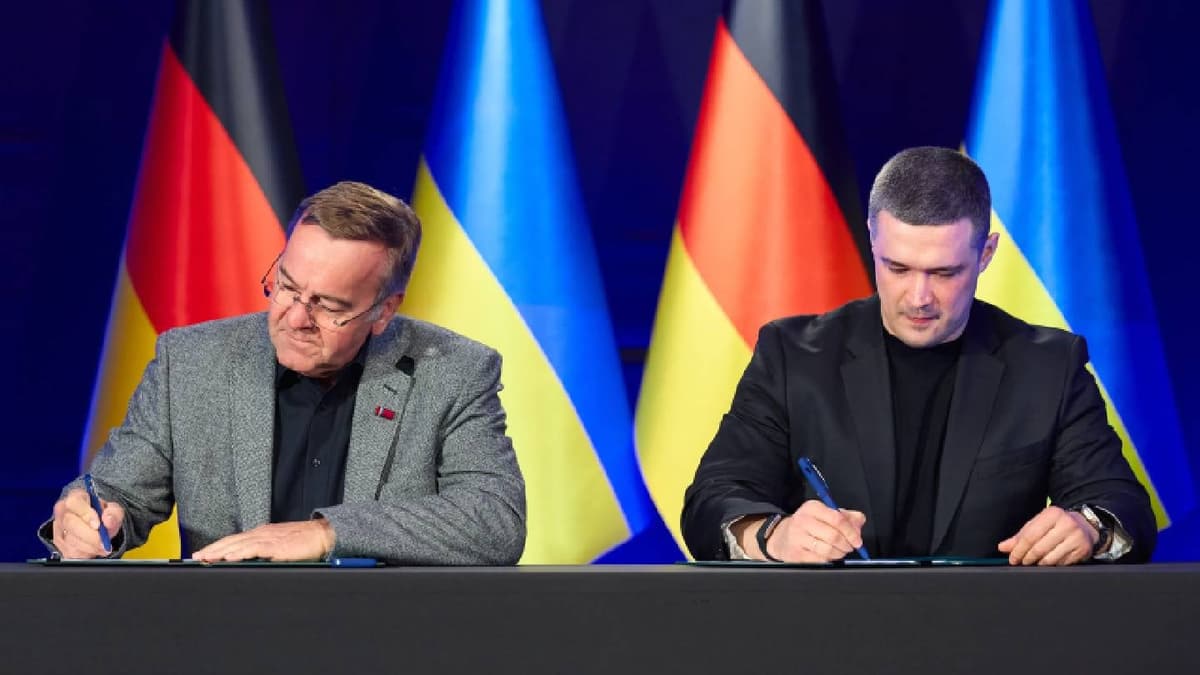
Ukraine and Germany Sign LoI for Joint Defence Tech Development
Why It Matters
The collaboration accelerates Ukraine’s access to cutting‑edge defence solutions while positioning Germany as a hub for European security innovation, strengthening collective deterrence against Russian aggression.
Key Takeaways
- •Brave Germany will fund Ukrainian and German defence startups.
- •Focus areas include AI, drones, lasers, missiles, and communications.
- •Germany has already pledged over $1 bn for deep‑strike capabilities.
- •Joint projects will analyze PzH 2000, RCH 155, and IRIS‑T systems.
Pulse Analysis
The signing of the Brave Germany letter of intent marks a deepening of Kyiv’s defence partnership with Berlin at a time when Ukraine’s survival hinges on rapid technological adaptation. By pooling resources, the two nations aim to accelerate the development of systems that can counter Russia’s increasingly sophisticated arsenal, from swarm drones to hypersonic missiles. The initiative also signals a broader European shift toward joint research, aligning with NATO’s push for interoperable capabilities and reinforcing the continent’s collective deterrence posture.
Brave Germany will channel grant funding into both Ukrainian and German start‑ups operating in artificial intelligence, unmanned platforms, laser weapons and advanced communications. By targeting early‑stage innovators, the programme hopes to shorten the prototype‑to‑field timeline that traditionally stalls defence procurement. Successful pilots could yield modular AI‑driven command networks, low‑observable drone swarms or compact directed‑energy systems that are cheaper to produce than legacy hardware. The cross‑border collaboration also offers startups access to Germany’s industrial supply chain and Ukraine’s real‑world combat testing environment, creating a feedback loop that accelerates iteration.
Germany’s commitment of more than $1 billion to deep‑strike and middle‑strike capabilities underscores its intent to stay at the forefront of European defence innovation. The joint analysis of platforms such as the PzH 2000, RCH 155 and IRIS‑T not only enhances Ukraine’s artillery and air‑defence readiness but also creates export‑ready technologies for allied markets. As other EU members observe the tangible benefits of shared R&D, the Brave Germany model could catalyze a continent‑wide network of defence clusters, driving economic growth while bolstering collective security against emerging threats.
Ukraine and Germany sign LoI for joint defence tech development
Comments
Want to join the conversation?
Loading comments...