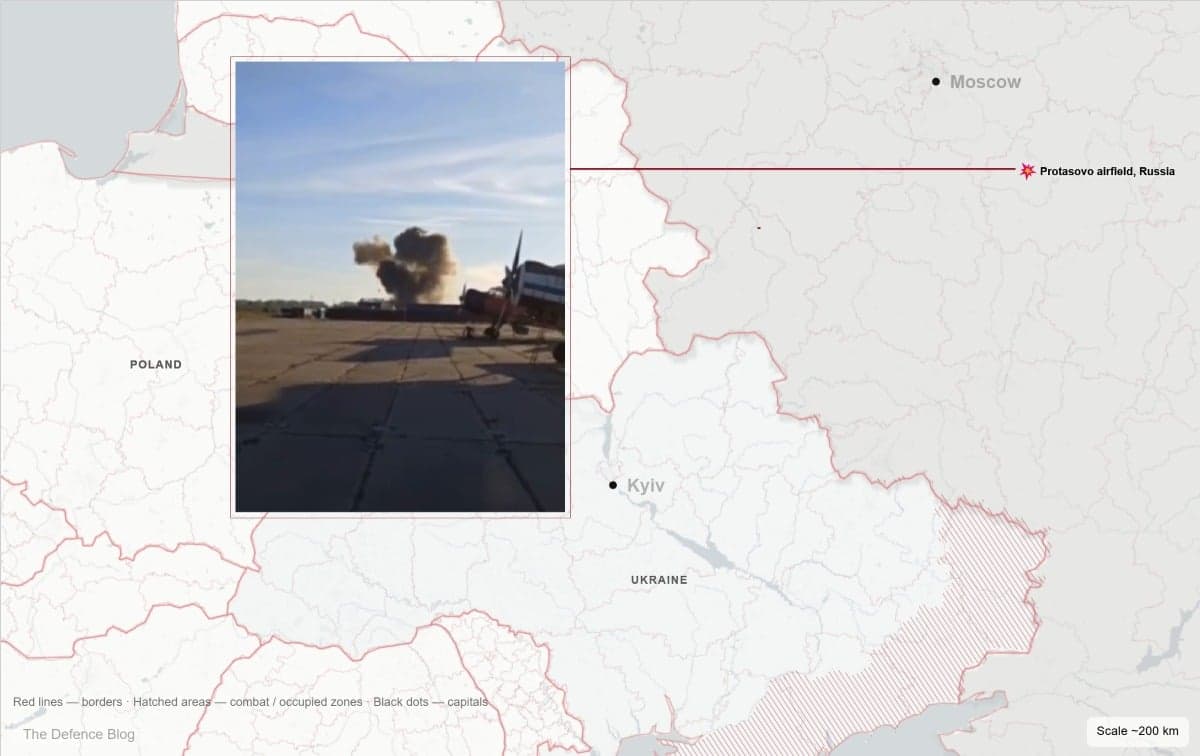
Ukraine Hit Russian Drone Factory Hidden Near Moscow
Why It Matters
Disrupting Protasovo could slow Russia’s mass production of attack drones, reducing the volume of nightly strikes on Ukrainian cities and altering the aerial balance of the war.
Key Takeaways
- •Ukrainian FP‑1 drone struck Protasovo hangars 180 km southeast of Moscow
- •Protasovo centre opened Aug 2023 to boost Russia’s drone production
- •Ukraine’s long‑range strike aims to cripple Russia’s UAV manufacturing network
- •Russia plans to produce 7.3 million FPV drones in 2026
- •Damage assessment pending; independent verification still lacking
Pulse Analysis
Ukraine’s deep‑strike capability has matured beyond short‑range loitering munitions, with the FP‑1 fixed‑wing drone emerging as a reliable platform for medium‑range, precision attacks. Developed by Fire Point, the FP‑1 can travel several hundred kilometres, allowing Kyiv to target strategic assets far beyond the front line. The Protasovo strike demonstrates how open‑source intelligence and indigenous UAV technology combine to extend Ukraine’s operational reach, challenging the conventional notion that only Western‑supplied systems can hit deep Russian targets.
The Protasovo airfield houses a research and production hub that Russia launched as part of a broader strategy to decentralise and accelerate drone manufacturing. By 2026 Moscow aims to churn out 7.3 million FPV drones, a figure that underpins its nightly barrage of Shahed‑type UAVs against Ukrainian cities. Hitting the facility not only threatens current output but also disrupts the engineering pipeline, component supply chains, and talent development that sustain future generations of Russian unmanned systems. Prior strikes in Kaluga and Sergiev Posad illustrate a systematic campaign to erode the industrial backbone of Russia’s aerial offensive.
If Ukraine can consistently degrade Russian drone production sites, the balance of power in the sky could shift. Fewer Russian drones would mean reduced saturation attacks, giving Ukrainian air defenses breathing room and potentially lowering civilian casualties. Moreover, the success of home‑grown strike drones like the FP‑1 signals a broader trend: nations are increasingly fielding indigenous long‑range UAVs to conduct strategic sabotage, reshaping modern warfare where airpower can be projected without traditional bomber fleets. This evolution may accelerate a global race for autonomous strike capabilities, compelling both sides to invest heavily in counter‑UAV technologies and hardened production facilities.
Ukraine hit Russian drone factory hidden near Moscow
Comments
Want to join the conversation?
Loading comments...