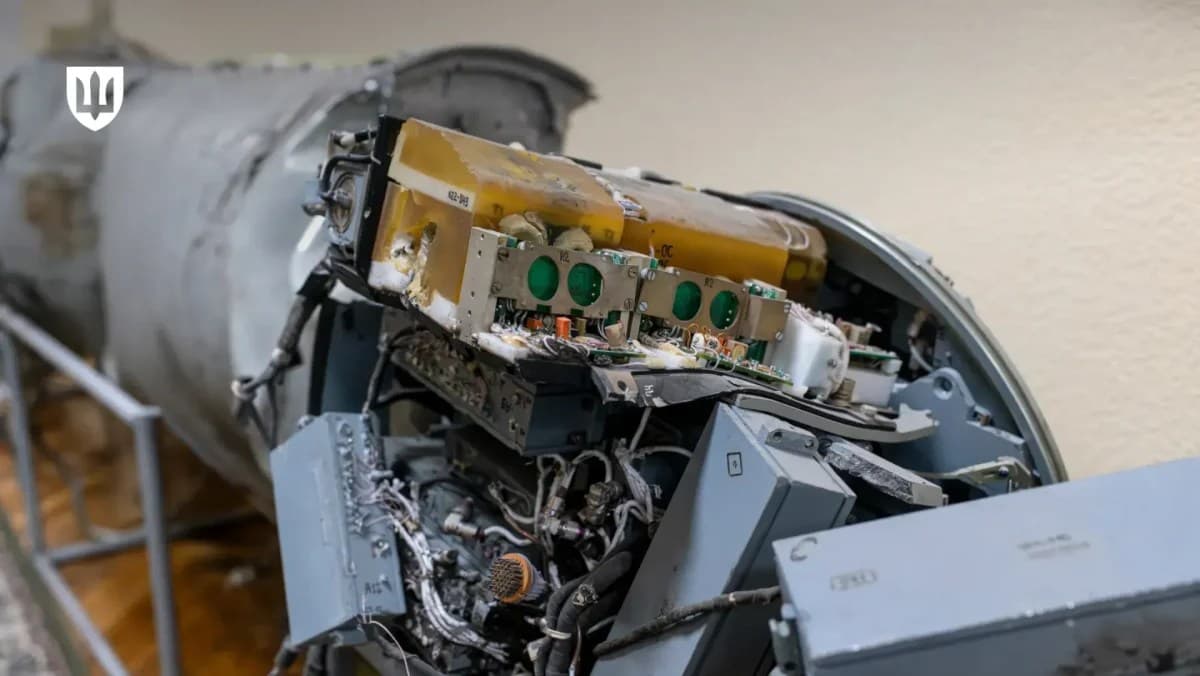
Ukraine Tears Down Russian Kalibr Cruise Missile: Exposes 80-90% Foreign Components Despite Sanctions
Companies Mentioned

Why It Matters
The findings reveal that Western‑origin parts continue to fuel Russia’s long‑range strike capability, undermining sanctions effectiveness and escalating civilian risk from newly added cluster munitions.
Key Takeaways
- •Kalibr guidance electronics 80‑90% foreign‑made, per Ukrainian analysis
- •Components trace to China, Turkey, UAE, India, and Hong Kong
- •Missile now fitted with cluster warhead, expanding impact area
- •Sanctions loopholes allow Western parts into Russian weapons
- •Kalibr shares modules with Iskander and Bastion missile systems
Pulse Analysis
The Ukrainian Ministry of Defence’s forensic teardown of a Kalibr 3M14 cruise missile provides a rare glimpse into the supply chain that sustains Russia’s long‑range strike arsenal. By cataloguing each circuit board and identifying manufacturer markings, analysts confirmed that the majority of the missile’s guidance suite—GPS, inertial, altimeter and terminal radar components—originates outside Russia. This discovery underscores how sophisticated export‑control regimes have been circumvented, with parts flowing through intermediaries in China, Turkey, the United Arab Emirates, India and Hong Kong. The persistence of such foreign inputs, even after intensified sanctions following the 2022 invasion, signals a need for tighter coordination among allied governments and more aggressive interdiction of illicit procurement networks.
For policymakers, the Kalibr case illustrates a broader vulnerability in the global defense supply chain: commercial off‑the‑shelf electronics can be repurposed for advanced weaponry with minimal modification. The Ukrainian report notes that Russia’s attempt to replace these parts with domestically produced equivalents in 2023‑24 fell short, prompting a re‑adoption of proven foreign components. This reality challenges the assumption that sanctions alone can starve a modern military of critical technology. Strengthening end‑user verification, expanding intelligence sharing, and imposing secondary sanctions on entities that facilitate these transfers are essential steps to close the loopholes that keep Russian missiles operational.
Beyond the technical and geopolitical dimensions, the addition of a cluster‑type warhead to the Kalibr marks a troubling escalation in the conflict’s humanitarian impact. Cluster munitions disperse dozens to hundreds of sub‑munitions, increasing the likelihood of civilian casualties and leaving dangerous unexploded ordnance long after hostilities cease. Their use contravenes the 2008 Convention on Cluster Munitions, which, while not signed by Russia, remains a benchmark for international norms. The modification expands the missile’s destructive radius, enabling attacks on dispersed targets such as airfields and urban infrastructure, and raises the specter of higher civilian tolls. As the war continues, the Kalibr’s evolution highlights the intersection of sanction evasion, advanced weaponry, and the urgent need for stronger legal and diplomatic mechanisms to curb the proliferation of indiscriminate armaments.
Ukraine Tears Down Russian Kalibr Cruise Missile: Exposes 80-90% Foreign Components Despite Sanctions
Comments
Want to join the conversation?
Loading comments...