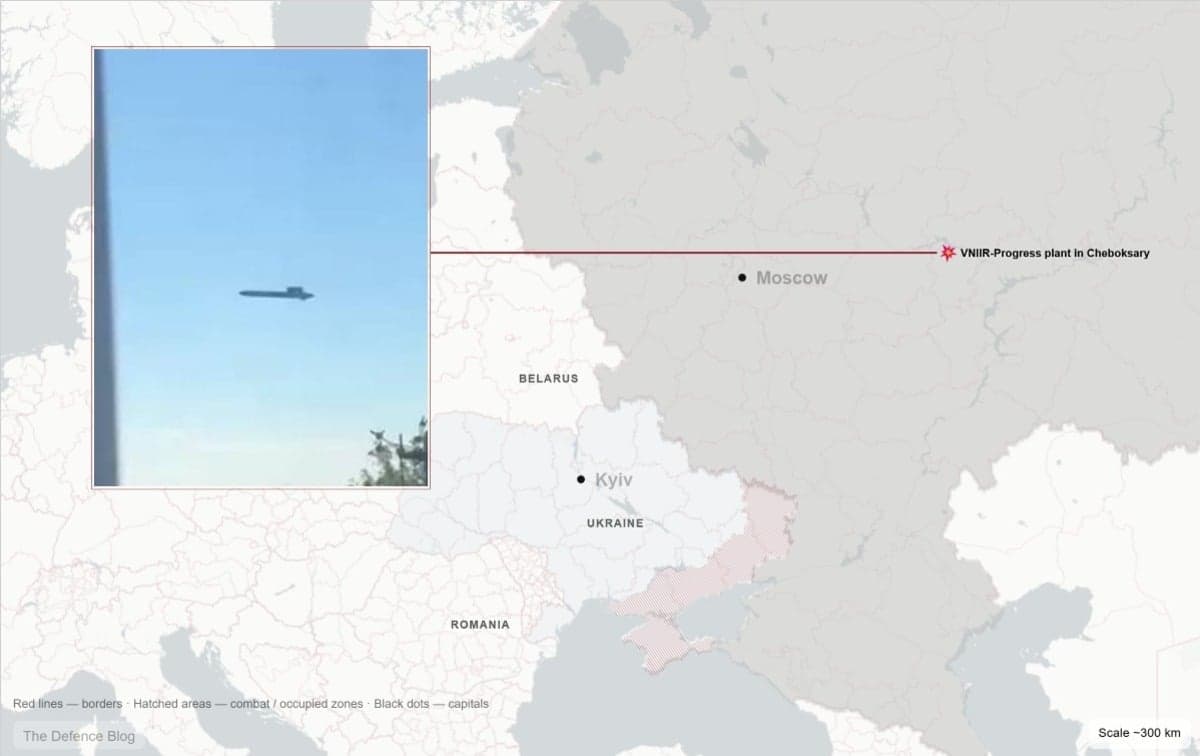
Ukrainian Cruise Missiles Hit Russian Weapons Factory in Cheboksary
Why It Matters
Repeated hits on a key component supplier erode Russia’s ability to sustain high‑precision weapons, forcing costly adjustments to its production network and bolstering Ukraine’s strategic leverage in the conflict.
Key Takeaways
- •FP‑5 Flamingo missiles struck Cheboksary factory again within five weeks
- •Plant supplies anti‑jamming modules for Shahed drones and guided bombs
- •Attack highlights Ukraine’s growing long‑range strike reach into Russia
- •Repeated hits may force Russia to relocate defense production eastward
- •Each strike adds logistical costs and strategic pressure on Russian war effort
Pulse Analysis
Ukraine’s FP‑5 Flamingo missile, a road‑mobile system unveiled in late 2025, has quickly moved from prototype to battlefield. Developed by the private firm Fire Point, the missile’s 1,000‑kilogram warhead and autonomous navigation allow it to travel roughly 1,000 km, reaching deep into Russian territory without reliance on fixed launch sites. Its recent deployment at the SAHA Expo in Istanbul signals an ambition to export the technology, but its combat debut—first against the Votkinsk plant and now the Cheboksary VNIIR‑Progress facility—demonstrates a rapid operational maturation that challenges Russia’s traditional air‑defense perimeter.
The Cheboksary plant is a linchpin in Russia’s high‑precision warfare ecosystem. It produces the Kometa‑M anti‑jamming antenna modules that keep Shahed loitering munitions and guided bombs on target, as well as electronics for Yasen‑M nuclear submarines and the S‑300/400/500 air‑defense suites. By disabling the factory, Ukraine not only disrupts current weapon deliveries but also hampers future production cycles, potentially delaying upgrades to existing platforms. The lingering fire and blocked streets indicate a significant operational setback, forcing Russian engineers to scramble for spare parts or shift output to alternate sites.
Strategically, the repeated deep‑strike capability forces Moscow to reconsider the geography of its defense industry. Relocating critical lines eastward would increase logistical burdens, raise costs, and dilute the concentration of expertise that underpins Russia’s weapons complex. Moreover, each successful hit validates Ukraine’s doctrine of targeting supply‑chain nodes rather than front‑line units, a shift that could reshape the broader conflict by eroding Russia’s capacity to sustain prolonged high‑intensity operations. As Ukraine refines its long‑range arsenal, the pressure on Russia’s industrial resilience is set to intensify, with implications for global arms markets and regional security calculations.
Ukrainian cruise missiles hit Russian weapons factory in Cheboksary
Comments
Want to join the conversation?
Loading comments...