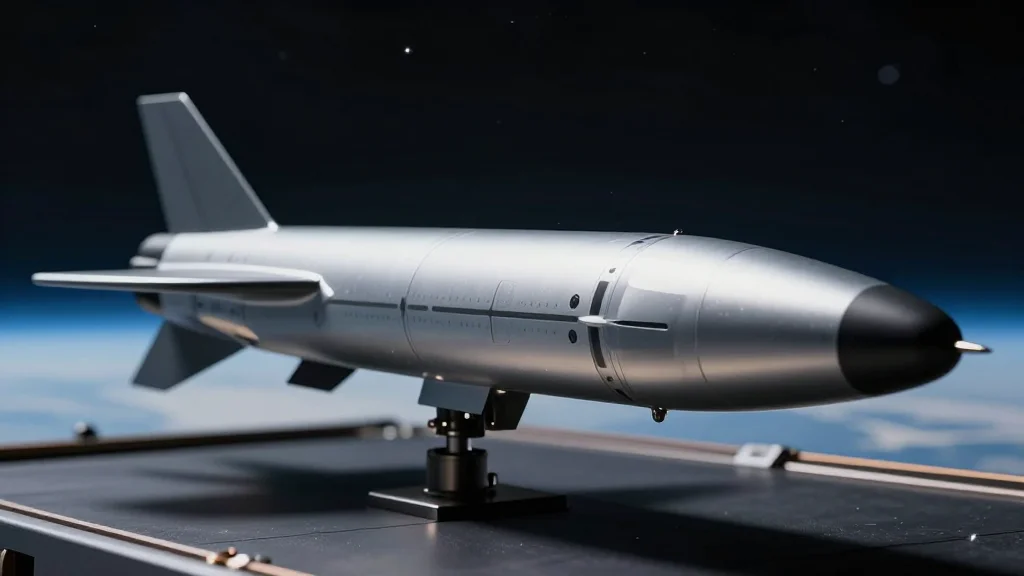
U.S. Air Force Unveils NGI Kinetic Interceptor to Destroy ICBMs in Space

Companies Mentioned
Why It Matters
NGI represents a fundamental evolution in missile defense by moving the intercept point into space and using kinetic impact rather than explosives. This reduces the window for adversary counter‑measures and improves the probability of destroying sophisticated ICBM warheads that employ decoys and maneuverable re‑entry vehicles. The system’s digital‑twin development cycle accelerates testing, potentially shortening the time to field a reliable solution. If NGI proves successful, it could reshape the strategic balance by strengthening the United States’ ability to defend against long‑range nuclear threats, thereby influencing deterrence calculations for Russia and China. The technology also promises spillover benefits for commercial hypersonic and high‑energy systems, expanding the defense industrial base and creating new markets for advanced materials and AI‑driven guidance solutions.
Key Takeaways
- •U.S. Air Force unveiled the Next Generation Interceptor (NGI), a kinetic‑kill missile for exo‑atmospheric ICBM defense.
- •Lockheed Martin developed NGI, featuring multiple kill vehicles and autonomous decoy discrimination.
- •Digital‑twin simulations enable extensive performance modeling before live testing.
- •NGI will be housed in underground silos, allowing upgrades without removal from the vault.
- •Full operational capability is targeted for the early 2030s, with flight tests slated for later 2026.
Pulse Analysis
The NGI program reflects a broader pivot in U.S. defense strategy toward hypersonic and kinetic solutions that can operate in the contested domain of space. Historically, missile defense relied on explosive warheads that detonated near a target, a method vulnerable to sophisticated penetration aids. By embracing kinetic impact, the United States is betting on precision engineering and AI‑driven guidance to outpace adversary counter‑measures. This mirrors trends in commercial aerospace, where digital twins and rapid prototyping have shortened development cycles.
From a market perspective, NGI could catalyze a new wave of investment in high‑temperature composites, advanced sensors, and autonomous decision‑making software. Companies that can supply these components may see accelerated contracts, while traditional explosives manufacturers could face reduced demand. Geopolitically, a reliable exo‑atmospheric kinetic interceptor would reinforce U.S. deterrence, potentially prompting Russia and China to accelerate their own space‑based defense initiatives, raising the stakes for an emerging arms race in near‑Earth space.
Looking ahead, the success of NGI will depend on proving its autonomous target‑identification algorithms against increasingly complex decoy fields. If the system can reliably differentiate real warheads from sophisticated false targets, it will set a new benchmark for missile defense. Conversely, any failure to demonstrate consistent kill rates could undermine confidence in kinetic approaches and push policymakers to reconsider alternative concepts such as directed‑energy interceptors or space‑based sensors. The next few years of testing will therefore be critical not only for NGI’s deployment timeline but also for the strategic direction of U.S. missile defense architecture.
U.S. Air Force Unveils NGI Kinetic Interceptor to Destroy ICBMs in Space
Comments
Want to join the conversation?
Loading comments...