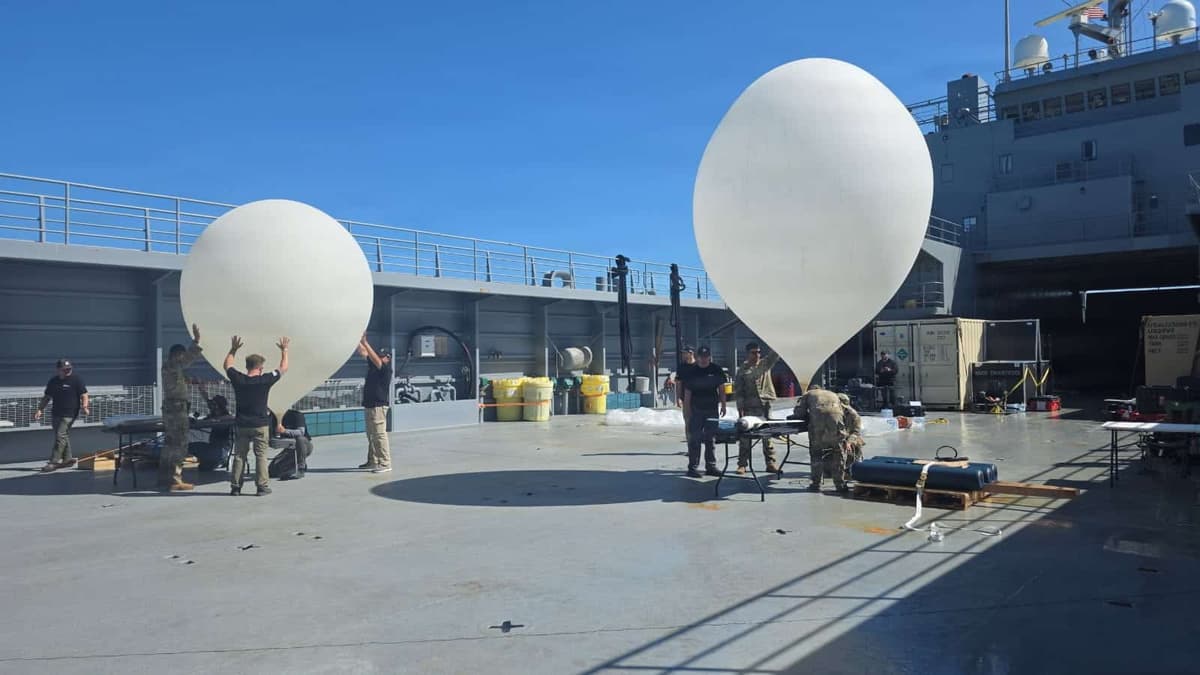
U.S. Army Landing Craft Launches Drone-Dropping High-Altitude Balloons
Companies Mentioned
Why It Matters
The test proves that low‑cost, rapidly deployable balloon platforms can deliver both intelligence and strike options, filling critical communication gaps for U.S. forces operating across vast theaters like the Pacific and Middle East.
Key Takeaways
- •Six micro‑high‑altitude balloons launched from a landing craft off Morocco
- •Balloons carried one‑way attack drones and satellite‑linked communication relays
- •Tested by USSOCOM to give Special Ops persistent ISR and strike
- •Deployable by small teams, extending reach in contested Pacific or Middle‑East environments
- •Demonstrated 100% target‑hit rate, proving kinetic effect viability
Pulse Analysis
The U.S. military’s renewed focus on high‑altitude balloons marks a strategic pivot from the 2023 Chinese surveillance incident that exposed vulnerabilities in airspace monitoring. Since then, the Pentagon has accelerated field‑testing of both large, ocean‑spanning platforms and compact micro‑balloons that can be launched from ships, trucks, or even handheld kits. These stratospheric assets operate above 60,000 feet, out of reach of most conventional air defenses, and provide a low‑cost, persistent presence for intelligence gathering, communications relay, and even kinetic effects. The recent trials underscore how balloons are evolving from passive sensors to active combat tools.
During the African Lion 26 exercise off Morocco, a U.S. Army landing craft deployed six micro‑high‑altitude balloons equipped with Mach Industries’ launch‑effect and satellite‑communication suite. Each balloon carried a one‑way attack drone and a relay node that extended line‑of‑sight beyond the horizon, delivering real‑time video and data to ground operators. The system proved its strike capability, with all payloads hitting designated targets, while simultaneously furnishing ISR coverage for Special Operations forces operating in contested environments such as the Pacific or the Middle East. The modular design allows a four‑person team to field the system within minutes, dramatically expanding the Army’s reach.
The successful demonstration signals a broader doctrinal shift toward “persistent local situational awareness” as a cornerstone of future expeditionary operations. By marrying low‑observable balloons with satellite links and expendable drones, the Army can project power without relying on vulnerable forward bases or expensive aircraft. Analysts anticipate integration with existing network‑centric architectures, enabling seamless handoff to joint air, sea, and cyber assets. However, challenges remain, including deconfliction with civilian air traffic and the need for robust command‑and‑control safeguards. If these hurdles are addressed, micro‑balloon platforms could become a staple of U.S. force projection in the 2030s.
U.S. Army Landing Craft Launches Drone-Dropping High-Altitude Balloons
Comments
Want to join the conversation?
Loading comments...