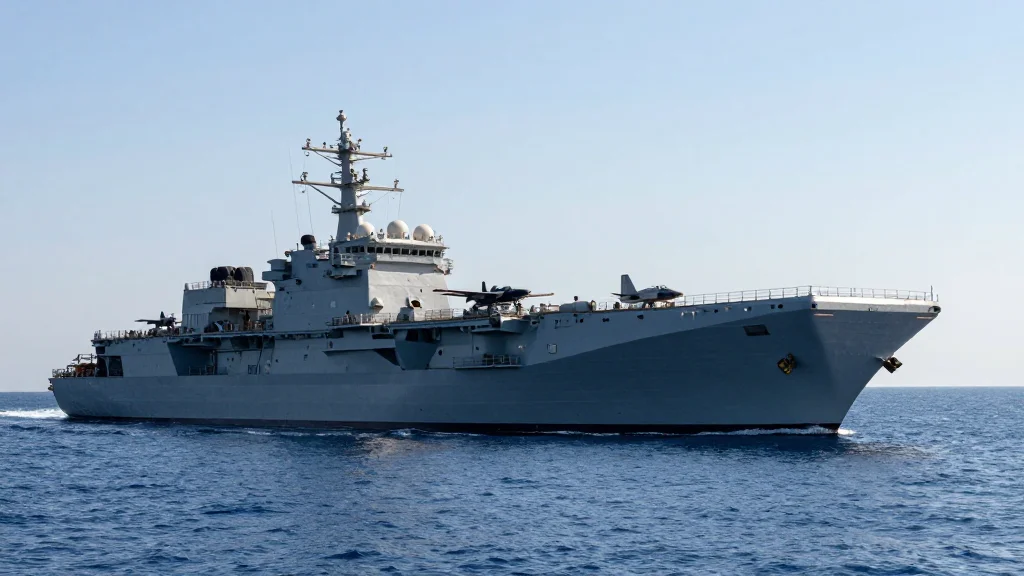
US Central Command Denies IRGC Missile Strikes on USS Tripoli
Why It Matters
The denial preserves U.S. naval credibility and deters escalation, while exposing the IRGC’s use of unverified claims to influence perception in a volatile theater.
Key Takeaways
- •CENTCOM denies IRGC missile strike claims on USS Tripoli.
- •Tripoli remains operational in Arabian Sea supporting Epic Fury.
- •IRGC also claimed attacks on Israeli cargo ship and carrier.
- •USS Tripoli can launch MV‑22s and F‑35Bs.
- •No evidence of damage; US maintains regional naval presence.
Pulse Analysis
The arrival of the amphibious assault ship USS Tripoli (LHA‑7) in the Arabian Sea marks the latest escalation of U.S. naval activity under Operation Epic Fury, a campaign launched to deter Iranian aggression and protect commercial shipping lanes in the Strait of Hormuz. Tripoli, the flagship of the Tripoli Amphibious Ready Group and the 31st Marine Expeditionary Unit, carries roughly 3,500 sailors, marines, MV‑22 tilt‑rotor aircraft and F‑35B fighters, providing a versatile platform for power‑projection and humanitarian missions. Its advanced gas‑turbine propulsion and electric distribution system give it a speed advantage and operational flexibility that are critical in a contested maritime environment.
Iran’s Islamic Revolutionary Guard Corps quickly countered the deployment with a series of unverified missile‑strike claims, alleging hits on Tripoli, an Israeli cargo vessel and even the carrier USS Abraham Lincoln. CENTCOM’s swift denial, backed by satellite and radar data, underscores the growing role of information warfare in the region, where each side seeks to shape perception as much as battlefield reality. Analysts view the IRGC’s statements as an attempt to project strength domestically and internationally, despite a lack of corroborating evidence, raising concerns about escalation driven by propaganda rather than kinetic actions.
For the U.S. Navy, the episode reinforces the importance of transparent communication and real‑time intelligence sharing to counter misinformation. Maintaining an active presence with high‑visibility assets like Tripoli deters hostile actions while reassuring allies and commercial partners of continued security guarantees. Looking ahead, the United States is likely to sustain or even expand its forward‑deployed forces in the Persian Gulf, integrating newer platforms such as the America‑class amphibious assault ships to ensure a credible deterrent against any future IRGC missile threats.
US Central Command denies IRGC missile strikes on USS Tripoli
Comments
Want to join the conversation?
Loading comments...