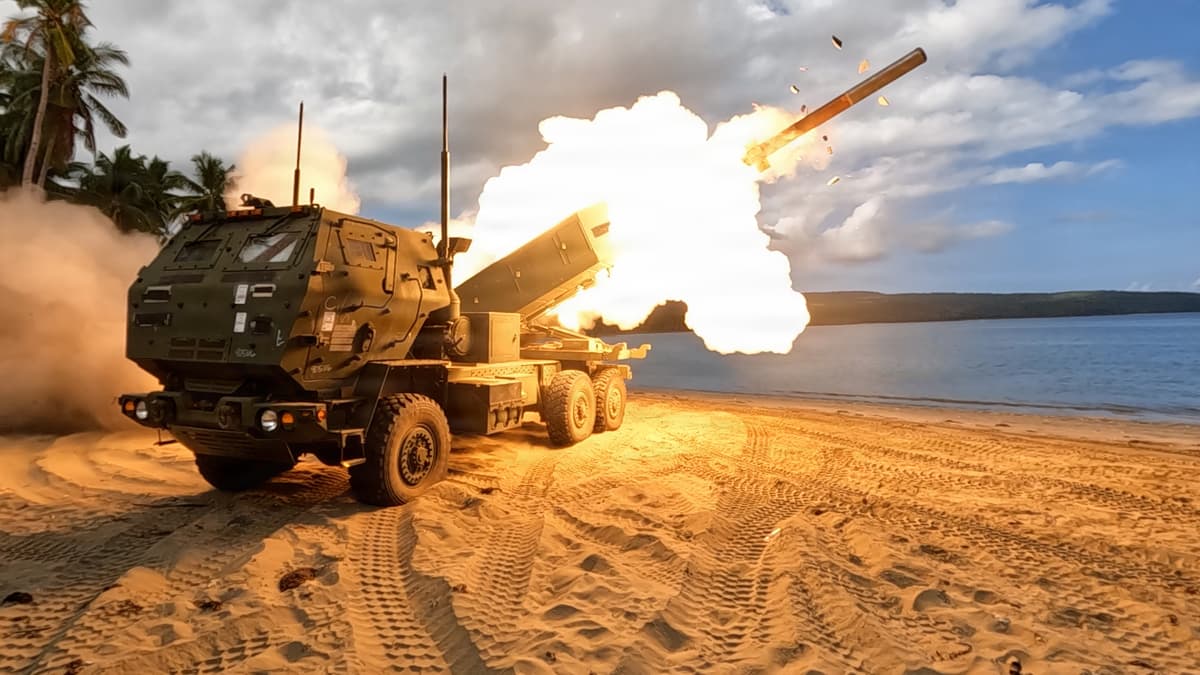
US Marines Help Gun Down Beach Invaders in Simulated Philippines Defense
Why It Matters
The drill demonstrates tangible interoperability among U.S. and regional partners, reinforcing deterrence against potential aggression in the South China Sea and signaling a united commitment to a rules‑based maritime order.
Key Takeaways
- •Balikatan 2026 involved ~17,000 troops from seven nations
- •US Marines used HIMARS, jets, and drones in live‑fire drill
- •Exercise showcased integrated amphibious defense against potential Chinese aggression
- •Philippine forces highlighted importance of West Philippine Sea security
- •China dispatched a four‑ship task force to monitor the drills
Pulse Analysis
Exercise Balikatan, the annual U.S.–Philippines joint war game, entered its 2026 edition on April 27 with a dramatic counter‑landing scenario on Palawan’s western coast. More than 500 troops from the United States, Australia, New Zealand and the Philippines dug in behind palm‑frond camouflaged foxholes to repel a simulated amphibious assault, while the broader drill involves roughly 17,000 personnel from seven nations through May 8. The chosen beach faces the contested West Philippine Sea, making the live‑fire demonstration a clear signal of collective resolve to protect the archipelago’s exclusive economic zone.
U.S. Marine Rotational Force‑Darwin, represented by 1/5 Marines, deployed a full spectrum of firepower: HIMARS rockets, fighter‑jet bombs, 105 mm howitzers, 81 mm mortars, Javelin and TOW missiles, and a first‑person‑view drone laden with explosives. Marine commanders highlighted that the drill’s value lies not only in showcasing individual weapons but in proving the seamless integration of air, land and unmanned systems across allied forces. Such interoperability reinforces the Marine Corps’ global readiness pledge and demonstrates that allied troops can coordinate complex defensive operations under real‑time combat conditions.
The exercise unfolded against a backdrop of rising tension in the South China Sea, where Beijing’s expansive maritime claims and island fortifications have heightened regional insecurity. In response, the People’s Liberation Army’s Southern Command dispatched a four‑ship task force, including a Dongdiao‑class intelligence vessel, to monitor the drills without direct confrontation. While the Philippines emphasized a rules‑based order, the presence of Chinese surveillance underscores the strategic contest for influence. Observers see Balikatan 2026 as a deterrent benchmark, signaling that the United States and its partners remain committed to a free and open Indo‑Pacific.
US Marines help gun down beach invaders in simulated Philippines defense
Comments
Want to join the conversation?
Loading comments...