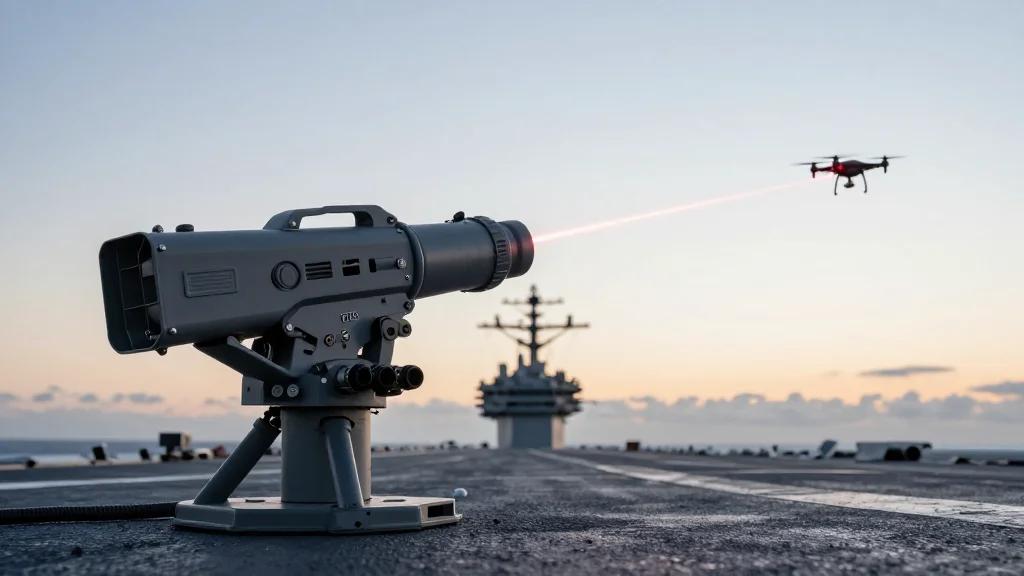
U.S. Navy Achieves 100% Kill Rate with Portable LOCUST Laser on Carrier

Companies Mentioned
Why It Matters
A flawless kill rate in realistic carrier conditions validates the operational viability of portable directed‑energy weapons, a technology that has long been confined to laboratory settings. By proving that a 35‑kW laser can protect a high‑value platform without permanent installation, the Navy gains a flexible tool against the accelerating proliferation of inexpensive drone threats. This capability reduces reliance on costly missile interceptors and expands defensive coverage in congested or restricted waters where traditional air‑defense assets are limited. The broader defense market stands to see a shift toward modular, containerized systems that can be fielded across services. Contractors that can deliver compact, ship‑ready lasers may capture new contracts, while legacy high‑power laser programs could face budget re‑allocation. The outcome also informs allied navies, many of which are evaluating similar directed‑energy concepts to safeguard carrier groups and amphibious task forces.
Key Takeaways
- •LOCUST laser achieved 100% kill rate against multiple drone threats during carrier trials.
- •The 35‑kW palletized system can be powered up in 15 minutes and operated after less than an hour of training.
- •Weight of 3,400 lb allows rapid installation and removal, preserving flight‑deck operations.
- •Tests confirmed resilience to salt‑fog, humidity and ship motion, meeting naval environmental standards.
- •Success may accelerate procurement and drive adoption of modular directed‑energy weapons across the fleet.
Pulse Analysis
The LOCUST trial signals a turning point in how the Navy approaches ship‑board defense. Historically, the service has invested in high‑megawatt lasers that require extensive structural modifications and long development cycles. By demonstrating that a 35‑kW unit can deliver perfect lethality against drones, the Navy now has a credible, lower‑cost alternative that can be fielded on existing hulls. This reduces the financial barrier to widespread adoption and aligns with the Department of Defense’s push for rapid, modular solutions that can be reconfigured as threats evolve.
From a market perspective, AeroVironment’s success could reshape the competitive landscape. Companies that specialize in fixed‑install lasers may need to pivot toward more portable architectures or risk losing relevance. The ability to integrate with a ship’s existing power grid and to be removed without impacting flight operations also addresses a long‑standing operational concern: preserving the carrier’s primary mission while adding a new defensive layer. If the Navy proceeds with a fleet‑wide rollout, procurement volumes could reach into the dozens, creating a sizable revenue stream for vendors that can meet the Navy’s stringent reliability and environmental standards.
Strategically, the adoption of portable lasers like LOCUST could alter adversary calculations. Drone swarms, which have become a low‑cost method for saturating defenses, lose much of their appeal when faced with a weapon that engages at the speed of light and can be redeployed across multiple platforms. This may force potential opponents to invest in more sophisticated counter‑measures or to develop stealthier, higher‑speed threats, thereby shifting the technology race toward even faster detection and response capabilities. The Navy’s next steps—integrating LOCUST with combat systems and expanding testing to surface threats—will determine how quickly this technology moves from experimental to operational status.
U.S. Navy Achieves 100% Kill Rate with Portable LOCUST Laser on Carrier
Comments
Want to join the conversation?
Loading comments...