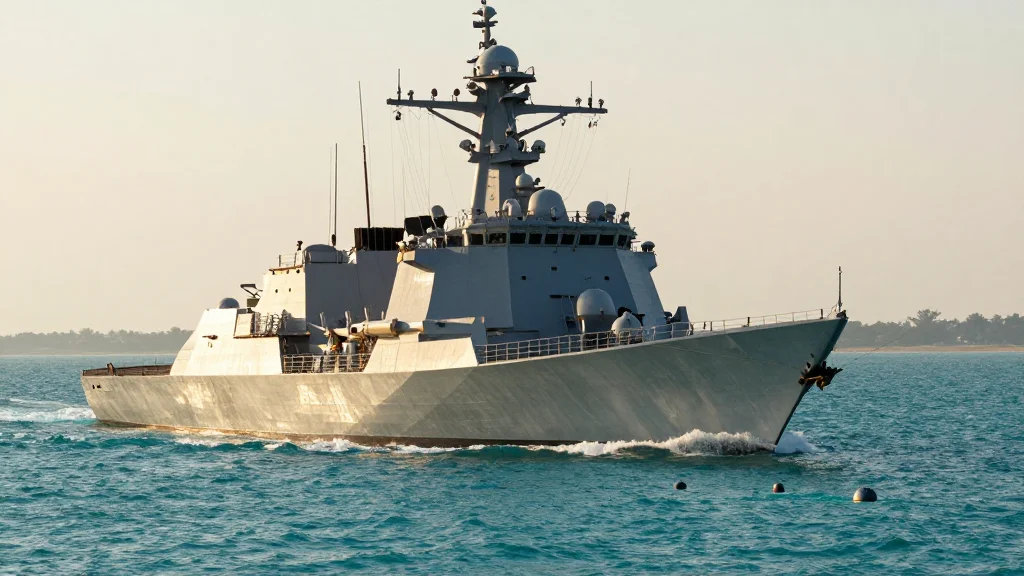
U.S. Navy Deploys Two Destroyers to Clear Mines in Strait of Hormuz

Why It Matters
Restoring safe passage through the Strait of Hormuz is critical for global energy stability. With roughly 20% of the world’s oil supply flowing through the narrow waterway, any disruption reverberates across commodity markets, raising fuel costs and straining economies that depend on steady imports. The U.S. mine‑clearance mission signals a willingness to use naval power to protect commercial shipping, potentially deterring further Iranian aggression and reassuring allies in the region. Beyond economics, the operation tests the United States’ ability to conduct rapid, coordinated mine‑countermeasure campaigns in contested waters. Success could reinforce U.S. credibility with partners such as Saudi Arabia and the United Arab Emirates, while also providing a template for future engagements in littoral environments where asymmetric threats like sea mines pose outsized risks.
Key Takeaways
- •USS Frank E. Peterson (DDG‑121) and USS Michael Murphy (DDG‑112) entered the Strait of Hormuz to start mine clearance.
- •Admiral Brad Cooper announced the creation of a new safe passage for commercial traffic.
- •President Donald Trump posted on Truth Social: “We’re now starting the process of clearing out the Strait of Hormuz.”
- •The strait handles about 20% of global crude oil shipments, roughly 21 million barrels per day.
- •Additional assets, including underwater drones, are slated to join the effort in the coming days.
Pulse Analysis
The mine‑clearance operation marks a rare instance of overt kinetic action aimed at re‑establishing a commercial artery rather than purely targeting an adversary’s military capability. Historically, the U.S. has relied on diplomatic pressure and sanctions to curb Iran’s maritime threats; this shift to a visible naval presence underscores a growing impatience with protracted negotiations and a recognition that energy market volatility can quickly become a national security issue.
From a strategic standpoint, the deployment of two Arleigh Burke‑class destroyers, equipped with advanced sonar and mine‑hunting suites, demonstrates the Navy’s emphasis on multi‑mission flexibility. Coupled with autonomous underwater vehicles, the operation showcases how legacy platforms are being integrated with emerging technologies to address low‑tech but high‑impact threats. Competitors watching the U.S. response may recalibrate their own mine‑laying doctrines, potentially spurring a regional arms race in counter‑mine capabilities.
Economically, the clearance could act as a catalyst for a modest pull‑back in oil price premiums that have lingered since the strait’s closure. However, the operation’s success hinges on the thoroughness of the sweep; any residual mines could reignite market fears and embolden Iran to leverage the waterway as a bargaining chip in future talks. The coming days will therefore be a litmus test for how effectively the United States can blend hard power with diplomatic overtures to stabilize a critical chokepoint.
U.S. Navy Deploys Two Destroyers to Clear Mines in Strait of Hormuz
Comments
Want to join the conversation?
Loading comments...