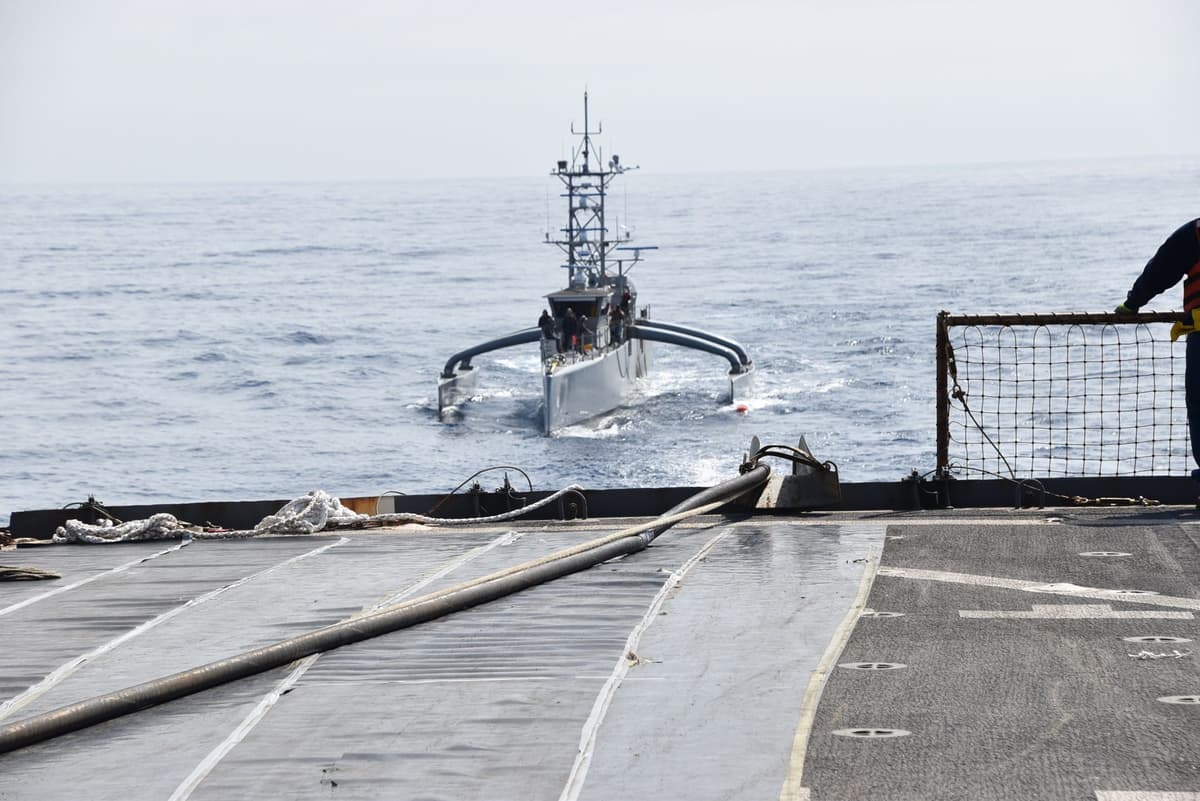
U.S. Navy Drills in At-Sea USV Fueling Ahead of CSG Deployment
Companies Mentioned
Why It Matters
At‑sea fueling makes unmanned surface vessels operationally viable alongside carriers, accelerating the Navy’s shift toward a distributed, sensor‑rich fleet in a contested region. The capability underpins the service’s strategy to counter a growing Chinese navy with cost‑effective, networked assets.
Key Takeaways
- •USNS Guadalupe refueled MUSV Seahawk at sea
- •Deployment targets up to 30 MUSVs by 2030
- •Marketplace procurement model replaces canceled MASc program
- •USV sensors boost carrier strike group maritime awareness
- •Logistics integration remains major challenge for mass USV rollout
Pulse Analysis
The recent at‑sea refueling drill marks a pivotal step in transitioning unmanned surface vessels from experimental toys to operational tools. By coupling the medium‑size MUSV Seahawk with the fleet oiler USNS Guadalupe, the Navy proved that autonomous platforms can keep pace with carrier strike groups without returning to port. This capability eliminates a traditional bottleneck—fuel logistics—and paves the way for sustained, long‑duration missions that enhance the fleet’s reach and resilience.
Strategically, the Navy’s push to embed MUSVs within the Theodore Roosevelt Carrier Strike Group reflects a broader doctrine of distributed maritime awareness. The Seahawk’s advanced sensor suite acts as a floating radar and acoustic array, feeding real‑time data to manned warships and providing early warning against surface and subsurface threats. In the Indo‑Pacific, where the People’s Liberation Army Navy is expanding both in number and sophistication, these low‑cost drones offer a force multiplier, extending surveillance coverage and, when equipped with containerized payloads, delivering additional firepower without sacrificing carrier speed or maneuverability.
To field thousands of USVs by the 2030s, the Navy abandoned the Modular Attack Surface Craft program in favor of a “marketplace” procurement model that leverages commercial off‑the‑shelf technology and rapid acquisition cycles. This approach aims to streamline integration, reduce development risk, and allow iterative upgrades as sensor and weapon modules evolve. However, scaling logistics—especially refueling, maintenance, and command‑and‑control—remains a formidable challenge. Success will hinge on synchronized efforts across the Navy, Military Sealift Command, and industry partners, ultimately reshaping how the United States projects power across the world’s largest oceanic theater.
U.S. Navy drills in at-sea USV fueling ahead of CSG deployment
Comments
Want to join the conversation?
Loading comments...