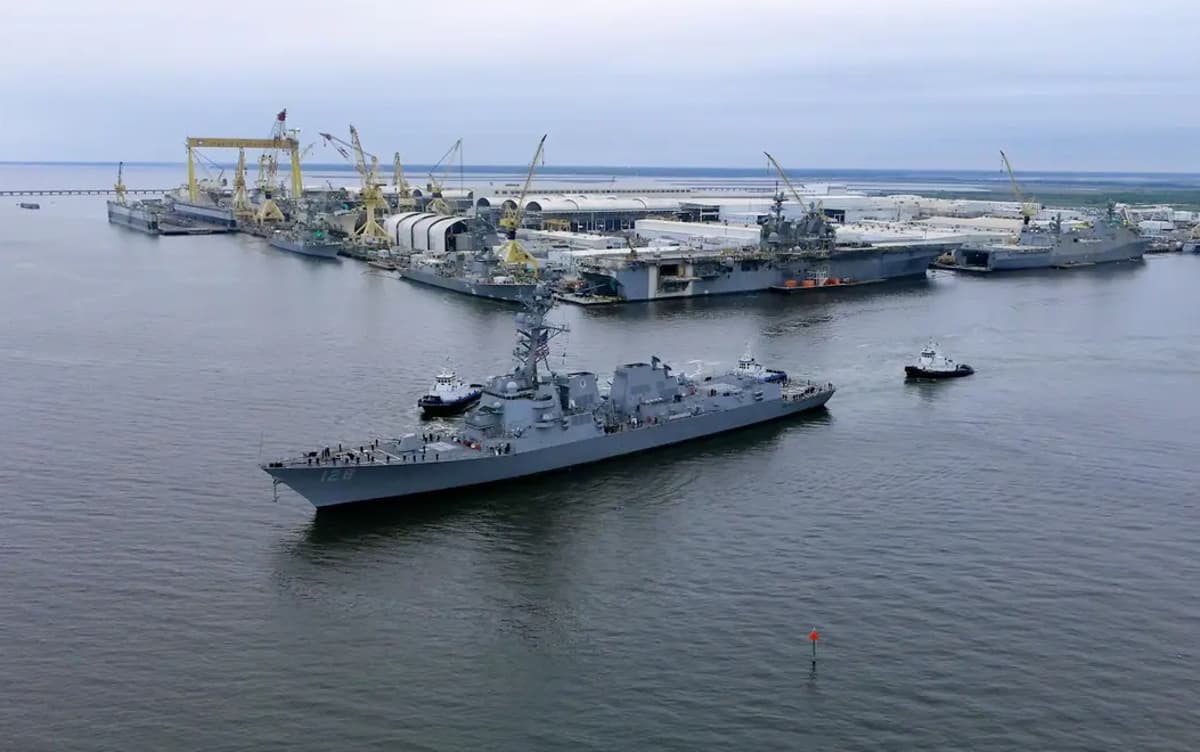
US Navy’s Newest Flight III Arleigh Burke-Class Destroyer Heads Toward Commissioning
Why It Matters
Adding DDG‑128 bolsters the Navy’s next‑generation surface‑combatant force, enhancing air‑and‑missile defense across both oceans. Faster delivery of Flight III destroyers supports the United States’ strategic aim of maintaining maritime superiority amid rising great‑power competition.
Key Takeaways
- •USS Ted Stevens (DDG‑128) departs Ingalls for Norfolk, heading to Alaska commissioning.
- •Second Flight III Arleigh Burke destroyer, equipped with AN/SPY‑6(V)1 radar.
- •Ingalls has delivered 36 Arleigh Burke destroyers, five Flight III under construction.
- •Distributed shipbuilding initiative aims to speed up Navy surface‑combatant schedules.
- •Flight III ships boost U.S. maritime security with advanced Aegis Baseline 10.
Pulse Analysis
The Flight III variant of the Arleigh Burke‑class represents a quantum leap in surface‑warrior capability. Its AN/SPY‑6(V)1 Air and Missile Defense Radar delivers three‑times the detection range of legacy systems, while the Aegis Baseline 10 combat suite integrates advanced software for simultaneous multi‑domain threat tracking. These upgrades enable the destroyer to defend carrier strike groups against sophisticated ballistic‑missile and hypersonic threats, positioning the class at the forefront of U.S. naval power projection.
Ingalls Shipbuilding, the primary builder of the Arleigh Burke line, has now delivered 36 destroyers, including the first Flight III ship, USS Jack H. Lucas, and the newly launched DDG‑128. To meet the Navy’s accelerating demand, Ingalls has adopted a distributed shipbuilding model, partnering with regional yards and fabricators to shorten critical path timelines. With five Flight III hulls under construction and seven more in pre‑planning, the program aims to sustain a steady flow of advanced destroyers into the fleet, mitigating schedule risks that have plagued earlier surface‑combatant programs.
Strategically, the commissioning of USS Ted Stevens in Alaska underscores the Navy’s focus on the Indo‑Pacific theater, where enhanced air‑defense and missile‑intercept capabilities are vital. The ship’s homeport shift to Norfolk also provides Atlantic‑fleet flexibility, ensuring that the United States can project power and protect sea lanes on both coasts. As the fleet modernizes, each new Flight III destroyer extends the Navy’s operational reach and reinforces deterrence against peer competitors, cementing America’s maritime dominance for decades to come.
US Navy’s newest Flight III Arleigh Burke-class destroyer heads toward commissioning
Comments
Want to join the conversation?
Loading comments...