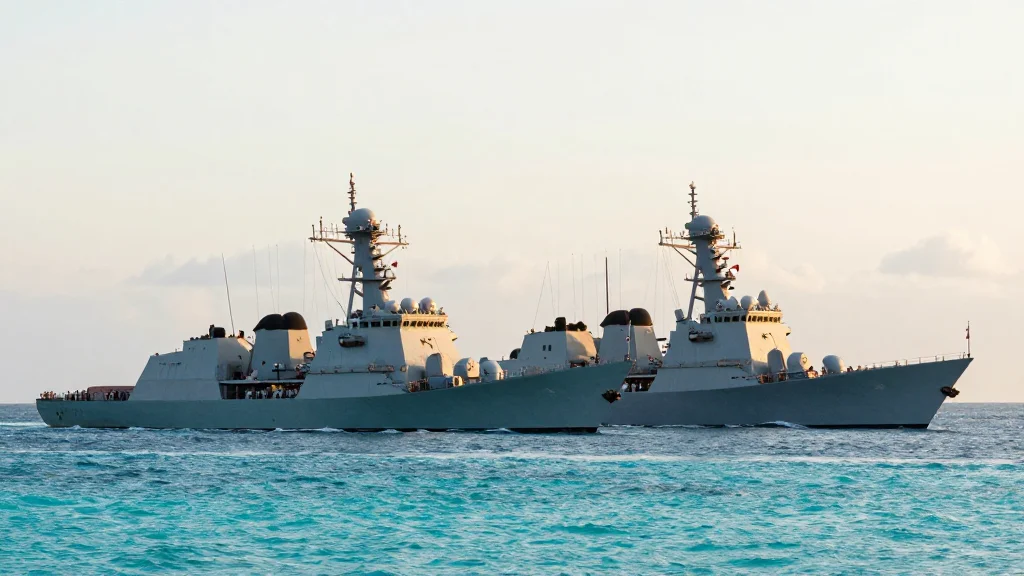
US, Philippines Launch Largest Joint Drills, 17,000 Troops; Japan Adds 1,000

Why It Matters
The unprecedented scale of the Balikatan drills sends a strong deterrent signal to any state contemplating coercive actions in the South China Sea. By integrating Japanese combat troops, the United States is reinforcing a multilateral security architecture that counters Beijing’s growing maritime assertiveness. For the Philippines, the exercises provide critical training, bolster defense capabilities, and affirm its strategic relevance as a frontline partner. The joint effort also raises the stakes of regional arms competition. Japan’s disclosed defense budget of $58 billion and its sizable plutonium stockpile highlight the potential for an arms race if neighboring powers respond with heightened military posturing. Policymakers in Washington, Manila, and Tokyo will need to balance deterrence with diplomatic outreach to avoid escalation.
Key Takeaways
- •US and Philippines commence Balikatan drills with >17,000 troops, the largest ever.
- •Japan contributes >1,000 combat troops, its first deployment to the Philippines since 1945.
- •Japanese defense budget hits a record $58 billion for FY 2026.
- •Japan’s plutonium stockpile could yield roughly 5,500 nuclear warheads, according to experts.
- •The exercises aim to improve interoperability and signal collective resolve against regional aggression.
Pulse Analysis
The Balikatan expansion marks a decisive moment in the Indo‑Pacific security calculus. Historically, U.S.‑Philippine drills have been a cornerstone of American forward presence, but the addition of Japanese combat forces transforms the exercise into a tri‑national deterrence platform. This shift reflects Tokyo’s broader strategic pivot from a strictly defensive posture toward a more expeditionary role, enabled by recent legislative changes that relax constraints on the Self‑Defense Forces.
From a market perspective, the heightened alliance activity could spur demand for advanced weapons systems, logistics support, and joint‑training infrastructure. Defense contractors in the United States, Japan, and the Philippines are likely to see increased orders for amphibious vehicles, air‑defence missiles, and communications suites that enable seamless coordination among disparate forces. Moreover, the visible commitment of resources—$58 billion in Japan’s defense budget—signals robust fiscal backing for future procurement, potentially accelerating modernization programs across the region.
Strategically, the drills serve a dual purpose: they reassure allies while warning adversaries. By showcasing the ability to mobilise a force of this magnitude, the United States and its partners demonstrate that any attempt to alter the status quo in the South China Sea would encounter a coordinated, well‑trained response. However, the involvement of Japan—still a sensitive issue for China—could also entrench rival narratives of encirclement, prompting Beijing to accelerate its own naval and missile deployments. The coming weeks will test whether the deterrent effect outweighs the risk of a security dilemma, making the outcomes of Balikatan a bellwether for regional stability.
US, Philippines launch largest joint drills, 17,000 troops; Japan adds 1,000
Comments
Want to join the conversation?
Loading comments...