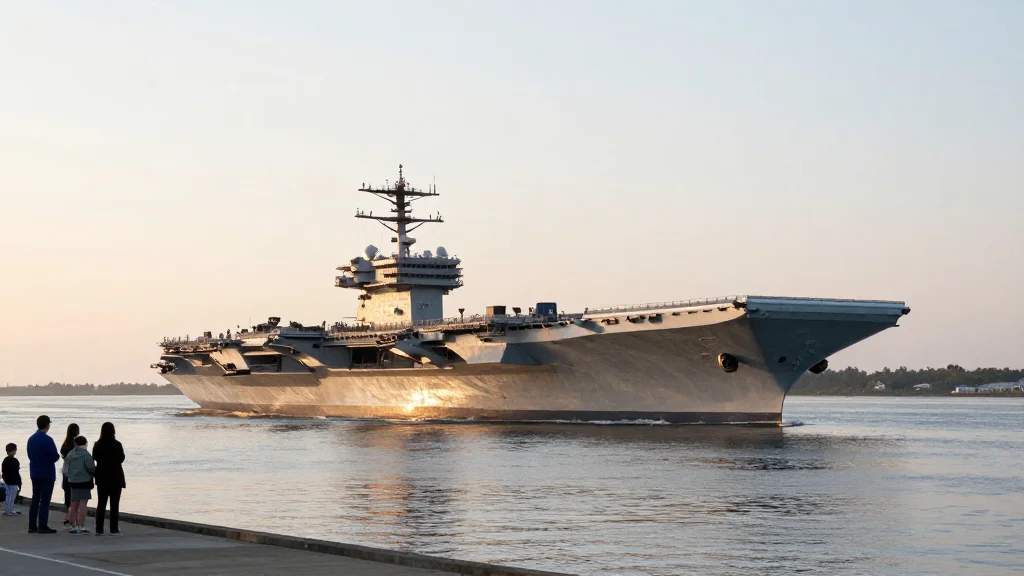
USS Gerald R. Ford Returns to Norfolk After 334‑Day Deployment, Setting New Navy Record

Why It Matters
The carrier’s unprecedented 334‑day deployment spotlights a growing tension between strategic necessity and personnel sustainability. Extended tours enable the United States to maintain a continuous deterrent posture in volatile regions—from the Caribbean to the Persian Gulf—but they also risk eroding morale, increasing maintenance backlogs, and stretching the limited pool of qualified sailors. As the Navy confronts a shrinking carrier fleet and delayed retirements, the Ford’s homecoming could accelerate reforms to shorten deployment cycles, invest in crew welfare, and prioritize ship readiness. The episode also signals to allies and adversaries alike that the U.S. can sustain long‑duration power projection, yet it may prompt regional actors to test the limits of that endurance. Furthermore, the public nature of the welcome‑home event underscores the political dimension of carrier deployments. Families, lawmakers and defense analysts will watch how the Navy translates lessons from the Ford’s tour into policy, influencing future budget allocations for new hulls, crew support programs, and the overall balance of force across the globe.
Key Takeaways
- •USS Gerald R. Ford completed a 334‑day deployment, the longest carrier mission since Vietnam.
- •Approximately 3,500 sailors remained aboard at the time of the homecoming.
- •Rear Adm. Gavin Duff reported roughly 80 children were born to crew members during the tour.
- •Admiral Daryl Caudle reiterated the Navy’s target deployment length of seven months.
- •The carrier’s itinerary covered the Caribbean, Red Sea and Arabian Gulf, supporting operations against Iran.
Pulse Analysis
The Ford’s record deployment is a double‑edged sword for U.S. naval strategy. On one hand, it demonstrates the United States’ ability to sustain a high‑end warfighting platform across multiple theaters for nearly a year, reinforcing deterrence against Iran, Venezuela and other regional flashpoints. On the other, the human cost—extended separations, morale challenges and accelerated wear on the ship’s systems—highlights a systemic strain that could undermine long‑term readiness.
Historically, carrier tours have hovered around six to eight months, a rhythm that balances operational tempo with crew recuperation. The Ford’s 11‑month stint broke that norm, driven by political directives that prioritized immediate geopolitical objectives over traditional force‑generation cycles. As the Navy grapples with an aging carrier fleet—delayed retirements of Nimitz‑class hulls and a limited pipeline of new vessels—policy makers must decide whether to accept longer tours as a temporary necessity or to double‑down on investments that restore the seven‑month cadence.
Looking ahead, the Ford’s homecoming will likely feed into congressional hearings on force structure and personnel policy. If the Navy can translate the lessons learned into concrete changes—such as expanding crew rotation programs, accelerating shipyard maintenance slots, and fast‑tracking the next‑generation carriers—it may preserve the strategic advantage that carriers provide while safeguarding the welfare of the sailors who man them. Failure to address these issues could erode the Navy’s ability to project power sustainably, a risk that adversaries are watching closely.
USS Gerald R. Ford Returns to Norfolk After 334‑Day Deployment, Setting New Navy Record
Comments
Want to join the conversation?
Loading comments...