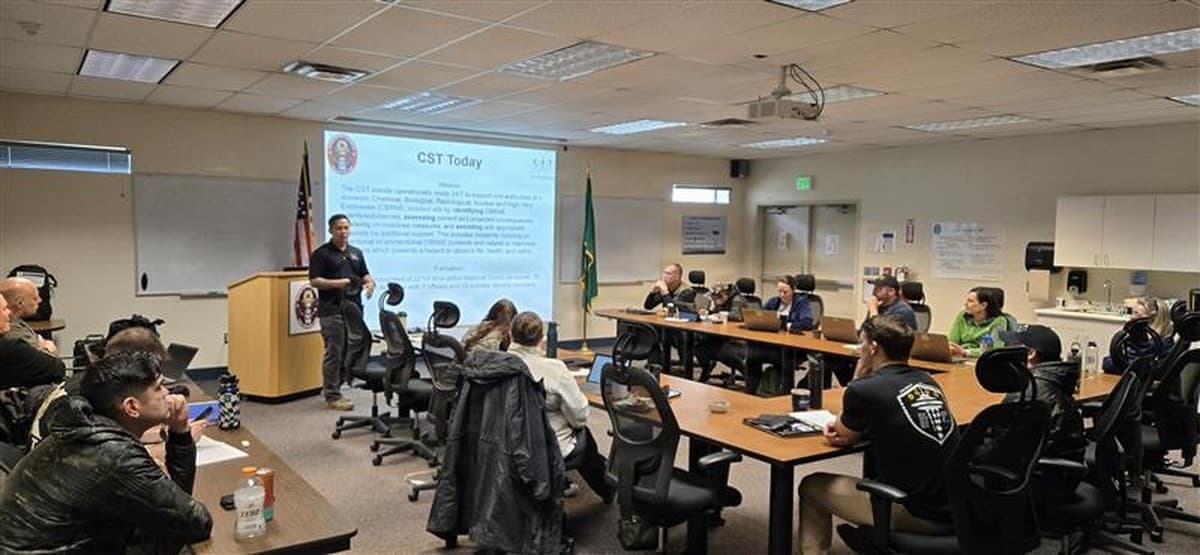
Washington Guard Hosts Radiation Response Workshop
Why It Matters
Strengthening coordination among federal, state and local responders cuts critical response time during radiological events, protecting public health and national security. The exercise demonstrates a proactive model for other jurisdictions facing similar WMD‑type threats.
Key Takeaways
- •10th Civil Support Team convened federal, state, local agencies for radiation readiness
- •Tabletop exercise simulated a small-scale radiological incident to test communication
- •FBI, DOE, and Health Department clarified roles in WMD investigations
- •Lessons from 2025 Route 16 gauge spill informed standoff procedures
- •Improved interagency trust reduces response time when seconds matter
Pulse Analysis
Radiation emergencies, whether accidental or malicious, demand rapid, coordinated action across a patchwork of agencies. The 10th Civil Support Team, part of the Washington National Guard, serves as a hub for expertise in hazard detection, field analysis and decontamination. By aligning the FBI’s investigative authority, the Department of Energy’s rapid‑response assets, and state health and environmental bodies, the workshop created a unified command structure that mirrors the National Incident Management System, ensuring that each stakeholder knows its precise role when a radiological event unfolds.
The April 3 workshop went beyond theory, employing a realistic tabletop scenario that mirrored a small‑scale, non‑terrorist incident. Participants traced the information flow from first responders to federal investigators, testing communication protocols that were previously strained during the 2025 State Route 16 cesium gauge accident. Real‑world case studies, such as the Harborview Medical Center contamination, underscored gaps in reporting and hospital preparedness, prompting concrete revisions to standoff distances and public messaging guidelines. These hands‑on drills translate abstract policies into actionable steps, sharpening decision‑making under pressure.
Looking ahead, the workshop’s emphasis on pre‑incident relationship building sets a benchmark for other states grappling with radiological risk. As infrastructure modernization introduces more density gauges and other radioactive sources, the need for seamless inter‑agency data sharing and joint exercises will only grow. Policymakers can leverage the lessons learned here to allocate funding for regular training, upgrade detection equipment, and codify inter‑governmental protocols, thereby bolstering national resilience against both accidental releases and potential radiological terrorism.
Washington Guard hosts radiation response workshop
Comments
Want to join the conversation?
Loading comments...