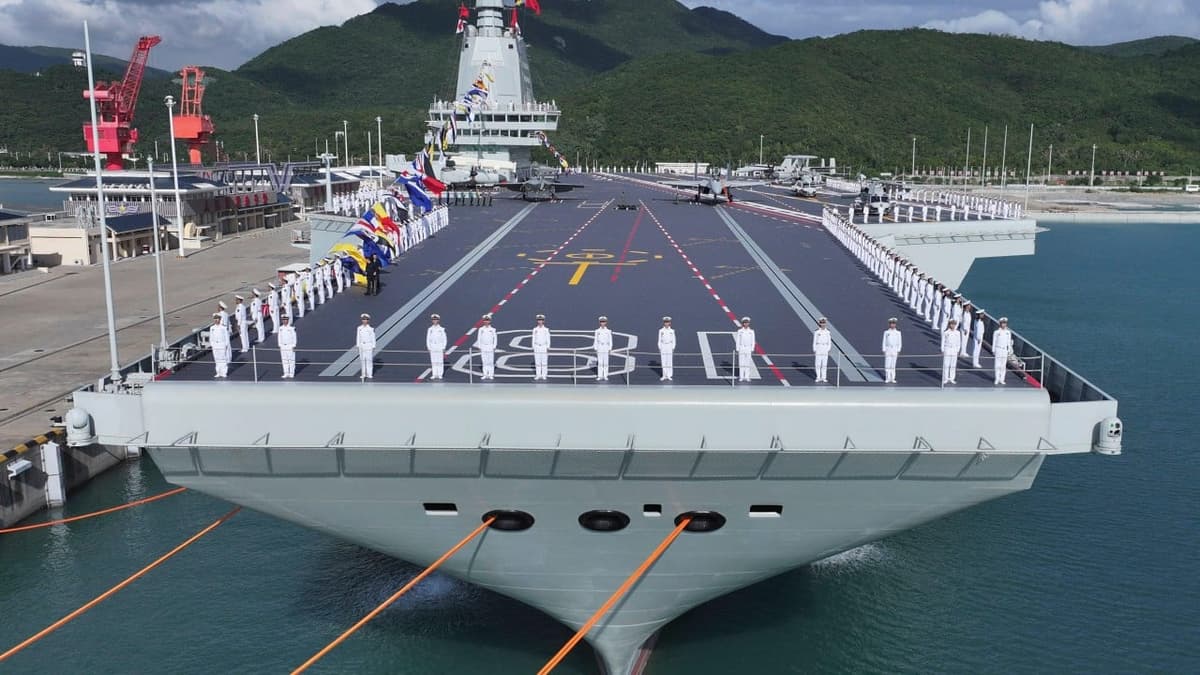
Why Hainan Holds the Key to Survival for China’s Aircraft Carriers
Why It Matters
Locating carriers in Hainan improves survivability and expands China’s power projection in the South China Sea, complicating U.S. and allied response options in any Taiwan conflict.
Key Takeaways
- •Fujian carrier homeported in Sanya, boosting Hainan’s naval role.
- •Hainan base lies outside main U.S./Japanese missile coverage zones.
- •Access to Bashi and Balintang Channels eases Pacific deployment.
- •Supports potential maritime blockade and air control over Taiwan Strait.
- •Enhances PLA Navy’s blue‑water capability against first island chain constraints.
Pulse Analysis
China’s rapid carrier buildup reflects a deliberate shift toward a blue‑water navy capable of operating far from its traditional coastal anchors. By basing the Fujian and Shandong in Sanya, the PLA Navy leverages Hainan’s proximity to the South China Sea while distancing its most valuable assets from the dense U.S. and Japanese missile umbrella that covers Qingdao and Dalian. This geographic realignment not only reduces exposure to shore‑based anti‑access weapons but also grants carriers direct access to the Bashi and Balintang Channels, corridors that are less heavily defended and enable swift movement into the Pacific.
The strategic calculus centers on the first island chain, a Cold‑War concept that still frames U.S. containment policy. Operating from Hainan, Chinese carrier groups can bypass the heavily monitored Miyako Strait and instead exploit the relatively open southern gaps, complicating allied air‑sea coordination. In a Taiwan contingency, carriers launching from the south could establish air superiority and maritime control, disrupting reinforcement routes that rely on the Philippines and the Bashi Channel. This repositioning forces Washington and Tokyo to reconsider force postures, potentially prompting a redistribution of forward‑deployed assets and increased investment in long‑range strike capabilities.
Beyond immediate military considerations, the Hainan base signals Beijing’s broader ambition to project power across the Indo‑Pacific. The integration of shore‑based air defenses, missile batteries, and surveillance systems around the island creates a layered shield that protects carrier movements and supports joint operations with ground forces in the East China Sea. As China continues to refine catapult launch technology and expand its carrier fleet, Hainan will likely become a pivotal hub for training, logistics, and strategic deterrence, reshaping the regional security architecture for years to come.
Why Hainan holds the key to survival for China’s aircraft carriers
Comments
Want to join the conversation?
Loading comments...