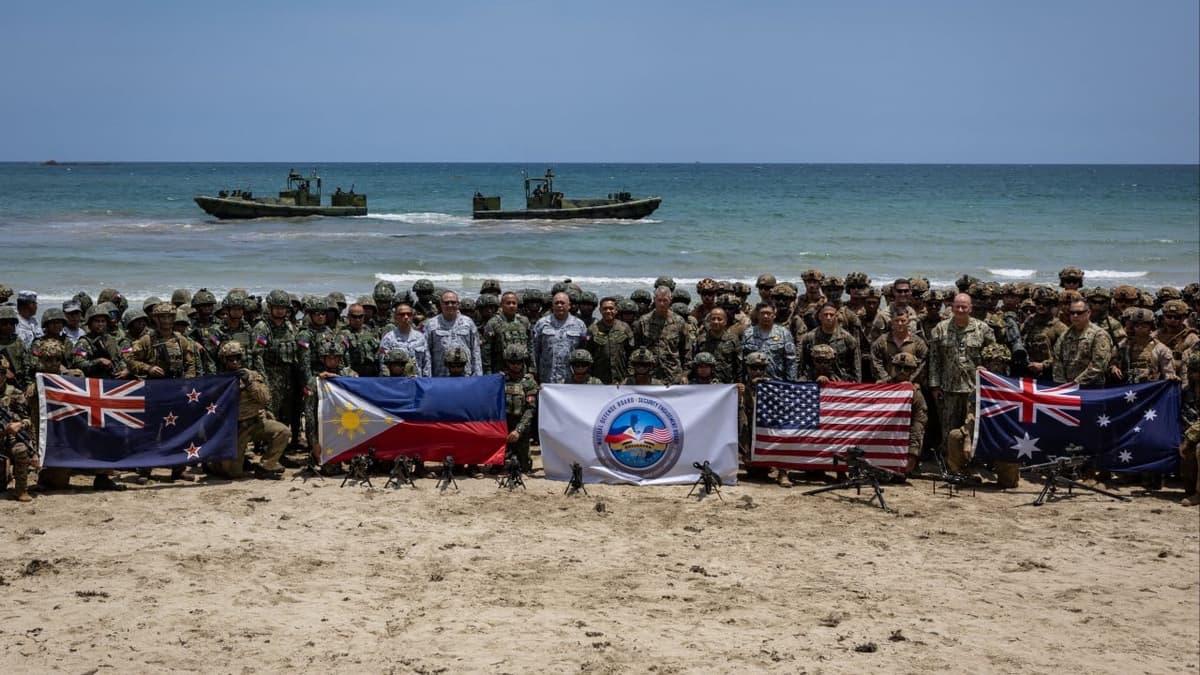
Why the Largest-Ever US-Philippine Drill, and Japan’s Role in It, Is Making China Uneasy
Why It Matters
The expanded drill signals a stronger trilateral deterrence posture against China, potentially reshaping power dynamics in the Indo‑Pacific and influencing future security cooperation. It also pressures ASEAN members to navigate a delicate balance between major powers.
Key Takeaways
- •Balikatan 2026 involved 17,000 troops from seven nations.
- •Japan sent 1,400 troops and Type 88 missiles, first deployment.
- •China warns drills raise instability and may trigger PLA responses.
- •U.S. tested Typhon mid‑range missile, expanding regional deterrence.
Pulse Analysis
The 2026 Balikatan exercise marks a watershed moment for U.S. and Philippine defense cooperation, scaling up to 17,000 participants and spanning a 1,200‑kilometer maritime corridor. By integrating forces from Canada, France, Australia, New Zealand and, for the first time, Japan, the drill showcases a multilateral approach to countering Beijing’s assertiveness in the South China Sea. The inclusion of advanced weaponry—such as the U.S. Typhon missile and Japan’s Type 88 shore‑to‑ship system—demonstrates a shift from traditional training to live‑fire, high‑intensity scenarios that mirror potential conflicts around Taiwan.
Japan’s involvement carries historical weight, being the first combat‑troop deployment to the Philippines since World War II. The deployment of 1,400 Self‑Defense Force personnel and the Type 88 missile system signals Tokyo’s willingness to project power beyond its immediate periphery, aligning more closely with Washington’s Indo‑Pacific strategy. This move also serves as a direct response to recent Japanese political rhetoric suggesting intervention could be justified in a Taiwan crisis, a stance that Beijing has flagged as a red line. The combined U.S.–Japan presence amplifies deterrence but also raises the risk of miscalculation, especially as both sides conduct live‑fire drills near contested waters.
China’s reaction—framing the exercise as a destabilizing provocation—highlights the fragile equilibrium in the region. While ASEAN nations remain cautious, observing rather than joining, the drill’s scale may force regional actors to reassess security postures and alliance choices. As the United States, Japan, and the Philippines deepen their strategic integration, future Balikatan iterations could evolve into even larger, more complex operations, potentially shaping the Indo‑Pacific’s security architecture for years to come.
Why the largest-ever US-Philippine drill, and Japan’s role in it, is making China uneasy
Comments
Want to join the conversation?
Loading comments...