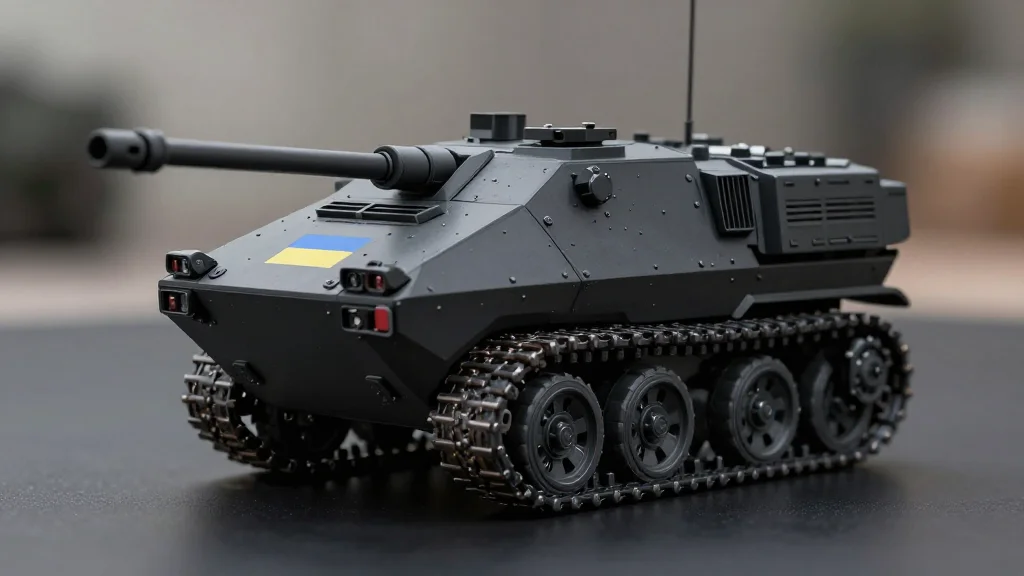
Zelensky Calls on Global Buyers for Ukraine’s Combat Robots After 22,000 Missions

Why It Matters
Ukraine’s combat robots represent a rare case of battlefield‑tested technology emerging from an active war zone, offering a proof‑point for other nations considering rapid unmanned capability development. Their adoption could accelerate the global shift toward autonomous ground combat, reducing soldier exposure and reshaping procurement priorities. Additionally, successful export deals would inject much‑needed capital into Ukraine’s war‑strained defense sector, sustaining innovation and preserving a strategic edge against Russia. The broader defense ecosystem stands to feel the ripple effects. Western allies may need to reconcile support for Ukrainian firms with existing contracts from traditional suppliers, while export‑control bodies will grapple with the challenge of vetting AI‑enabled weapons that blur the line between defensive and offensive use. Ultimately, the market response will signal how quickly the international community is willing to integrate combat‑proven autonomous systems into their arsenals.
Key Takeaways
- •Zelensky announced Ukrainian combat robots have completed >22,000 missions in three months.
- •He urged international buyers, highlighting firms Ratel, TerMIT, Ardal, Rys, Zmiy, Protector and Volia.
- •Gulf states are evaluating Ukrainian interceptor drones; Norway pledged $500 million for drones, Netherlands €200 million (~$215 million).
- •Germany’s €4 billion (~$4.3 billion) Patriot package and Raytheon’s $3.7 billion contract underscore allied funding streams.
- •Potential export contracts could fund next‑gen humanoid robots and sustain Ukraine’s defense industry amid frozen capital markets.
Pulse Analysis
Zelensky’s public solicitation of foreign buyers is more than a diplomatic flourish; it is a strategic maneuver to monetize battlefield innovation. Historically, war‑time tech breakthroughs—such as the U.S.’s GPS or Israel’s Iron Dome—have taken years to transition from field use to export markets. Ukraine’s robots, however, have already logged tens of thousands of missions, compressing that timeline dramatically. This creates a competitive advantage for firms that can quickly certify and export platforms that have proven themselves under fire.
From a market perspective, the push could fragment the traditional unmanned systems supply chain. Established players like General Dynamics and Boeing may see demand for their higher‑priced, integrated solutions erode as cost‑effective Ukrainian UGVs and drones gain traction, especially among nations with constrained defense budgets. The Gulf states’ interest signals a willingness to diversify suppliers away from legacy Western vendors, a trend accelerated by geopolitical frictions and the need for rapid fielding.
Looking ahead, the key variable will be the ability of Ukrainian firms to navigate export‑control hurdles and scale production. If they secure a flagship contract—perhaps a multi‑year deal with a NATO ally for counter‑drone kits—the resulting cash flow could fund a new wave of AI‑driven prototypes, including the humanoid Phantom series mentioned by Foundation Robotics. Such a development would not only cement Ukraine’s role as a supplier but also reshape global defense R&D pipelines, forcing traditional manufacturers to double‑down on autonomous ground combat capabilities.
Zelensky Calls on Global Buyers for Ukraine’s Combat Robots After 22,000 Missions
Comments
Want to join the conversation?
Loading comments...