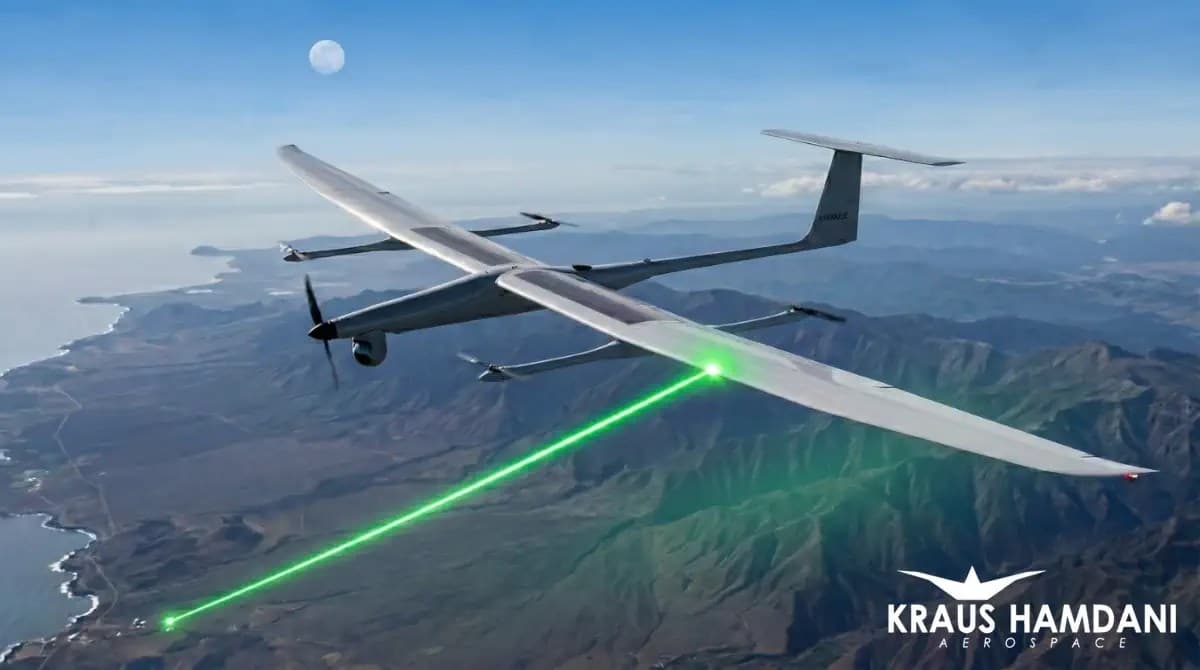
Kraus Hamdani K1000ULE Recharges without Landing

Why It Matters
By removing the need for landing, laser power‑beaming could give military and security operators near‑constant aerial presence, slashing logistics costs and expanding mission reach. The technology reshapes how persistent ISR and border‑security platforms are deployed and sustained.
Key Takeaways
- •First in-flight laser power beaming recharges aircraft batteries
- •K1000ULE can stay airborne indefinitely without landing
- •Enables persistent ISR for border patrol and base security
- •Reduces logistics by eliminating refuel and recovery cycles
- •Merges tethered endurance with untethered maneuverability
Pulse Analysis
Laser power‑beaming, once a concept confined to laboratory experiments, has taken a decisive step toward operational use with the K1000ULE’s successful in‑flight recharge. The technology relies on a high‑precision ground laser that transmits energy across the atmosphere, where a specially designed receiver converts the photons into electrical power. Unlike traditional wireless charging, the beam can be directed at moving platforms, allowing the aircraft to stay aloft while continuously topping up its batteries. This capability addresses a long‑standing limitation of unmanned aerial systems: finite endurance dictated by fuel or battery capacity.
For defense and homeland‑security agencies, the ability to keep a sensor platform aloft indefinitely opens new tactical possibilities. Persistent intelligence, surveillance, and reconnaissance (ISR) over remote borders can now be achieved without the downtime associated with rotation or recovery, enhancing situational awareness and response times. Forward operating bases gain a mobile, always‑on‑watch eye that can pivot quickly to emerging threats, while the elimination of refueling logistics reduces the supply chain footprint in contested environments. Moreover, the blend of tether‑like persistence with the freedom of untethered flight offers a hybrid solution that outperforms both conventional drones and stationary radar installations.
Looking ahead, the K1000ULE signals a broader shift toward energy‑as‑a‑service for aerial platforms. As laser efficiency improves and regulatory frameworks evolve, commercial sectors such as telecommunications, disaster monitoring, and logistics could adopt similar beaming solutions to extend the range and uptime of high‑altitude platforms. Challenges remain, including atmospheric attenuation, safety protocols, and the high upfront cost of ground‑based laser infrastructure. Nevertheless, the demonstration marks a pivotal moment, positioning laser‑powered UAVs as a strategic asset that could redefine endurance standards across multiple industries.
Kraus Hamdani K1000ULE recharges without landing
Comments
Want to join the conversation?
Loading comments...