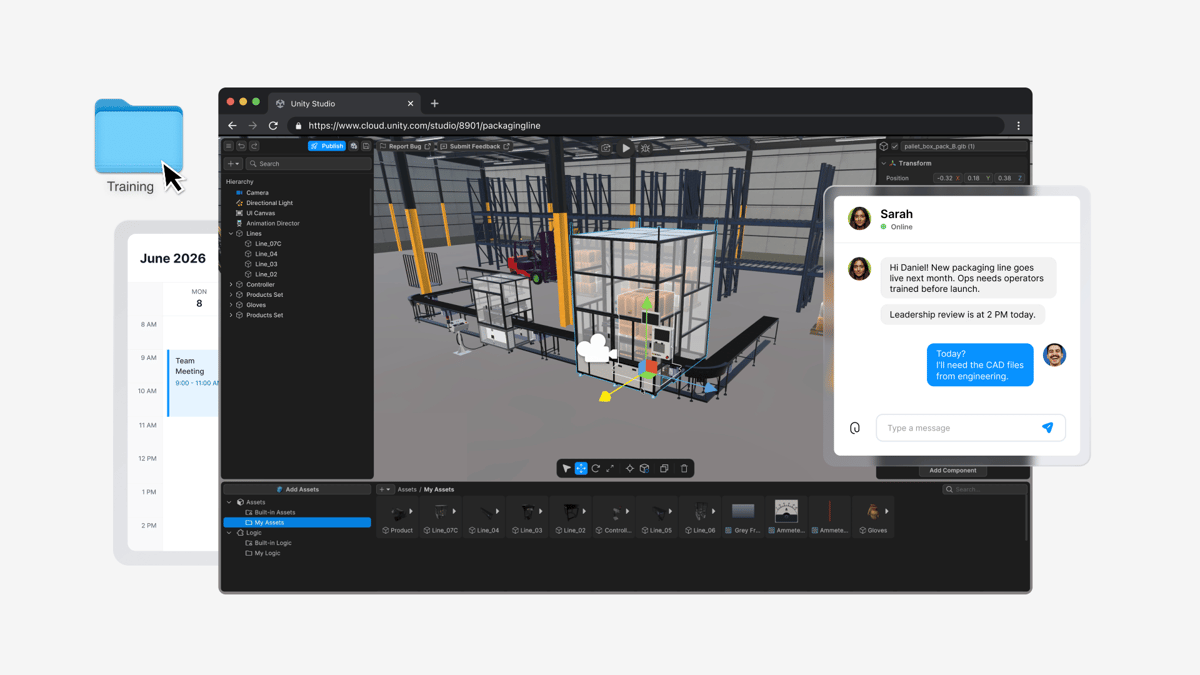
A Day in the Life of a Training Designer Building Interactive 3D — without Waiting on Specialized Simulation Teams
Why It Matters
The approach slashes time‑to‑training, reduces reliance on scarce engineering resources, and boosts safety by giving operators hands‑on practice before they touch real equipment.
Key Takeaways
- •Unity Studio lets designers import CAD assets directly into a browser.
- •Visual scripting creates safety scenarios without writing code.
- •Stakeholders review live prototypes, cutting feedback cycles to minutes.
- •Web‑based deployment eliminates hardware installs for global pilot.
- •Iterative updates keep training aligned with evolving production processes.
Pulse Analysis
Manufacturing onboarding has long wrestled with static manuals, slide decks, and costly simulation pipelines. Traditional 3D training required dedicated engineers, lengthy CAD‑to‑simulation conversions, and often months of waiting before a prototype could be shown. The result was stale content that lagged behind fast‑moving production lines, leading to skill gaps and higher safety risk when new operators stepped onto the floor.
Unity Studio disrupts that model by offering a cloud‑native authoring environment where training designers can drag CAD assets straight from the company’s data vault into an interactive scene. Its node‑based visual scripting empowers non‑programmers to embed conditional logic—such as safety latch checks or fault‑response prompts—without a single line of code. Because the experience runs in a standard web browser, subject‑matter experts can instantly test, comment, and request changes, collapsing feedback loops from weeks to minutes. This rapid‑prototype workflow not only accelerates delivery but also ensures that the training mirrors the exact equipment and procedures that will be used on day one.
The broader impact reaches beyond speed. Faster, more accurate training translates into higher retention rates, fewer on‑the‑job errors, and lower incident costs. Companies can pilot modules across multiple regions without costly installations, gathering real‑world usage data to refine content continuously. As production lines evolve, the same Unity Studio environment lets designers push updates instantly, keeping learning material in lockstep with the shop floor. For manufacturers seeking to modernize their talent pipeline while controlling spend, simulation‑free, web‑based 3D training is emerging as a strategic differentiator.
A day in the life of a training designer building interactive 3D — without waiting on specialized simulation teams
Comments
Want to join the conversation?
Loading comments...