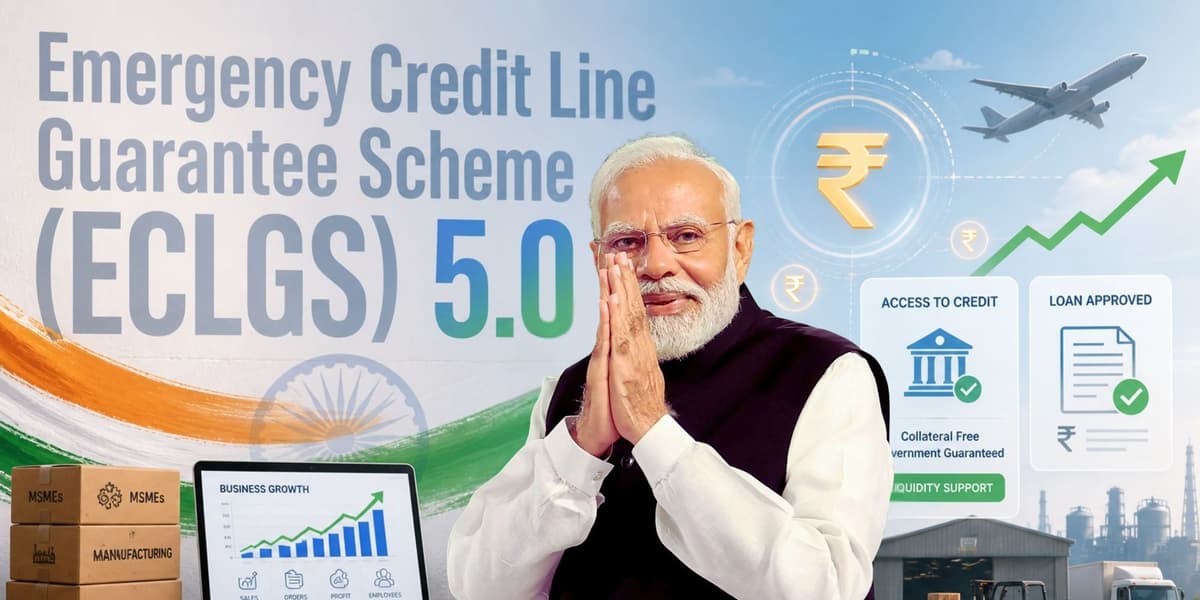
Cabinet Approves ECLGS 5.0 for MSME Credit Boost
Why It Matters
By lowering financing costs and risk for lenders, ECLGS 5.0 seeks to keep credit flowing to a sector that fuels nearly 30% of India’s GDP, preserving jobs and supply‑chain stability amid global uncertainty.
Key Takeaways
- •ECLGS 5.0 targets up to $30.7 bn credit for MSMEs
- •Government guarantees 100% for MSMEs, 90% for non‑MSMEs and airlines
- •Interest rates capped at 9% for banks, 13% for NBFCs
- •Airlines receive up to $602 m and a seven‑year repayment term
- •Scheme runs until March 2027 with a $2.2 bn fiscal outlay
Pulse Analysis
The Emergency Credit Line Guarantee Scheme, first launched during the COVID‑19 pandemic, has been repurposed for a new set of macro‑economic headwinds. With the West‑Asia crisis driving oil prices higher and disrupting trade routes, India’s heavily import‑dependent economy faces tighter margins for its 60 million‑plus MSMEs. By pledging roughly $30.7 bn in credit guarantees, the government is attempting to offset the cash‑flow squeeze that typically forces small firms to curtail production or lay off staff. The policy mirrors earlier stimulus measures but shifts focus from pandemic lockdowns to geopolitical volatility and commodity‑price spikes.
Under the 5.0 framework, the National Credit Guarantee Trustee Company will underwrite 100% of loans to eligible MSMEs and 90% for larger non‑MSME borrowers and airlines. This high‑coverage ratio dramatically reduces the risk premium banks would otherwise charge, allowing the scheme to enforce a 9% ceiling on bank lending rates and a 13% cap for non‑bank lenders. For a typical MSME with a working‑capital need of $5 m, the guarantee translates into a near‑cost‑free loan, preserving liquidity for inventory purchases, payroll and debt servicing. The nil‑fee guarantee and moratorium period further enhance affordability, making the program a potent tool for sustaining the sector’s contribution of almost 30% to national GDP.
The inclusion of the aviation sector acknowledges the disproportionate impact of soaring jet‑fuel costs on carriers. By allocating $602 m and offering a seven‑year repayment horizon, the scheme gives airlines breathing room to restructure routes and defer capital expenditures. However, the real test lies in execution: banks must process applications swiftly, and borrowers need to meet eligibility criteria without excessive documentation. If disbursement lags, the intended liquidity boost could dissipate, leaving firms exposed to prolonged cost pressures. Nonetheless, ECLGS 5.0 represents a decisive policy lever that, if efficiently deployed, could stabilize credit flows, protect employment and reinforce supply‑chain resilience in a turbulent global environment.
Cabinet Approves ECLGS 5.0 for MSME Credit Boost
Comments
Want to join the conversation?
Loading comments...