Genesis AI Unveils Full‑Stack Robotic Hand, $105M Seed Fuels New Demo


Why It Matters
The demonstration proves that a startup can simultaneously own the physical device and the AI brain, a combination that could dramatically shorten development cycles for robotic manipulation. For entrepreneurs, this validates a business model where data collection is baked into the hardware, potentially unlocking new revenue streams from licensing the sensor‑glove data as well as the robot itself. If Genesis AI can scale its human‑sized hand to industrial use cases, it may set a new benchmark for early‑stage hardware founders, showing that deep integration of AI and hardware is not just a research curiosity but a viable path to market differentiation and investor interest.
Key Takeaways
- •Genesis AI raised a $105 million seed round, the largest seed for a robotics AI startup.
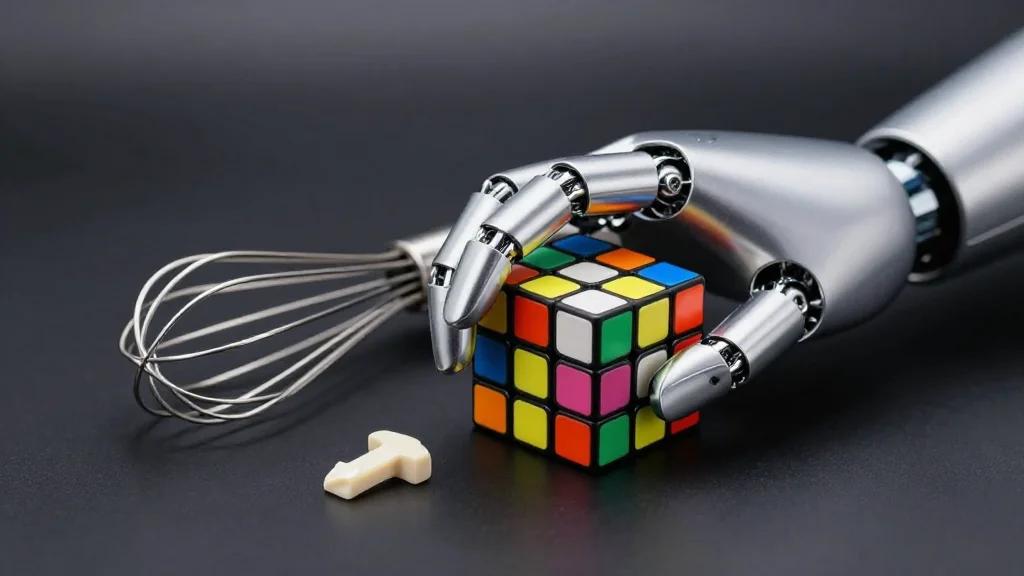
- •The company unveiled GENE‑26.5, a human‑sized robotic hand that can cook, play piano and solve a Rubik’s cube.
- •Co‑founders Zhou Xian (CEO) and Théophile Gervet (President) emphasized the need for a full‑stack approach to close the “embodiment gap.”
- •A sensor‑loaded glove captures human motion data, feeding the AI model and accelerating training cycles.
- •Genesis joins rivals Physical Intelligence and Skild AI in a funding race to dominate AI‑driven robotics.
Pulse Analysis
Genesis AI’s decision to go full‑stack reflects a broader shift in the robotics sector where data is the new oil. By engineering a hand that mirrors human anatomy, the startup sidesteps the costly and time‑consuming process of retrofitting generic grippers with custom sensors. This hardware‑first stance also gives Genesis a proprietary data moat: every motion captured by the glove becomes a training sample that competitors cannot easily replicate. In a market where AI models are increasingly commoditized, owning the data pipeline can be a decisive advantage.
Historically, robotics firms have struggled to translate lab‑scale breakthroughs into commercial products because of the “embodiment gap” – the mismatch between simulated environments and the messy realities of physical interaction. Genesis’s integrated approach, coupling a human‑scale hand with a simulation‑driven training loop, could compress the iteration timeline from months to weeks. If the company can prove that this speed translates into lower unit costs, it may force incumbents to rethink their reliance on off‑the‑shelf hardware.
For investors, the $105 million seed round signals confidence that the market is ready for AI‑enhanced manipulators beyond niche research labs. The capital will likely be deployed to scale manufacturing, refine the glove data pipeline, and secure early enterprise pilots. Success could catalyze a wave of similar full‑stack ventures, reshaping the venture capital playbook for hardware‑intensive AI startups and potentially accelerating the arrival of truly autonomous factories.
Genesis AI Unveils Full‑Stack Robotic Hand, $105M Seed Fuels New Demo
Comments
Want to join the conversation?
Loading comments...