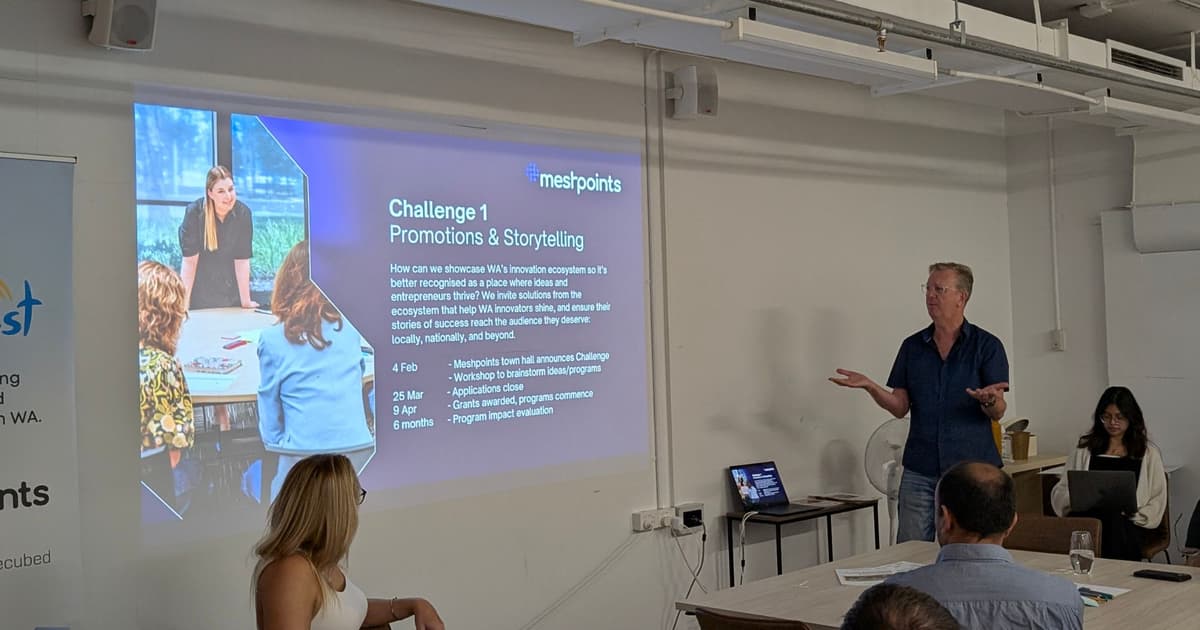
Meshpoints Launches Challenge-Led Funding Model To Strengthen WA’s Innovation Ecosystem
•February 7, 2026
0
Why It Matters
By aligning private challenge funding with expanded public grants, WA creates a more resilient pipeline for high‑growth ventures, especially those from under‑represented groups, strengthening the state’s competitive edge in tech and education sectors.
Key Takeaways
- •Meshpoints introduces challenge-led funding for WA startups
- •WA government doubles innovation grants to $2M, $300k per project
- •21 startups receive $1.9M in Innovation Booster, Bridge grants
- •Students win $35k for climate and animal safety solutions
- •Paperly secures $3M to expand EdTech internationally
Pulse Analysis
The challenge‑led funding model introduced by Meshpoints flips the traditional venture‑capital script by tying capital to the successful completion of predefined problem‑solving milestones. Entrepreneurs submit proposals that address real‑world needs, and funding is released incrementally as each challenge is met, reducing risk for investors while incentivising measurable outcomes. This approach mirrors successful hackathon‑to‑startup pipelines seen in Silicon Valley, yet it is tailored to Western Australia’s unique industry mix, from mining tech to agritech. By embedding validation into the financing process, Meshpoints aims to accelerate product‑market fit and attract follow‑on capital.
The timing aligns with the Western Australian government’s decision to double its Innovation Booster Grants and Commercialisation Bridge Grants to a combined $2 million, with individual awards now capped at $300,000. The latest disbursement saw 21 startups claim $1.9 million, a clear indicator of demand for early‑stage capital. Complementary initiatives, such as the $35,000 student prize pool for climate‑focused solutions and Paperly’s $3 million Series A round, illustrate a multi‑tiered ecosystem where public, private, and academic resources converge to de‑risk innovation.
Collectively, these moves deepen Western Australia’s talent pipeline and diversify funding sources, which is critical for retaining high‑growth founders in the region. The challenge‑led model also lowers barriers for under‑represented entrepreneurs by providing transparent, milestone‑based financing rather than opaque equity deals. As more startups achieve commercial traction, the state stands to benefit from job creation, export‑ready technologies, and a stronger reputation as an innovation hub. Other Australian states may soon emulate this coordinated strategy to boost their own tech ecosystems.
Meshpoints Launches Challenge-Led Funding Model To Strengthen WA’s Innovation Ecosystem
0
Comments
Want to join the conversation?
Loading comments...