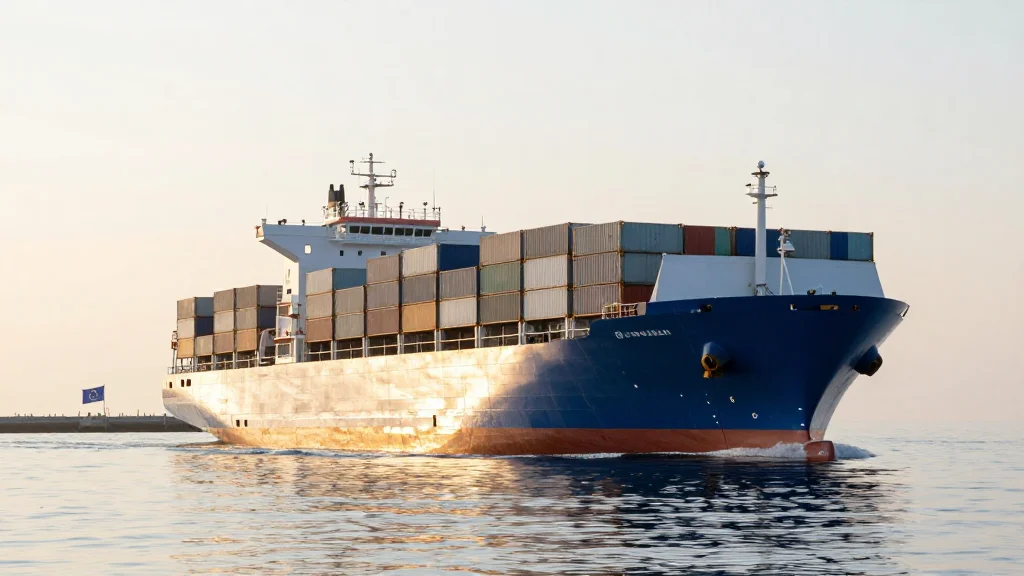
Maersk Profit Plunge Triggers >7% Share Drop as Earnings Slump

Why It Matters
Maersk is the world’s largest container shipping company and a cornerstone of the Euro‑stock market, representing a significant portion of Denmark’s market cap and a key indicator of global trade health. Its profit slump signals that freight demand may be weakening, which could cascade into lower earnings for other logistics, manufacturing, and export‑oriented firms across Europe. Moreover, the sharp share decline underscores investor sensitivity to earnings volatility in a sector already grappling with high fuel costs, regulatory scrutiny, and geopolitical uncertainty. For investors, the episode serves as a reminder to monitor macro‑economic indicators—such as German industrial output and EU trade policies—that directly affect shipping volumes. A sustained downturn in Maersk’s performance could prompt a reallocation away from trade‑linked equities toward more defensive sectors, reshaping portfolio strategies within the Euro‑stock universe.
Key Takeaways
- •Maersk reported a sharp profit and revenue decline for Q1 2026.
- •Shares fell more than 7% before the market close on Thursday.
- •The earnings miss highlights pressure on European logistics and trade‑linked stocks.
- •Analysts warn of broader implications for Germany’s export‑driven economy.
- •Future earnings guidance from Maersk remains limited, increasing market uncertainty.
Pulse Analysis
Maersk’s earnings shock is a microcosm of the broader stress facing Europe’s trade‑dependent sectors. The company’s profit contraction reflects a confluence of headwinds: lingering supply‑chain bottlenecks, volatile bunker fuel prices, and a slowdown in global container volumes as manufacturers recalibrate output amid uneven demand. Historically, Maersk’s performance has been a leading indicator for the health of the Euro‑stock market’s industrial and logistics components; a dip often presages broader sectoral weakness.
The lack of detailed guidance from Maersk adds a layer of opacity that fuels market nervousness. In past cycles, the firm has used forward‑looking statements to reassure investors about fleet utilization rates and digital platform rollouts. This time, the silence may be interpreted as an acknowledgment of deeper challenges, prompting a risk‑off tilt among portfolio managers. The reaction also underscores the heightened sensitivity of European equities to earnings volatility, especially in a post‑pandemic environment where investors demand clearer pathways to profitability.
Looking ahead, the key variables will be the trajectory of global freight rates, the pace of economic recovery in Germany and other core Euro‑zone economies, and the impact of regulatory shifts—such as stricter emissions standards—on operating costs. If Maersk can stabilize margins through cost efficiencies and capture growth in high‑value logistics services, it could stem the sell‑off and restore confidence. Conversely, a prolonged slump could accelerate a sector‑wide rotation toward defensive assets, reshaping the composition of Euro‑stock portfolios for the remainder of the year.
Maersk profit plunge triggers >7% share drop as earnings slump
Comments
Want to join the conversation?
Loading comments...