Acquisition
ICE Acquires Hagerstown Warehouse for $102.4M to Expand Detention Capacity
•February 16, 2026
0
Participants
Why It Matters
The federal investment creates a massive operational burden for small jurisdictions, exposing them to costly infrastructure upgrades and public‑health risks, while highlighting gaps in local oversight of federal detention expansions.
Key Takeaways
- •ICE plans $38.3B for seven large detention warehouses
- •Hagerstown warehouse bought for $102.4M, 1,500 beds
- •Local water, sewage infrastructure inadequate for detainee population
- •Project Salt Box reports no federal medical payments since October
- •Dignity Not Detention Act doesn’t block federal facilities
Pulse Analysis
The ICE warehouse program marks a dramatic shift in U.S. immigration enforcement, moving from traditional detention centers to repurposed commercial spaces. By earmarking $38.3 billion for seven massive facilities, the Department of Homeland Security aims to streamline deportations with a logistics model likened to Amazon Prime. This strategy leverages existing real‑estate assets, reducing construction timelines but raising questions about compliance with housing standards, human‑rights obligations, and long‑term fiscal sustainability.
At the community level, the Hagerstown acquisition illustrates the practical challenges of converting industrial shells into high‑density detention sites. The 825,620‑square‑foot building was designed for storage, not human occupancy, leaving only six equivalent dwelling units for water, four toilets, two showers and two sinks. Local health officials report no prior coordination, and the region’s well‑water system faces potential contamination risks. Moreover, the lack of federal payments for medical services since October forces county hospitals to shoulder costly care for detainees, straining already limited nursing and primary‑care resources.
Beyond immediate infrastructure concerns, the initiative tests the limits of state and local authority. Maryland’s 2021 Dignity Not Detention Act bars new state‑level detention agreements but does not preclude federal ownership, leaving municipalities with little leverage. While proponents tout job creation, analysts argue that the facility acts as an economic drain, diverting public funds toward maintenance and emergency services. Tools like Project Salt Box’s ICE Warehouse Purchase Tracker empower communities to monitor future acquisitions and advocate for transparent zoning, environmental impact assessments, and adequate funding mechanisms before such projects proceed.
Deal Summary
U.S. Immigration and Customs Enforcement (ICE) recently purchased an 825,620‑square‑foot warehouse in Hagerstown, Maryland for $102.4 million, converting it into a detention facility. The acquisition is part of DHS’s broader $38.3 billion plan to build seven large‑scale warehouses to hold up to 80,000 immigrants. The deal was announced in a Forbes article on February 16, 2026.
Article
Source: Forbes – Healthcare
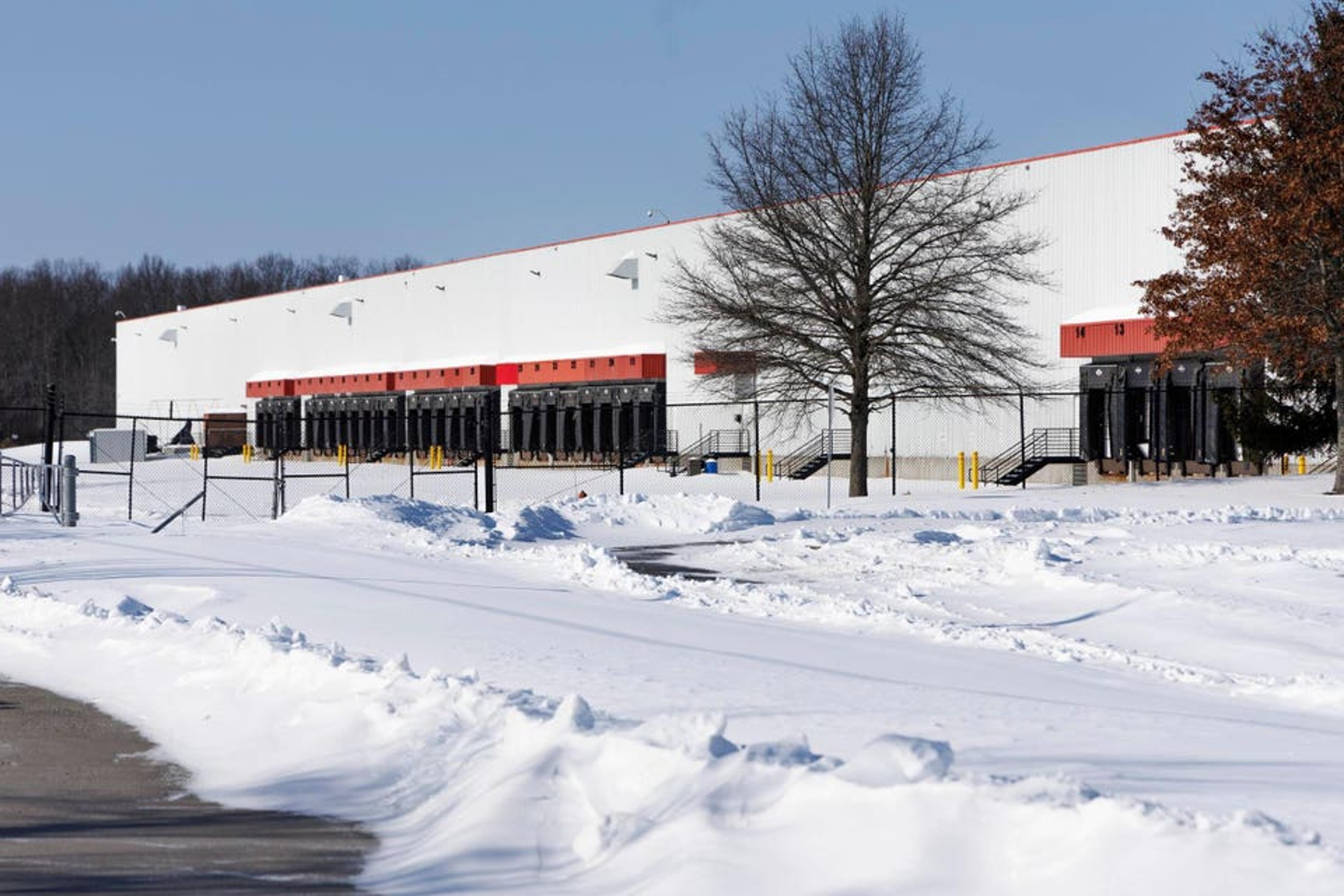
Image Caption:
This empty warehouse in Chester, NY, is similar to the one DHS recently purchased in Hagerstown, MD. (Photo by Matthew Hoen/NurPhoto via Getty Images)
The Department of Homeland Security has been buying warehouses throughout the country to convert for use as Immigration and Customs Enforcement detention facilities. The Washington Post reports the plan is to spend $38.3 billion to build seven large‑scale warehouses, each holding up to 10,000 immigrants, to hold 80,000 people in order to speed up deportations. Other smaller warehouses will each hold 1,000‑1,500 detainees. ICE acting director Todd M. Lyons was quoted (via the Arizona Mirror) as saying the administration’s goal “was to deport immigrants as efficiently as Amazon moves packages: ‘Like Prime, but with human beings.’”
Recently, in Hagerstown, Maryland, ICE purchased an 825,620‑square‑foot warehouse for $102.4 million, planning for 1,500 detention beds. The Washington County Commissioners offered their full support; public comment was not allowed at the hearing. Note: Requests for comment from the commissioners and ICE were not returned.
“How do you sell a warehouse for $100 million in a place that you know doesn’t have living conditions?” — Tekesha Martinez, former mayor of Hagerstown.
She added that the facility would put enormous strain on public safety and water.
The county health department spokeswoman told me they were caught unawares. “We have not been contacted by anyone at state or federal level,” nor by the county commissioners, she said. Michael Wriston, a spokesperson for Project Salt Box, a nonprofit news organization, told me that the ICE Health Service Corps can only provide basic‑level frontline care. If detainees have more complicated problems, they would need to be cared for at the local hospital, where there are chronic nursing and primary‑care shortages.
Water and sanitation are also major concerns. Wriston said that “all of the residents around the warehouse are on well water; they are all scared of sewage leaking into the water table and ending up in their wells.” The warehouse was allocated only six Equivalent Dwelling Units for water. It is permitted only for four toilets, two showers, and two sinks—suitable as an “industrial shell only,” per Wriston.
A further complicating factor is that Williamsport (the warehouse is located on the outskirts of Hagerstown) purchases its water supply from the city and has only a limited allotment. Also, the water and sewer lines were designed for storage use rather than dense residential occupancy.
As is typical in warehouses, temperature and air exchanges were not considered in designing these units, making them rife for infections.
Factors Towns Should Consider When Faced With An ICE Detention Center
These are some of the questions I asked the Commissioners:
-
Why don’t you feel you can enforce zoning restrictions and are “powerless?” Did you seek a legal opinion?
-
What is the county going to do to supply adequate water to the site? How will sewage be handled? Increased traffic?
-
Will the county pick up the tab for that? Or will the rest of Maryland taxpayers have to?
-
What services will need to be cut in the county from the loss of $300,000 annually in taxes from the commercial property?
-
What impact might this facility have on local fire departments and EMTs?
-
Where are you going to get adequate staffing? Will it pull staff from the Roxbury prison near you?
-
Infectious disease outbreaks, such as measles, occur regularly in prison settings and have spilled over into the community. How would such outbreaks be managed? Remember that since last October, ICE has not paid any third‑party providers for medical care and will not at least through April.
Other Questions and Tools
In 2021, Maryland passed the “Dignity Not Detention Act,” which prohibited state and local governments from making new agreements to detain immigrants. The law does not prohibit federal ownership, however. DHS purchased the Hagerstown/Williamsport warehouse without public notice or community education and engagement.
Another consideration for many communities is the impact on their quality of life. Hagerstown is already the site of a state prison, so it may not be as affected as some smaller rural communities.
Communities facing similar problems should examine environmental impact and state regulations regarding water use, zoning considerations, and other permitting requirements.
Economic impact: While the center might bring some jobs, the Maryland Wire notes that the Hagerstown purchase “is not just another warehouse. It’s a regional anchor. The kind of facility that attracts satellite businesses, payroll, and long‑term investment…A warehouse is an engine. A detention center is a drain.” One observer commented, “The secrecy is not incidental. It is the story.”
You can track where detention centers are planned through Project Salt Box’s ICE Warehouse Purchase Tracker. PSB volunteers provide other extensive resources as well to help you assess the impact of such a center on your community.
0
Comments
Want to join the conversation?
Loading comments...