Finance Deals and Investments
  • All Technology
  • AI
  • Autonomy
  • B2B Growth
  • Big Data
  • BioTech
  • ClimateTech
  • Consumer Tech
  • Crypto
  • Cybersecurity
  • DevOps
  • Digital Marketing
  • Ecommerce
  • EdTech
  • Enterprise
  • FinTech
  • GovTech
  • Hardware
  • HealthTech
  • HRTech
  • LegalTech
  • Nanotech
  • PropTech
  • Quantum
  • Robotics
  • SaaS
  • SpaceTech
AllNewsDealsSocialBlogsVideosPodcastsDigests

Finance Pulse

EMAIL DIGESTS

Daily

Every morning

Weekly

Sunday recap

NewsDealsSocialBlogsVideosPodcasts
Lee County Port Authority Announces $681.3M Bond Issuance for Southwest Florida International Airport Concourse E
OtherFinanceInvestment Banking

Lee County Port Authority Announces $681.3M Bond Issuance for Southwest Florida International Airport Concourse E

The Bond Buyer (municipal finance)
•February 19, 2026
The Bond Buyer (municipal finance)
The Bond Buyer (municipal finance)•Feb 19, 2026
0

Participants

Lee County Port Authority

Lee County Port Authority

company

BofA Securities

BofA Securities

underwriter

J.P. Morgan

J.P. Morgan

underwriter

Raymond James

Raymond James

underwriter

Why It Matters

The bond financing enables critical capacity expansion to capture growing tourism demand, while testing the airport’s credit resilience amid rising debt obligations.

Key Takeaways

  • •$681.3M bonds finance Concourse E, adding 14 gates.
  • •Bonds rated A2/A/AA‑, stable outlooks from agencies.
  • •Airport revenue grew 13.7% CAGR, expenses 7.8% CAGR.
  • •Debt per enplanement peaks $300 in 2026, manageable risk.
  • •10‑year airline use agreement secures debt‑service coverage.

Pulse Analysis

Southwest Florida International Airport has emerged as a regional growth engine, recording 11.1 million passengers in 2025 and posting a 13.7% compound annual revenue increase since 2019. The surge reflects both a booming resident population and a resilient tourism market that rebounded quickly after COVID‑19 and Hurricane Ian. To accommodate this demand, the Lee County Port Authority is constructing Concourse E, a 215,000‑square‑foot expansion that will add 14 gates, increase TSA lanes, and unify terminal operations, positioning the airport to handle future traffic spikes and attract additional carriers.

The $681.3 million bond package is structured across three series: the $464.1 million AMT‑eligible Series 2026A‑1, the $169.8 million Series 2026A‑2 with a mandatory tender option, and the $47.3 million non‑AMT Series 2026B earmarked for refinancing and a public‑safety building. Credit agencies have assigned A2 (Moody’s), A (Fitch) and AA‑minus (KBRA) ratings, citing the airport’s strong liquidity—675 days cash on hand—and a stable, fully amortizing, fixed‑rate debt profile. Investors are attracted by the steep yield curve, put‑bond features, and the airport’s ability to remarket debt if market conditions improve, offering a balanced risk‑return proposition.

Financially, the airport’s debt‑per‑enplanement metric is projected to peak at $300 in 2026, a level that analysts consider manageable given the diversified carrier base—nine airlines covering 95% of market share—and a 10‑year airline use agreement that safeguards debt‑service coverage at a 1.45‑times ratio. Revenue growth outpaces expense inflation, and the capital improvement plan, though sizable, is funded largely by bonds (approximately 63% of the $2 billion CIP). This financing model showcases how mid‑hub airports can leverage municipal bond markets to fund strategic expansions while maintaining credit quality, offering a template for similar infrastructure projects nationwide.

Deal Summary

Lee County Port Authority announced a $681.3 million bond issuance to fund the construction of Concourse E at Southwest Florida International Airport. The offering includes $464.1 million of AMT‑eligible Series 2026A‑1 bonds, $169.8 million of Series 2026A‑2 bonds, and $47.3 million of Series 2026B tax‑exempt bonds. BofA Securities will act as lead underwriter with J.P. Morgan and Raymond James as co‑underwriters.

Article

Source: The Bond Buyer (municipal finance)

Lee County Port Authority to Issue $681.3 Million in Bonds for Concourse E at Southwest Florida International Airport

Robert Slavin – Southeast Reporter, The Bond Buyer

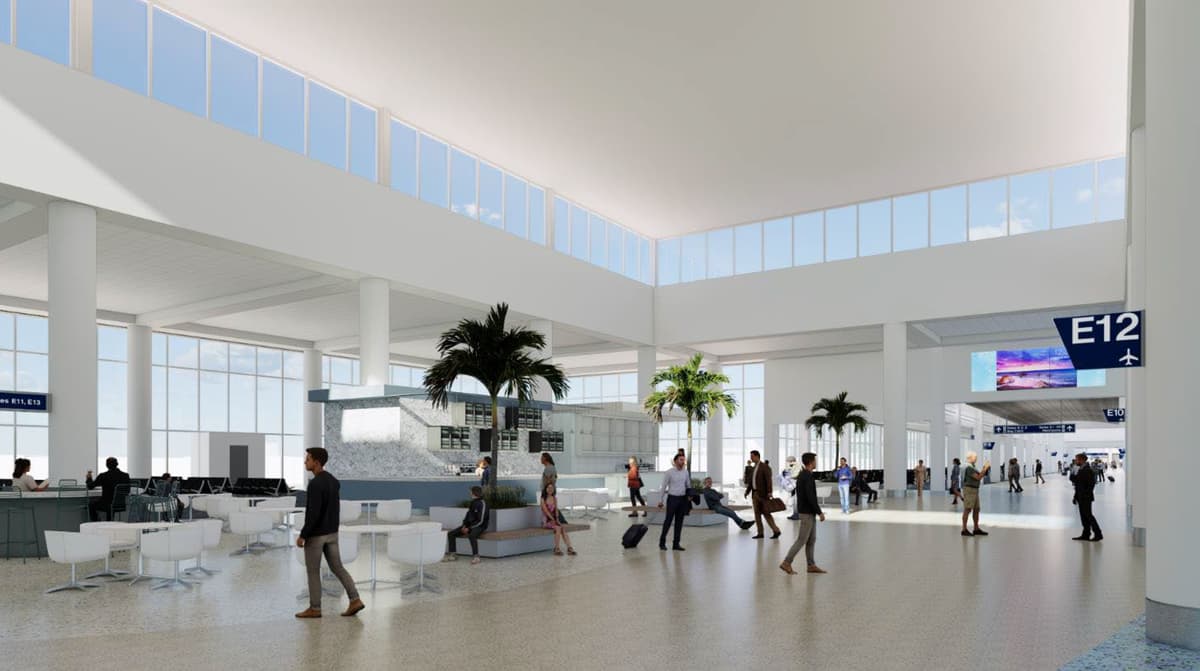
Rendering of planned Concourse E, Southwest Florida International Airport

Rendering of planned Concourse E, Southwest Florida International Airport. Proceeds from the planned Series 2026A‑1 and 2026A‑2 bonds will be used to build the concourse.

Lee County Port Authority

Growing population and its status as a tourist destination has Southwest Florida International Airport eying a new concourse in its main terminal and Lee County, Florida, will issue $681.3 million of bonds to fund the construction, but one rating agency stated concern about the facility's $2 billion capital improvement plan.

Lead underwriter BofA Securities is scheduled to price on Feb. 26 the $464.1 million alternative minimum tax‑eligible Series 2026A‑1 revenue bonds, with serial maturities from 2034 to 2046 and terms in 2051 and 2056; $169.8 million AMT‑eligible Series 2026A‑2 revenue bonds, with a mandatory tender in October 2031 and final maturity in 2056; and $47.3 million non‑AMT tax‑exempt Series 2026B revenue bonds, with serial maturities from 2032 to 2036.

J.P. Morgan and Raymond James are co‑underwriters. PFM is the municipal advisor and Nabors, Giblin & Nickerson is bond counsel on the deal.

The bonds are rated A2 by Moody’s Ratings, A by Fitch Ratings, and AA‑minus by KBRA. All give stable outlooks. S&P Global Ratings rated Lee County airport revenue bonds A in September 2024 but hasn’t put out a report for this issue.

If the Series 2026A‑2 bonds can’t be tendered, investors will receive a stepped‑up coupon rate, to be determined when the bonds are sold, said Victoria Moreland, chief communications and marketing officer for the Lee County Port Authority. “They will remain outstanding until their maturity unless they are tendered prior to maturity.”

“Put bonds are not that unusual for airports,” according to Cumberland Advisors Vice President and Chief Investment Officer John Mousseau. “Really, the airport [is] taking advantage of the steep yield curve and willing to remarket bonds in a few years, betting the remaking of both puts (or bonding out) is a better deal than issuing long bonds now.”

Proceeds from the Series 2026A‑1 and A‑2 bonds will be used primarily to complete Concourse E at the Main Terminal building. Proceeds from the Series 2026B bonds will be used to refund Series 2015 bonds and to build a public safety building.

But KBRA noted the airport’s $2 billion capital improvement plan, which will elevate debt and operating costs, presents a credit challenge, as is the increased costs and lengthened construction schedule associated with the redesign of phase 1 of the Terminal Expansion Program.

Moreland noted the airport received grants for much of the cost of the runway rehabilitation and rental‑car and parking expansion projects. As for the increased costs and schedule, Moreland said, “After the completion of the redesign, the board approved an increase to the project budget and revised the 42‑month schedule in March 2025.” Since then, she said, the projects are on schedule and within budget.

Moody’s expressed concern that debt per enplanement would peak at $300 in 2026.

“I understand the concern about the debt levels, but if they do peak in 2026, that risk is diminished,” said Joseph Krist, publisher of Muni Credit News. “Although debt is above average, it is manageable,” he added.

Nine airlines, accounting for 95 % of market share, signed a 10‑year use agreement with the airport in October 2024. The presence of the big four airlines, without a dominant carrier, “is also a plus,” Krist said. Delta’s 21.5 % share in fiscal 2025 topped other carriers at the facility, according to the airport.

Mousseau said the climbing wealth characteristics of the Naples area allay his worries about debt per enplanement levels.

Moreland said the airport’s “ongoing terminal projects represent years of coordination and planning between the [Lee County] Port Authority and the airlines serving our market.” The aforementioned airline use and lease agreement protects “our most crucial financial metrics, including debt service coverage,” Moreland said. It reflects the nine carriers’ “commitment and desire to grow in our high‑yield market.”

“The rating agencies have commended the agreement, listing it as a credit strength safeguarding the long‑term finances of the Port Authority,” she said. “As the rating agencies pointed out, [the airport’s] debt and cost metrics will remain competitive relative to other medium‑hub airports undertaking major capital programs.”

KBRA noted tourism or discretionary travel prevails at the airport, making it susceptible to an economic downturn. But analysts shrugged off this concern.

“Yes, the market for the airport is clearly discretionary but the area has traditionally attracted a fairly economically strong tourist [or winter resident],” Krist said. “It’s a different crowd than the regional airports on the east coast which draw a less ‘premium’ demographic. That offsets the concern about discretionary travel.”

While economic downturns are a concern as they can impact discretionary spending, Mousseau said, with “southwest Florida having grown so much since COVID,” with people moving there and also vacationing in the region, “I think that mitigates concern. The issue is much different for a Las Vegas or New Orleans.”

Moreland pointed to the region’s “resiliency.”

Southwest Florida International “was one of the fastest recovering airports after COVID. Similarly, [after Hurricane Ian devastated the area] in September 2022, passenger traffic … rebounded with record traffic months continuing to be recorded,” she said. “[The airport] served a record‑breaking 11.1 million passengers in calendar year 2025. Strong liquidity and conservative financial management have allowed the Port Authority to endure prior economic downturns, which have proven to be short‑lived, as the area has quickly recovered on more than one occasion.”

Lee County boasts a growing population base and resilient tourism sector, Moody’s said. Airline traffic exceeds pre‑pandemic highs. Moody’s said its rating reflects that the airport lacks direct competition and its strong diversity of carriers.

“The rating further incorporates the airport’s strong liquidity and the strength of the Concourse E Coverage Protection featured in the airport’s new 10‑year airline use and lease agreement through fiscal 2034, which allows [the airport] to recoup costs associated with the Concourse E project to achieve adequate net‑revenue debt‑service coverage ratio of 1.45 times,” Moody’s said.

KBRA agreed the airport’s air‑carrier diversity and enplanements are credit strengths, and the airport benefits from sound operating performance, strong liquidity, and good debt‑service coverage, stemming from healthy non‑airline revenues.

While Fitch’s comments echoed the others, it noted the airport’s outstanding debt is fixed‑rate and fully amortizing.

The airport is 15 miles from the nearest city, Fort Myers.

The Lee County Port Authority said in its investor presentation the airport has enjoyed a 13.7 % compound annual growth rate in revenue from fiscal 2019 to fiscal 2025, significantly exceeding the 7.8 % compound annual growth rate of expenses in that time.

The airport’s fiscal year ends on Sept. 30.

Days cash on hand has gone up and down since fiscal 2019, but as of fiscal 2025 was 675 days, up from the 669 days in fiscal 2019, according to the investor presentation.

The Port Authority said about 63 % of its roughly $2 billion CIP from fiscal 2025 to fiscal 2031 is expected to come from bonds, according to the presentation.

The Port Authority expects Concourse E to cost $1.07 billion and be completed in fall 2027. It will be 215,000 sq ft with 14 aircraft gates, nine lanes of Transportation Security Administration lanes, connectivity between all concourses and ticket counters. Total airport gates will increase to 42 from 28.

0

Comments

Want to join the conversation?

Loading comments...