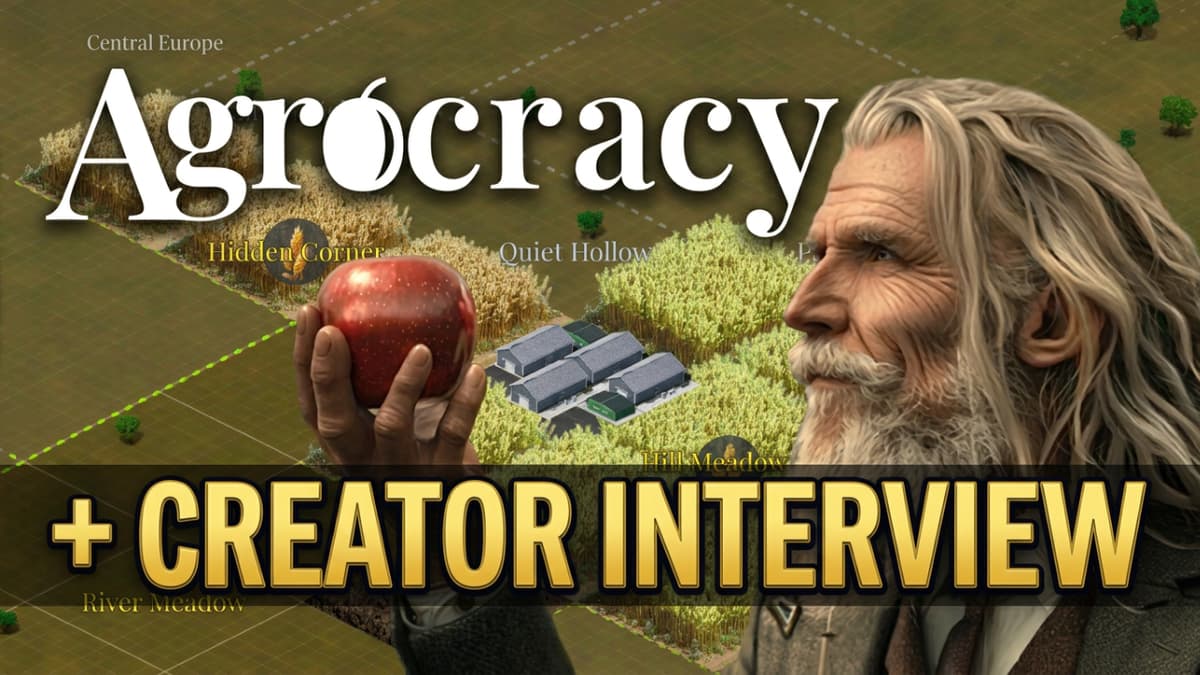
Agrocracy: A Phaser Hardcore Farming Game + Dev Interview
Companies Mentioned
Why It Matters
It proves that web‑centric engines and AI‑driven asset pipelines can power deep, data‑intensive simulations, expanding the indie market beyond casual titles.
Key Takeaways
- •Phaser powers isometric rendering, shaders, and map logic.
- •Turn‑based loop isolates simulation, preventing spaghetti code.
- •AI tools generate base art, cleaned manually in GIMP.
- •30 km² map blends finance, weather, and labor systems.
- •Solo dev plans to build all future games with Phaser.
Pulse Analysis
Agrocracy arrives at a moment when the indie gaming market is hungry for experiences that go beyond the cozy aesthetic that dominates many farm simulators. By leveraging the open‑source Phaser engine—originally designed for browser‑based games—Filip Wróbel has crafted a 30 km² isometric world that feels more like a business‑strategy title than a casual pastime. The decision to pair Phaser with Angular for the UI and Java for the underlying simulation demonstrates how web‑centric stacks can scale to handle the data‑intensive demands of a hardcore tycoon, offering a blueprint for other solo creators seeking cost‑effective, cross‑platform solutions.
The game's core loop is deliberately turn‑based, allowing every system—weather, crop cycles, labor allocation, and financial accounting—to resolve only at the end of a two‑week turn. This separation simplifies code maintenance and gives players a clear decision window, mirroring the cadence of real‑world farm management. Weather, for instance, is driven by statistical climate data rather than computationally heavy physics, delivering believable variability without sacrificing performance. Visual assets were jump‑started with Midjourney and Gemini, then meticulously refined in GIMP, illustrating how AI‑generated art can accelerate production while still requiring human polish.
Agrocracy’s early playtest on Steam provides valuable feedback on how niche, simulation‑heavy titles are received by a broader audience. Its success could encourage more indie studios to adopt Phaser as a primary engine, especially when combined with AI‑assisted pipelines that lower the barrier to high‑quality graphics. As the line between web technologies and traditional desktop development continues to blur, developers like Wróbel show that a well‑architected, modular stack can deliver deep, financially driven gameplay without the overhead of larger teams or proprietary engines.
Agrocracy: A Phaser Hardcore Farming Game + Dev Interview
Comments
Want to join the conversation?
Loading comments...