Gaming News and Headlines
  • All Technology
  • AI
  • Autonomy
  • B2B Growth
  • Big Data
  • BioTech
  • ClimateTech
  • Consumer Tech
  • Crypto
  • Cybersecurity
  • DevOps
  • Digital Marketing
  • Ecommerce
  • EdTech
  • Enterprise
  • FinTech
  • GovTech
  • Hardware
  • HealthTech
  • HRTech
  • LegalTech
  • Nanotech
  • PropTech
  • Quantum
  • Robotics
  • SaaS
  • SpaceTech
AllNewsDealsSocialBlogsVideosPodcastsDigests

Gaming Pulse

EMAIL DIGESTS

Daily

Every morning

Weekly

Sunday recap

NewsDealsSocialBlogsVideosPodcasts
GamingNewsGames Workshop Had a Warhammer FTL Clone Pulled From Steam over some Overly Space Marine-Esque Shoulderpads
Games Workshop Had a Warhammer FTL Clone Pulled From Steam over some Overly Space Marine-Esque Shoulderpads
Gaming

Games Workshop Had a Warhammer FTL Clone Pulled From Steam over some Overly Space Marine-Esque Shoulderpads

•February 9, 2026
0
Rock Paper Shotgun
Rock Paper Shotgun•Feb 9, 2026

Companies Mentioned

Games Workshop Ltd

Games Workshop Ltd

Why It Matters

The takedown illustrates how powerful IP holders can disrupt indie releases, highlighting legal risk for developers who draw inspiration from established franchises.

Key Takeaways

  • •Void War temporarily removed from Steam after DMCA notice
  • •Games Workshop objected to shoulder‑pad design resembling Space Marines
  • •Developers removed offending trailer to restore game availability
  • •Incident highlights power imbalance between large IP owners, indie studios
  • •Raises questions about DMCA abuse and creative freedom

Pulse Analysis

Void War entered the market as a hybrid of classic roguelike space exploration and the grimdark aesthetic of Warhammer 40,000, quickly attracting fans of both genres. When Games Workshop’s legal team identified a trailer featuring oversized convex shoulder pads that echoed the iconic Space Marine armor, they issued a DMCA notice that forced the game offline. Tundra Interactive’s decision to pull the specific trailer rather than contest the claim allowed the title to return to Steam within weeks, demonstrating a pragmatic approach to an otherwise costly legal battle.

The incident shines a spotlight on the broader dynamics of intellectual‑property enforcement in the gaming industry. Large publishers wield extensive legal resources and can leverage the DMCA to protect their trademarks, often prompting swift compliance from smaller developers wary of protracted litigation. While copyright law is designed to safeguard original expression, critics argue that the current system is vulnerable to overreach, enabling powerful entities to silence works that merely share visual tropes. This tension raises important questions about where the line should be drawn between homage and infringement, especially in a medium that thrives on iterative design.

For indie studios, the Void War case serves as a cautionary tale about due diligence in art direction and the importance of pre‑emptive legal reviews. Developers may need to invest in IP clearance processes or adopt more distinctive visual languages to mitigate risk. Meanwhile, the industry continues to debate reforms to the DMCA framework that could balance protection with creative freedom. As the market evolves, navigating these legal waters will be as critical to a game’s success as its gameplay mechanics.

Games Workshop had a Warhammer FTL clone pulled from Steam over some overly Space Marine-esque shoulderpads

Void War now back online following DMMA takedown

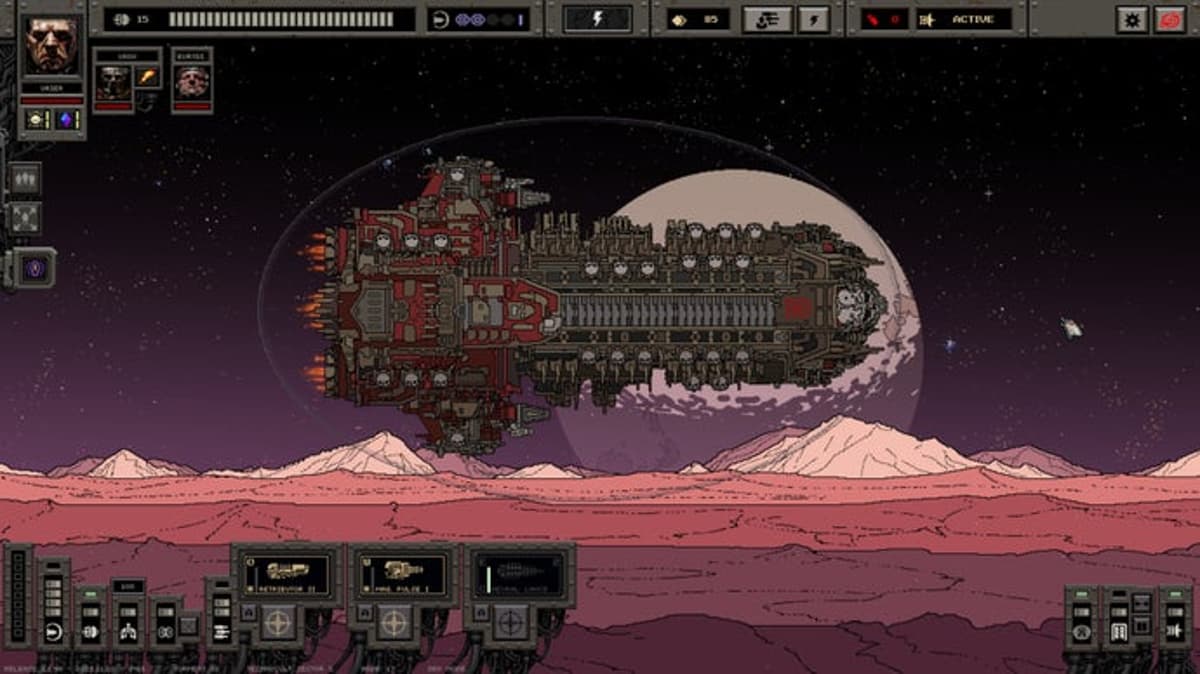
Image 1: A Gothic spaceship made up of skulls and craggy weaponry flying over the red surface of a planet with a moon behind, in Void War.

Image credit: Tundra Interactive

Last year I covered the demo for Void War, robotically describing it as FTL meets Warhammer 40,000, because that is what it is, and sometimes, you have to call a Spade Marine a Spade Marine (I did enjoy the demo, as flagrantly combinatory as the game may be).

Void War's art direction has apparently proven a little too familiar in places for Games Workshop’s liking. Developers Tundra Interactive report that the Warhammer publisher issued a Digital Millennium Copyright Act takedown notice earlier this year, which led to their game being temporarily removed from Steam.

Initially, it was thought that the DMCA notice was a nonsense claim similar to that levelled at No Players Online, the DMCA system being perilously easy to abuse. It was issued by somebody called Mal Reynolds, and Mal Reynolds is also the name of Nathan Fillion’s character in Firefly. Suspicious indeed. Tundra have now spoken with Games Workshop, however, and confirmed the claim’s authenticity, though they've yet to clear up the implication here that interplanetary gunslinger Mal Reynolds is secretly a copyright lawyer.

Image 2: An artwork of a grizzled cyborg wearing horned shoulder plates with circuitry across his face, from Void War.

Image credit: Tundra Interactive / Eurogamer

According to the developers, Games Workshop's inquisitors were particularly irked by the design of some shoulder‑pads in one of the featured trailers, referred to in correspondence as “oversized convex shoulder pads with a metallic rim.” Tundra insist that those convex shoulder‑pads are all their own work, but say they’ve removed the trailer anyway to avoid disruption.

“All of the artwork in the trailer is original work created by our artists,” reads a statement to IGN. “While we disagree with their assessment, the simplest way to get the game back up and avoid getting bogged down in DMCA process was to remove that trailer and move on. We may re‑upload an updated version later after we find time to adjust that shot, but for now our priority is shipping content and finishing multi‑language font support so we can finally deliver proper translations.”

As ever with these things, it is possible to decry how companies with massive legal teams slice the ankles of smaller independent developers, while also acknowledging that the game in question is a screaming rip‑off, however entertaining.

That aside, I could absolutely imagine Warhammer 40,000's Imperium launching a crusade in response to copyright infringement. Those Chaos Space Marines are naught but tepid plagiarists. You can’t just glue some novelty Halloween fingers and a rug to your Primarch armour and say you’ve invented the wheel, Horus! Nathan Fillion is on his way over with a subpoena.

Read Original Article
0

Comments

Want to join the conversation?

Loading comments...