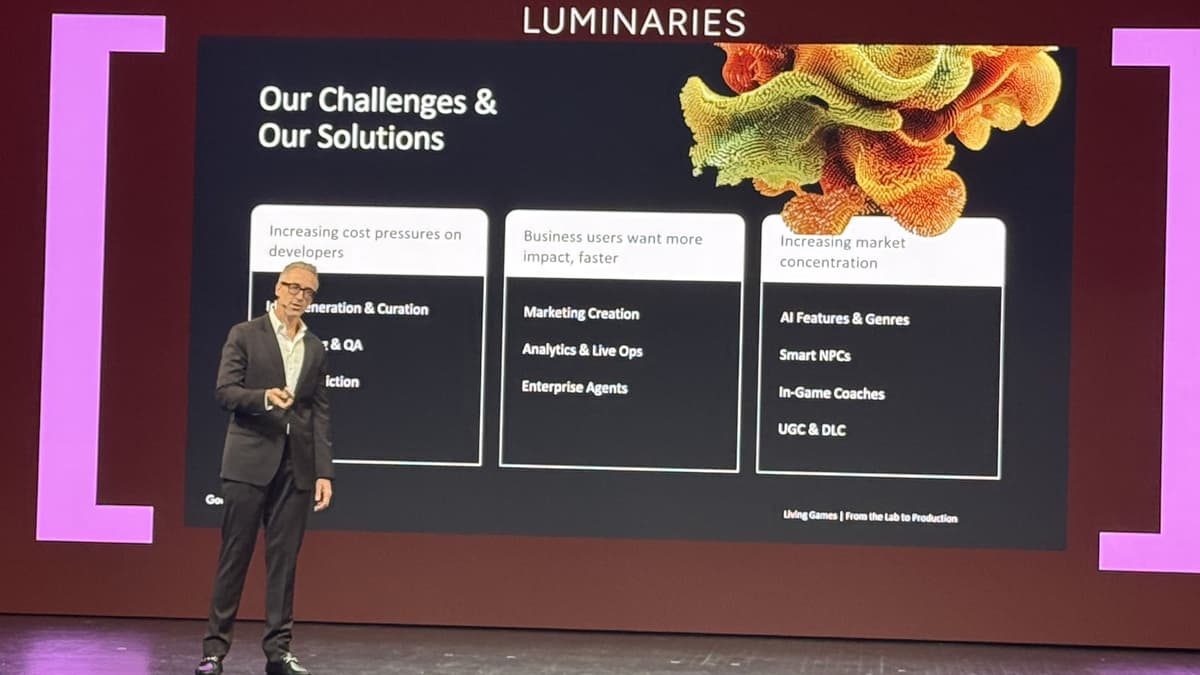
Google Cloud's Vision for AI in the Game Industry
•March 11, 2026
0
Why It Matters
AI adoption could lower production costs and unlock new revenue models, reshaping the competitive landscape of the game industry. Studios that leverage Google Cloud’s AI tools may gain a decisive edge in player retention and operational efficiency.
Key Takeaways
- •AI accelerates pre‑production idea generation and asset curation.
- •Unified player data enables real‑time hyper‑personalized marketing.
- •Smart NPCs and AI moderation reduce churn and toxicity.
- •Google Cloud positions AI as developer ‘Iron Man’ suit.
- •AI could reshape every major game genre within five years.
Pulse Analysis
The game industry faces a paradox of growing revenues but shrinking development margins, driven by high‑cost productions and the dominance of long‑lived titles that monopolize player attention. Google Cloud’s “Living Game” concept reframes AI not as a replacement for talent but as an accelerator that reduces friction across the development pipeline. By embedding generative models into pre‑production, studios can auto‑tag assets, generate design concepts, and cut thousands of hours of manual curation, effectively turning AI into an "immune system" that catches inefficiencies before they become costly.
Beyond creation, AI’s real power lies in unifying fragmented data silos into a single, queryable player profile. This enables near‑real‑time analytics for hyper‑personalized marketing, churn prediction, and dynamic in‑game offers—capabilities previously reserved for tech giants. Google Cloud’s infrastructure scales these workloads, allowing studios to run billions of data points instantly, thereby shortening the feedback loop between player behavior and content updates, which is critical in a market where player attention is fragmented across platforms like Roblox and Fortnite.
For players, AI translates into richer, safer experiences. Smart NPCs can adapt to individual playstyles, while AI‑driven moderation tackles toxicity in seconds rather than weeks, directly impacting retention. As Buser predicts, these advances will not only refine existing genres but also spawn entirely new ones, reshaping the industry’s creative frontier. Early adopters leveraging Google Cloud’s AI suite will likely set the benchmark for next‑generation gaming, establishing a competitive moat that blends technical efficiency with compelling player engagement.
Google Cloud's vision for AI in the game industry
0
Comments
Want to join the conversation?
Loading comments...