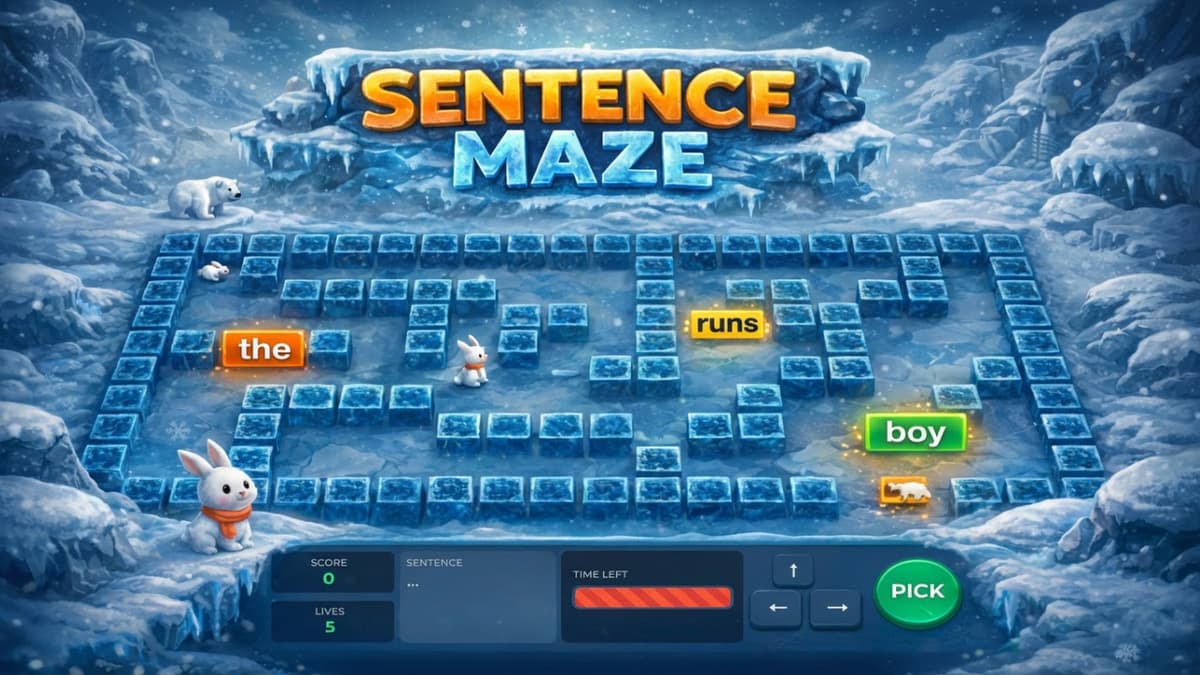
Ice Maze: A Free Game That Makes English Learning Fun
•February 19, 2026
0
Companies Mentioned

Why It Matters
By turning rote grammar drills into interactive play, Ice Maze boosts engagement and accelerates language acquisition, offering a cost‑free solution for schools seeking scalable digital instruction.
Key Takeaways
- •Free browser game teaches English via colour-coded semantics.
- •Adjustable difficulty suits diverse classroom levels worldwide.
- •Open-source code enables customization and no subscription fees.
- •Used in Malaysia, US, and growing global adoption.
- •Supports desktop, Android, iPad with drag‑and‑drop.
Pulse Analysis
Game‑based learning has moved from niche experiments to mainstream classroom strategy, and Ice Maze exemplifies this shift. Built on the open‑source Phaser framework, the free title removes financial barriers while delivering a polished experience that runs on any modern device. Educators can instantly deploy the game without provisioning accounts, allowing them to focus on pedagogy rather than IT logistics. This accessibility aligns with district‑wide pushes for equitable digital resources, especially in regions where budget constraints limit technology adoption.
The instructional design hinges on "colourful semantics," assigning vivid hues to grammatical roles—orange for subjects, yellow for verbs, and so on. This visual cueing accelerates pattern recognition, helping learners internalize sentence structure without memorization. Teachers control difficulty by adjusting timers, obstacle density, and hint availability, ensuring the game scales from early learners to advanced ESL students. Such granular customization supports differentiated instruction, a core demand of modern curricula, while maintaining the intrinsic motivation that games provide.
Beyond immediate classroom impact, Ice Maze’s open‑source nature invites community contributions and localized adaptations. Schools can modify graphics, add language packs, or integrate analytics to track progress, fostering a collaborative ecosystem around the tool. As more institutions adopt the platform across continents, it illustrates how low‑cost, community‑driven software can drive substantive educational outcomes, positioning game‑based learning as a viable pillar of future language instruction strategies.
Ice Maze: A Free Game That Makes English Learning Fun
0
Comments
Want to join the conversation?
Loading comments...